
LMS Security: Critical Vulnerabilities & Pentesting Guide
Recent penetration tests reveal critical flaws in modern Learning Management Systems (LMS). Explore the technical mechanics of broken access controls, API vertical privilege escalation, and S3 bucket misconfigurations that expose sensitive student data and compliance certificates.
Learning Management Systems (LMS) are critical infrastructure for compliance training, yet recent Lean Security penetration tests reveal systemic vulnerabilities. From broken access controls exposing Unique Student Identifiers (USIs) to vertical privilege escalation and insecure S3 buckets, proactive Penetration Testing as a Service (PTaaS) is legally and operationally mandatory to secure sensitive educational data.
In the wake of sweeping Australian Privacy Act reforms, the regulatory microscope has turned sharply towards the Education Technology (EdTech) sector and corporate Learning and Development (L&D) platforms. Learning Management Systems (LMS) are no longer simple content repositories; they have evolved into massive data aggregators. To issue regulatory compliance certificates, these platforms must ingest and store vast quantities of Personally Identifiable Information (PII), including verified ID documents, Unique Student Identifiers (USIs), and highly sensitive payment details.
Yet, despite the staggering volume of critical data they hold, the architectural security of many modern LMS platforms remains perilously fragile. Recent penetration testing engagements conducted by Lean Security have identified a consistent, highly exploitable pattern of vulnerabilities across the LMS landscape. For Chief Information Security Officers (CISOs) and Risk Managers, relying on superficial security checklists is a guaranteed path to a data breach. True assurance requires aggressive, continuous technical validation.
Most Common LMS Vulnerabilities Discovered in Pentests
The Top 5 Critical LMS Security Vulnerabilities
Through extensive red teaming and vulnerability assessments, Lean Security has identified the exact mechanisms threat actors utilise to compromise LMS environments. The following vulnerabilities represent the most critical, systemic failures currently plaguing the industry.
1. Horizontal Privilege Escalation (Broken Access Control)
Broken access control remains the apex predator of web application vulnerabilities. In an LMS context, this manifests as Horizontal Privilege Escalation. By manipulating object references (such as student IDs in a URL or API request payload), an authenticated student can force the application to return data belonging to other students.
We consistently observe LMS platforms failing to enforce object-level authorisation checks. This allows a standard user to view their peers' private invoices, course completion details, and, most critically, raw USI data and ID verification documents. In the context of Australian privacy law, an exposed USI constitutes a high-risk data breach necessitating immediate notification to the Office of the Australian Information Commissioner (OAIC).
2. Vertical Privilege Escalation and API Exploitation
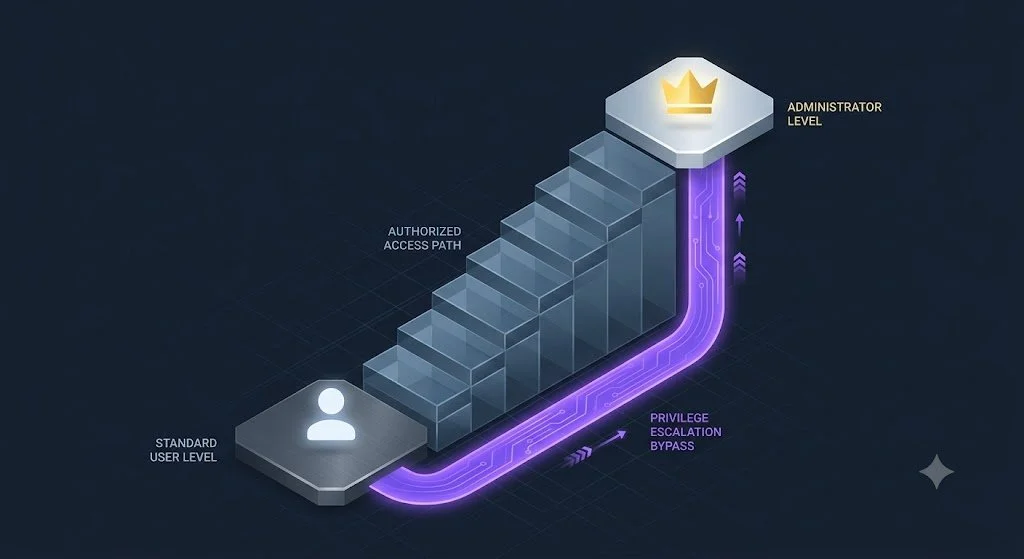
While horizontal escalation exposes peer data, Vertical Privilege Escalation compromises the integrity of the entire platform. Almost all modern LMS platforms feature a complex administrative interface meant to manage user enrolment, course material, and certificate issuance. This interface demands robust protection: Multi-Factor Authentication (MFA), strict password policies, immutable audit logs, and highly granular Role-Based Access Control (RBAC).
The Vertical Escalation Attack Path
(Standard restricted UI dashboard)
(Alters 'role_id' or 'user_id' in JSON payload)
(Direct backend communication ignores frontend checks)
(e.g., Unauthorised issuance of compliance certificate)
However, the underlying APIs powering these admin functions are frequently exposed. By directly querying restricted administrative endpoints, an authenticated standard user can bypass front-end UI restrictions. Lean Security engineers routinely execute vertical escalation to bypass mandatory coursework, alter grades, and illicitly trigger the issuance of highly regulated, officially sanctioned compliance certificates.
3. Insecure Cloud Storage (AWS S3 Bucket Misconfigurations)
The vast majority of modern LMS applications utilise native cloud storage solutions, such as Amazon S3 buckets, to host course materials, user uploads, and generated certificates. The security of these buckets is paramount.
Far too often, S3 buckets are provisioned with overly permissive access policies, rendering them either fully public or accessible to any authenticated user regardless of their enrolment status. When an S3 bucket containing sensitive ID verification uploads or raw payment data is left exposed, it transforms an LMS into a lucrative target for automated data scraping and ransomware extortion.
4. Flawed Authentication: The "Magic Link" Risk
To reduce user friction, many LMS platforms have adopted passwordless authentication via "Magic Links"—a URL sent via email that automatically logs the user in upon clicking. While convenient, the implementation is frequently disastrous.
A secure magic link requires three non-negotiable cryptographic controls: a cryptographically secure random token, a strict, short-lived expiry time (e.g., 15 minutes), and immediate invalidation after the first use. Lean Security frequently uncovers magic links that are entirely predictable, lack expiry windows, or can be reused indefinitely. If an attacker intercepts these links—often cached by corporate email gateways or exposed in server logs—they gain persistent, unauthenticated access to the student’s profile.
5. Payment Gateway Data Exposure
Corporate LMS environments frequently process direct payments for premium courses. While most platforms utilise third-party gateways (like Stripe or PayPal), the integration layer often leaks sensitive data. We frequently observe LMS APIs logging full credit card numbers or exposing extensive billing histories due to excessive data exposure in API responses. This directly violates Payment Card Industry Data Security Standard (PCI DSS) mandates.
Exploiting the Compliance Pipeline
During a recent Penetration Testing as a Service (PTaaS) deployment for a major Australian training provider, the Lean Security team targeted the platform’s certificate generation module. The LMS was responsible for issuing mandatory safety compliance certificates for the construction industry.
Our engineers identified an Insecure Direct Object Reference (IDOR) within the GraphQL API governing the course progression logic. While logged in as a standard student, we intercepted the API call meant to mark a single module as 'complete'. By manipulating the boolean value and the target user ID, we achieved vertical privilege escalation, bypassing all required video modules and quizzes. Furthermore, we manipulated a secondary, unauthenticated API endpoint used by the admin dashboard to forcefully generate a PDF compliance certificate bearing the official regulatory seal.
This engagement demonstrated that the risk was not just a data breach, but the complete destruction of the organisation's operational integrity and regulatory authority. Because this vulnerability was identified proactively via Lean Security’s continuous PTaaS model, the engineering team patched the API routing flaw before the platform launched to the public.
Validating Your Defensive Posture
Given the complexity of modern APIs, relying on standard automated scanners or a simple compliance checklist is entirely insufficient to protect highly sensitive student data and financial information. The only proven method to ensure your LMS is secure against these vectors is continuous, adversarial validation.
| Security Approach | Validation Method | LMS Risk Coverage |
|---|---|---|
| Traditional Compliance Checklists | Automated scans & policy reviews | Low (Consistently misses complex API logic flaws and IDOR vulnerabilities) |
| Annual Point-in-Time Pentest | Manual testing once a year | Medium (Creates dangerous visibility gaps between Agile development sprints) |
| PTaaS / Assumed Breach | Continuous, adversary-led red teaming | High (Validates RBAC and API logic dynamically alongside your deployment cycle) |
Frequently Asked Questions
What is Broken Access Control in an LMS?
Broken access control occurs when an application fails to properly enforce restrictions on what authenticated users can do. In an LMS, this often allows students to view other students' sensitive data (horizontal escalation) or access administrative functions like issuing certificates (vertical escalation).
How do insecure magic links lead to data breaches?
If a magic link lacks a short expiry time, is not invalidated after its first use, or uses predictable tokens, a threat actor who intercepts the link can hijack the user's session entirely, gaining access to all their personal and payment data without needing a password.
Why is penetration testing necessary for EdTech platforms?
EdTech platforms and LMS environments process highly sensitive PII, including USIs and financial data. Regular, rigorous penetration testing validates that security controls (like RBAC, API security, and S3 bucket permissions) are actually effective against real-world adversarial tactics, ensuring compliance with Australian privacy regulations.
Secure Your Educational Infrastructure
Do not wait for a regulatory audit or a public data breach to discover the vulnerabilities hiding in your LMS architecture. Lean Security provides elite Penetration Testing as a Service (PTaaS) tailored specifically for complex, data-heavy web applications.
Schedule a Technical Assessment
Why SaaS CTOs Are Transitioning to PTaaS for CI/CD Security
As SaaS release cycles accelerate, traditional point-in-time pentesting leaves dangerous visibility gaps. Here is why CTOs are integrating Penetration Testing as a Service (PTaaS) directly into their agile pipelines.
TL;DR: Traditional, point-in-time penetration testing is incompatible with agile SaaS CI/CD pipelines, creating a dangerous "visibility gap" between annual tests. Penetration Testing as a Service (PTaaS) solves this by embedding elite, continuous offensive security validation directly into the development lifecycle, drastically reducing Mean Time to Remediation (MTTR) and securing cloud infrastructure at the speed of modern deployment.
The Catalyst: CI/CD Supply Chain Compromises in Agile Environments
Over the past 60 days, the cybersecurity landscape has been rattled by a series of sophisticated supply chain compromises targeting cloud-native SaaS platforms. Adversaries are no longer merely looking for unpatched external-facing web vulnerabilities; they are deliberately pivoting to the Continuous Integration and Continuous Deployment (CI/CD) pipelines themselves. When deployment cycles happen hourly, the infrastructure automating those deployments becomes the ultimate high-value target.
For Chief Technology Officers (CTOs) operating in high-growth Software-as-a-Service environments, this shifting threat model introduces a terrifying reality. If your engineering team is pushing code to production 50 times a week, a static security posture is functionally equivalent to having no security at all. The speed of business has outpaced the traditional mechanics of security validation.
The Fundamental Flaw of Point-in-Time Testing
For over a decade, the annual penetration test has been the gold standard for compliance and security validation. However, its fundamental architecture is inherently flawed when applied to agile software development. A traditional penetration test represents a solitary point in time. It provides a highly detailed, extremely accurate snapshot of a network's security posture—on the specific day the test concluded.
Consider the lifecycle of a traditional engagement:
- Week 1-2: Scoping, contract negotiation, and scheduling.
- Week 3-4: Active testing and exploitation by the Red Team.
- Week 5: Report writing and technical peer review.
- Week 6: Delivery of a static 150-page PDF report.
By the time the CTO and engineering leads review the PDF, the SaaS application has undergone hundreds of micro-commits, dependency updates, and API modifications. The vulnerabilities identified might already be patched, but more critically, new, undocumented attack vectors (such as shadow APIs or misconfigured cloud IAM roles) have almost certainly been introduced. This creates the "visibility gap"—a massive, unmonitored window spanning 11 months where threat actors can operate undetected in newly deployed infrastructure.
Fig 1. Traditional pipelines deploy vulnerabilities to production at machine speed when testing is siloed.
The Mechanics of PTaaS: Continuous Validation
Penetration Testing as a Service (PTaaS) fundamentally rewrites this paradigm. It transitions offensive security from an isolated, annual event into a continuous, deeply integrated operational expenditure. PTaaS combines the unparalleled depth of elite human intelligence with the speed and integration capabilities of a modern SaaS platform.
Rather than waiting months to assess a new feature, PTaaS integrates directly with Jira, Slack, and GitHub. When developers push a significant update to a critical microservice, the PTaaS platform triggers targeted, human-led penetration testing on that specific Delta. This ensures that security validation occurs synchronously with agile development sprints.
Furthermore, PTaaS provides real-time vulnerability dashboards, rather than static PDFs. Engineering teams receive actionable, context-rich vulnerability reports immediately as they are discovered. Developers can communicate directly with the penetration testers through the platform, seeking clarification on PoC (Proof of Concept) exploits and validating patches instantly. This eliminates the archaic back-and-forth of email chains and drastically reduces the Mean Time to Remediation (MTTR).
Trench Story: The Invisible IAM Misconfiguration
During a recent PTaaS deployment for an Australian fintech SaaS provider, Lean Security's offensive team demonstrated exactly why continuous testing is non-negotiable. The client had undergone a traditional, highly rigorous annual penetration test just three months prior, receiving a clean bill of health.
However, during a routine bi-weekly agile sprint, the client's DevOps team implemented a new automated scaling script using Terraform. A minor oversight in the Infrastructure as Code (IaC) template granted a seemingly innocuous AWS Lambda function the iam:PassRole permission.
Because Lean Security was engaged under a PTaaS model, our continuous adversary emulation engines immediately flagged the environment change. Within 12 hours, our human operators pivoted to the newly deployed infrastructure. We demonstrated how an external attacker could exploit an adjacent Serverless API vulnerability to hijack the Lambda function, escalate privileges to AdministratorAccess, and dump the entire customer database via DCSync-equivalent techniques in the cloud.
Because the vulnerability was identified and triaged within the same development sprint it was introduced, the CTO's team patched the Terraform template before the code ever fully propagated into the primary production cluster. Under a traditional testing model, this critical vulnerability would have remained exposed on the public internet for nine months until the next annual test.
The Economic Imperative: Driving Down MTTR
For the C-Suite, the value of PTaaS is intrinsically linked to risk economics. The longer a vulnerability exists in production, the higher the probability of exploitation, and the more expensive it becomes to fix. The "Shift Left" philosophy—identifying bugs early in the Software Development Life Cycle (SDLC)—is economically sound.
By receiving real-time vulnerability intelligence, engineering teams avoid the massive disruption of tearing down production infrastructure to patch deeply embedded architectural flaws discovered during an annual audit.
Fig 2. PTaaS drives a continuous downward trend in MTTR through embedded remediation support.
Frequently Asked Questions (FAQ)
What is the difference between PTaaS and traditional penetration testing?
Traditional penetration testing is a point-in-time assessment resulting in a static report, typically conducted annually. PTaaS (Penetration Testing as a Service) is a continuous subscription model that integrates human-led testing directly into your development pipeline, providing real-time vulnerability alerts and continuous access to security experts.
Does PTaaS satisfy APRA CPS 234 and SOC 2 compliance mandates?
Yes. PTaaS not only satisfies regulatory requirements for rigorous, independent security testing but often exceeds them. Auditors increasingly prefer PTaaS because it proves that a company has a continuous, systematic approach to control validation rather than a once-a-year snapshot.
How does PTaaS integrate with our CI/CD pipeline?
Modern PTaaS platforms integrate directly with tools like Jira, GitHub, GitLab, and Slack. When vulnerabilities are discovered by human testers, they are pushed directly to your development backlog as tickets, complete with reproduction steps and remediation guidance, matching your engineering workflows.
Close the Visibility Gap Today
If your engineering team is deploying code faster than your security team can test it, you are accumulating massive technical security debt. You cannot defend a dynamic cloud environment with static, point-in-time assessments.
Lean Security provides elite Penetration Testing as a Service tailored specifically for complex, high-velocity Australian SaaS environments. We integrate seamlessly into your pipelines, turning security from a roadblock into a continuous enabler.
Explore Lean Security PTaaS
Reporting Hacking in Australia: 2026 Stats Guide
In 2026, Australia faces an unprecedented surge in cyber threats, with projections estimating over 1.2 million hacking incidents reported nationwide, a 35% increase from 2025. Businesses and individuals alike are grappling with sophisticated attacks that drain resources, erode trust, and expose sensitive data. Yet, amid this digital storm, one critical step often determines the outcome: knowing how to report hacking in Australia effectively.
In 2026, Australia faces an unprecedented surge in cyber threats, with projections estimating over 1.2 million hacking incidents reported nationwide, a 35% increase from 2025. Businesses and individuals alike are grappling with sophisticated attacks that drain resources, erode trust, and expose sensitive data. Yet, amid this digital storm, one critical step often determines the outcome: knowing how to report hacking in Australia effectively.
This comprehensive 2026 Stats Guide analyzes the latest data from government agencies, cybersecurity firms, and industry reports to equip intermediate professionals with actionable insights. We break down reporting trends by sector, from finance to healthcare; highlight regional hotspots like Sydney and Melbourne; and examine the impact of new regulations under the Privacy Act amendments. You will discover key statistics on response times, conviction rates, and cost savings from timely reporting, plus proven strategies to navigate ACSC portals, police protocols, and international cooperation channels.
Whether you are a compliance officer, IT manager, or business owner, this analysis empowers you to transform a breach into a fortified defense. Stay ahead of the curve, and ensure your organization reports hacking in Australia with precision and authority.
ACSC Annual Cyber Threat Report 2024-2025 Key Findings
The Australian Cyber Security Centre (ACSC) Annual Cyber Threat Report 2024-2025 reveals a stark escalation in cyber threats across Australia, underscoring the urgent need for organizations to bolster their defenses against sophisticated attacks. Released on October 14, 2025, the report details the ACSC's extensive operations during the financial year from July 2024 to June 2025, providing critical data for entities seeking to report hacking incidents and mitigate risks. This analysis draws directly from the official findings, highlighting trends that demand proactive vulnerability assessments and remediation. For Sydney-based firms and beyond, these insights emphasize prioritizing edge device security and identity protections to counter prevalent vectors like phishing and account compromises.
ACSC's Robust Incident Response
In FY2024-25, the ACSC responded to over 1,200 cybersecurity incidents, reflecting an 11% year-over-year increase that signals rising threat volumes from cybercriminals and state actors. This uptick aligns with global patterns of professionalized cybercrime, including ransomware and denial-of-service attacks. Complementing these efforts, the ACSC issued more than 1,700 notifications to organizations about malicious activities, a staggering 83% surge from the prior year. These alerts enabled early interventions, preventing potential escalations in sectors like finance and healthcare. Organizations should view this as a call to integrate automated threat intelligence feeds and conduct regular penetration testing to emulate ACSC-recommended mitigations. For actionable steps, establish internal reporting protocols tied to the ACSC Annual Cyber Threat Report 2024-2025.
Surge in Cybercrime Reporting
Public engagement with reporting mechanisms hit record levels, with 84,700 cybercrime reports submitted via the ReportCyber portal, averaging one every six minutes. This volume, while down 3% year-over-year, still overwhelms resources and highlights pervasive scams targeting individuals and businesses. The ACSC hotline fielded 42,500 calls, up 16% from last year and averaging 116 per day, with identity fraud comprising 30% of individual reports. Businesses faced average costs of $80,850 per incident, a 50% jump, driven by delays in detection averaging 68 days for financial attacks. Intermediate-level security teams can leverage this data by deploying phishing simulations and multi-factor authentication audits. To report hacking in Australia effectively, use ReportCyber or the hotline at 1300 CYBER1, as detailed in the Minister's media release.
Critical Infrastructure and Government Vulnerabilities
Critical infrastructure incidents accounted for 13% of the ACSC's total responses, up 2% year-over-year, with over 190 notifications issued, a 111% increase. Denial-of-service attacks dominated here at 31%, far exceeding the overall 16% rate. The government sector bore the brunt, with 408 incidents representing 33% of ACSC engagements; compromised assets led at 37%, followed by malware at 15%. Federal entities reported 32% of these, exposing legacy systems and supply chain weaknesses. Actionable insights include isolating operational technology and adopting zero-trust architectures to reduce success rates of edge device exploits, which hit 96% in over 120 cases. These findings, analyzed in business implications from the report, urge Australian organizations to audit high-risk assets immediately for resilience.
This data paints a clear picture of an evolving threat landscape, where early reporting and targeted fixes can avert multimillion-dollar breaches.
Ransomware and DDoS Incidents on the Rise
The ACSC's Annual Cyber Threat Report 2024-2025 highlights ransomware as a persistent menace, with the centre responding to 138 incidents that made up 11% of its total 1,253 cases. This figure held steady from the prior year in proportion, yet the impact deepened, particularly in healthcare where attacks doubled year-over-year and achieved a alarming 95% success rate. For context, ACSC proactively identified 39% of these cases through notifications, often involving data exfiltration prior to encryption under double-extortion tactics by groups like BianLian. A stark example struck in July 2024, when ransomware hit an e-prescription service, stealing 6.5 terabytes of data affecting 12.9 million Australians and risking patient care. These trends signal cybercriminals' professionalization via Ransomware-as-a-Service models, demanding organisations prioritise backups, patching, and multi-factor authentication to mitigate dwell times.
DDoS Attacks Surge Dramatically
DoS and DDoS incidents exceeded 200, marking a 280% year-over-year leap and comprising 31% of critical infrastructure cases, compared to 16% overall. June 2025 saw a record peak, fuelling a five-year upward trajectory that strained sectors like public administration (60% of attacks), financial services (32% in critical infrastructure), and transport (26%). Attackers increasingly pair DDoS with reconnaissance or phishing, leveraging AI to lower barriers and IoT botnets for amplification. ACSC Critical Infrastructure Factsheet details how these disruptions blur state-sponsored and criminal motives, urging resilience testing and traffic monitoring.
Soaring Financial Toll
Businesses faced an average cybercrime cost of $80,850, a 50% rise from last year, with large enterprises hit hardest at $202,700, up 219%. Detection lags compound losses; financial attacks like business email compromise averaged 68 days to uncover. ACSC Business Factsheet notes identity fraud and BEC as top culprits, emphasising proactive hunting.
Australian organisations must adopt rapid incident response to curb escalation. Embrace an "assume compromise" posture: enable 24/7 logging, report via ReportCyber or 1300 CYBER1 for free ACSC aid, and drill scenarios. Sydney-based experts can help identify vulnerabilities swiftly, turning reports into fortified defences before costs spiral.
Major Data Breaches in Australia 2025-2026
Australia witnessed a alarming surge in major data breaches, with 47 reported in 2025 and 20 year-to-date in 2026, totaling 67 high-profile incidents. According to the comprehensive tracker at Webber Insurance's data breaches list, education and healthcare sectors bore the brunt, suffering repeated ransomware attacks and data exfiltrations. Universities like the University of Sydney, Western Sydney University (hit multiple times), and colleges such as Scotch and Belmont faced exposures of student passports, tax file numbers, and health records. Healthcare providers, including Point Lonsdale Medical Group, Genea Fertility, and Riverina Medical, endured disruptions from groups like DragonForce and Qilin, halting treatments and leaking sensitive patient data. These patterns underscore vulnerabilities in legacy systems and third-party supply chains, amplifying risks for intermediate organizations handling PII.
Among the largest breaches, Sydney Tools stands out for exposing 34 million customer records, including names, addresses, and purchases, plus over 5,000 employee salaries via an unprotected Elasticsearch database in March 2025. Qantas suffered a call center compromise in July 2025, affecting 6 million customers with leaked names, emails, dates of birth, and Frequent Flyer numbers by the Scattered Spider group; the airline refused ransom, leading to dark web publication. In February 2026, fintech youX (formerly Drive IQ) lost 600,000 loan applications, including driver's licenses and bank details in a 141GB FulcrumSec ransomware dump, impacting hundreds of lenders.
Common attack patterns included ransomware (over 60% of cases), misconfigurations, and supply-chain ripples from global compromises like Booking.com and LexisNexis. Edge device exploits, such as routers and VPNs, featured in over 120 ACSC-tracked incidents with 96% success rates, often enabling initial access via brute-force or unpatched flaws. Organizations should prioritize perimeter hardening and zero-trust models to counter these.
Regulatory scrutiny intensified under the OAIC's Privacy Act, with 532 notifications in H1 2025 alone per OAIC's latest statistics; Qantas faced probes and class actions. Long-term reputational damage persists, from customer churn and fraud waves to multimillion-dollar remediation costs averaging AUD 4.5M per IBM data. Proactive vulnerability assessments can mitigate these, preventing breaches that erode trust for years. As Sydney-based experts, we recommend auditing edge devices and supply chains immediately to report and remediate hacking incidents effectively.
Top Attack Vectors Exploiting Vulnerabilities
Phishing and Account Compromise: Leading Initial Access Vectors
Phishing dominates as the top attack vector in Australia, accounting for 38% of incidents reported to the ACSC in FY2024-25, according to the Annual Cyber Threat Report 2024-25. Attackers deploy sophisticated lures, often enhanced by AI-generated deepfakes or personalized emails drawing from breached data, to trick users into revealing credentials or downloading malware. This vector featured in 60% of overall incidents, with government sectors seeing 52% prevalence compared to 25% in industry. Account compromise follows closely at 31%, involving stolen credentials from info stealer malware or dark web markets, enabling business email compromise (BEC) in 15% of business reports. These compromises led to 42% of high-severity incidents, as attackers exploit valid accounts for lateral movement. Organizations must implement multi-factor authentication (MFA) and user training to counter these persistent threats.
Edge Devices Under Siege
Edge devices, including routers, VPN concentrators, firewalls, and SOHO equipment, faced exploitation in over 120 ACSC incidents, achieving a staggering 96% success rate. Vulnerabilities stem from unpatched firmware, default credentials, and exposed remote access, turning these perimeter assets into botnet proxies or espionage footholds. For instance, PRC-linked botnets commandeered 260,000 devices, amplifying DDoS campaigns that surged 280% year-on-year. Legacy IT exacerbates risks, with publicly reported CVEs up 28%. In critical infrastructure, compromised networks topped 23% of cases. Regular patching and disabling unused services are essential to fortify these weak points.
Living-Off-the-Land and Malware-as-a-Service Evolution
State actors like PRC's APT40 and Russian GRU employ living-off-the-land (LOTL) techniques, using native tools such as PowerShell and WMI to blend malicious activity with legitimate operations, evading traditional antivirus. This enables rapid exploitation of zero-day vulnerabilities within days of disclosure. Cybercriminals professionalize through malware-as-a-service (MaaS), subscribing to info stealer kits that fuel ransomware-as-a-service operations like BianLian. These platforms lower barriers, scaling extortion with 60% financial motives. As noted in the 2026 Threat Report, AI integration accelerates phishing and evasion tactics.
Prioritize vulnerability assessments targeting these vectors: conduct quarterly scans on edge devices, enforce credential hygiene, and deploy behavioral analytics for LOTL detection. Align with ACSC's Essential Eight framework, including application control and backups. Sydney-based experts can help organizations identify and remediate these exposures efficiently, reducing incident risks proactively. Report suspicious activity via ReportCyber to stay ahead of evolving threats.
Step-by-Step Guide to Reporting Hacking in Australia
Step 1: Prepare and Contain the Incident Internally
Before reporting a hacking incident in Australia, organizations must first secure their environment to limit damage and preserve evidence. Confirm the breach through indicators like unusual logins or data exfiltration, then isolate affected systems by disconnecting them from networks while avoiding full shutdowns that could erase forensic data. Document everything meticulously in an incident log, including discovery date, initial symptoms, and containment steps taken. This preparation aligns with ACSC guidelines, ensuring reports are actionable and support national threat intelligence. For instance, in cases resembling the 47 major data breaches of 2025, early containment prevented wider spread in sectors like healthcare. Failing to log details upfront can delay triage and recovery, as seen in incidents where detection averaged 68 days for financial attacks.
Step 2: Report via the ReportCyber Portal
Access the official ReportCyber portal at https://www.cyber.gov.au/report-and-recover/report to submit non-urgent hacking reports securely online. Select "Cyber security incident" for unauthorized access or operational disruptions, providing organization details and an ABN for prioritized response if applicable. Anonymous submissions are possible, but including contact information allows follow-up via a unique CIRS reference number. In FY2024-25, this portal handled 84,700 cybercrime reports, enabling ACSC to identify trends like the 38% phishing prevalence. This method suits most "report hacking Australia" scenarios, offering a structured form that captures essential context without immediate pressure. Always report cybercrime elements separately to the Australian Federal Police for investigation.
Step 3: Call the ACSC Hotline for Urgent Assistance
For immediate threats, dial the 24/7 ACSC hotline at 1300 CYBER1 (1300 292 371), which fielded over 42,500 calls last year, averaging 116 daily. Operators provide free triage, advice on evidence preservation, and escalation to experts for containment support. Use this for active intrusions, such as ransomware encrypting systems, where delays exacerbate the average business cost of $80,850 per incident. Detailed ACSC contact information confirms its role in mitigating 37% of proactive alerts. Hotline guidance often references the cyber security incident guidelines, emphasizing rapid reporting.
Step 4: Supply Critical Details and Understand Post-Reporting
Include a precise incident description, event timelines, affected systems (e.g., software versions, data types), and evidence like screenshots, logs, or IP addresses. ACSC protects this under limited use obligations, focusing on threat intel rather than enforcement. Post-submission, expect triage for priority; urgent cases receive expert aid, with 1,700+ notifications issued last year to warn of similar risks. Organizations may face mandatory reporting under the Notifiable Data Breaches scheme if personal data risks serious harm, requiring OAIC notification within 30 days alongside individual alerts. Non-compliance risks penalties up to $2.22 million, as in recent education sector breaches. This process not only aids recovery but contributes to countering trends like 200+ DDoS incidents, up 280% year-over-year.
Sector-Specific Hacking Impacts and Trends
Healthcare Sector: Ransomware Surge with Alarming Success Rates
Healthcare organizations in Australia faced a dire escalation in ransomware attacks during FY2024-25, with incidents doubling from the previous year and attackers achieving a 95% success rate in investigated cases, far exceeding the 52% average across sectors. This vulnerability stems from high-value patient data and often outdated systems, as seen in a major breach where 6.5TB of health records affecting 12.9 million individuals was exfiltrated before encryption hit an e-prescription service. Such disruptions not only compromise sensitive information but also endanger patient care through halted services and delayed treatments. Organizations should prioritize segmenting operational technology networks from IT systems and enforcing rapid patching schedules to mitigate these risks. Regular vulnerability assessments reveal unpatched flaws that cybercriminals exploit via phishing or edge devices.
Education: Persistent High Breach Volumes
The education sector reported 5% of total ACSC incidents, grappling with high breach volumes due to vast repositories of student and research data. Recent examples include the global Canvas LMS compromise impacting Australian institutions and Queensland's Department of Education vendor-related disclosures, amplifying supply chain risks. Phishing and ransomware drive these incidents, with data often monetized on dark web markets. Educational bodies must implement continuous monitoring of third-party vendors and adopt zero-trust architectures to curb unauthorized access. Actionable steps include training staff on AI-enhanced phishing tactics and conducting frequent red team exercises.
Critical Infrastructure and Key Sectors Under Siege
Critical infrastructure (CI) sectors bore the brunt, with ACSC issuing over 190 notifications, a 111% year-over-year increase, focusing on scanning, DDoS, and phishing. Financial and insurance entities accounted for 32% of CI incidents, transport and postal for 26%, while government incidents reached 46% when aggregating federal, state, and local levels. These figures highlight espionage and extortion motives from state actors targeting logistics and finance. Transport faces GRU-linked probes, underscoring the need for OT/IT isolation.
As a Sydney-based firm of certified experts, Lean Security excels in identifying and remediating vulnerabilities across healthcare, education, finance, transport, government, and CI. Our manual penetration testing and prioritized fix guidance address sector-specific threats like IoT exploits and legacy systems, empowering Australian organizations to fortify defenses proactively.
2026 Trends: AI Threats and Cyber Extortion
State-Sponsored Actors Leveraging Advanced Techniques
State-sponsored actors pose an escalating threat in 2026, increasingly adopting Living Off The Land (LOTL) techniques to blend malicious activities with legitimate system tools, thereby evading traditional detection mechanisms. These groups, often linked to nations like China and North Korea, have weaponized IoT botnets comprising over 260,000 devices worldwide, including significant Australian footprints, for DDoS amplification and command-and-control operations. The CyberCX 2026 Threat Report underscores how these botnets stem from unpatched IoT vulnerabilities and phishing campaigns, enabling persistent espionage and disruption. Moreover, artificial intelligence (AI) supercharges their arsenals, with generative AI crafting hyper-personalized phishing lures and polymorphic malware that mutates to dodge signatures. Organizations should prioritize IoT inventory audits and behavioral analytics to counter LOTL, as edge device exploits succeeded in 96 percent of over 120 incidents last year. North Korean operatives, for instance, have infiltrated firms via fake IT worker schemes, combining AI-driven social engineering with LOTL for long-term access.
Cyber Extortion Dominates with AI-Enhanced Vectors
Cyber extortion has surged as the leading incident type in 2026, motivated by financial gain in approximately 60 percent of cases, surpassing previous leaders like business email compromise. Attackers deploy Adversary-in-the-Middle (AITM) proxies to intercept authentication sessions, effectively bypassing multi-factor authentication (MFA) even when properly implemented. The CyberCX report details how Phishing-as-a-Service kits, augmented by AI for deepfake voices and tailored emails, enable this, with identity attacks showing severe findings in 77 percent of tested scenarios. Detection times have doubled to 68 days for financial extortion, allowing attackers to exfiltrate data before encryption. Small businesses face closure risks within six months post-attack, amplifying economic fallout. To mitigate, deploy device-bound authenticators and continuous session monitoring alongside MFA.
Record Cyber Spend Targets Quantum and OT Risks
Australian cyber security spending will exceed AU$7.5 billion in 2026, marking a 9.5 percent year-on-year increase, according to Gartner forecasts, with security services and software leading at over AU$7 billion combined. This uptick reflects urgency around AI threats and legacy exposures, channeling funds into post-quantum cryptography (PQC) migrations to thwart future quantum decryption risks. Operational technology (OT) isolation emerges as a priority, segmenting industrial control systems from IT networks to shield manufacturing and healthcare from ransomware cascades. Gartner's breakdown highlights 12.3 percent growth in security software for AI defenses and resilience. As a Sydney-based firm of certified experts, we recommend vulnerability assessments focusing on OT air-gapping and PQC roadmaps to align with the 2030 Cyber Security Strategy. These investments, while robust, demand targeted prioritization to address the "worsening" landscape outlined in the CyberCX 2026 Threat Report.
Proactive Defenses: Prioritize Vulnerability Remediation
In the wake of escalating cyber threats across Australia, where edge devices were exploited in over 120 incidents with a staggering 96% success rate according to ACSC data, organizations must prioritize vulnerability remediation as a core defense strategy. Attackers routinely target unpatched routers, VPNs, and IoT devices for initial access, enabling lateral movement that amplifies breach impacts. Proactive edge device patching involves establishing automated update schedules, segmenting networks to isolate unmanaged assets, and conducting quarterly inventory audits to ensure no device falls through the cracks. Similarly, enhancing multi-factor authentication (MFA) requires shifting to phishing-resistant protocols like FIDO2 or hardware tokens, countering the rise of adversary-in-the-middle (AITM) attacks that bypassed traditional MFA in numerous 2025 incidents. Legacy system audits demand a systematic approach: map all outdated infrastructure, evaluate patch availability, implement compensating controls such as micro-segmentation and enhanced logging, and develop a phased replacement roadmap. These measures directly address the 29% of security assessments uncovering severe, exploitable vulnerabilities, as highlighted in recent industry analyses.
Certified vulnerability assessments from Sydney-based firms specializing in prioritized fixes offer organizations a structured path to resilience. These experts conduct manual penetration testing across web applications, networks, cloud environments, IoT, and even AI systems, delivering risk-rated reports with step-by-step remediation guidance tailored to business impact. Unlike automated scanners that miss nuanced flaws, certified assessments simulate real-world attacks, identifying issues like those in edge devices or legacy setups before exploitation occurs. For intermediate teams, engaging such services ensures compliance with ASD priorities, including threat-led penetration testing for critical infrastructure, while providing post-assessment support to verify fixes.
Lean Security, a Sydney-based firm of certified experts, plays a pivotal role in helping organizations identify and remediate critical vulnerabilities, particularly post-incident. Their manual testing uncovers hidden weaknesses scanners overlook, producing plain-English reports that prioritize fixes by severity and exploitability. Post-breach, Lean Security collaborates on implementation, from patching edge vulns to auditing legacy systems, enabling rapid recovery and prevention of repeat attacks. This expertise aligns with Australia's $7.5 billion cyber spend, focusing on high-impact remediation that matters most for Australian organizations.
Proactive Vulnerability Remediation Checklist
Scan for Edge Vulnerabilities: Run automated tools weekly alongside manual pen tests on routers, IoT, and OT devices; prioritize CVSS scores above 7.0 for immediate patching.
Monitor for Phishing: Deploy logging, anomaly detection, and threat intelligence to flag AITM or credential theft; train staff on AI-generated lures quarterly.
Report Promptly: Activate incident playbooks to notify ACSC via ReportCyber within 72 hours for ransomware or major breaches, preserving evidence for investigations.
By embedding these practices, organizations transform vulnerability management from reactive to strategic, significantly reducing exploit risks in Australia's high-stakes cyber landscape.
Key Takeaways and Next Steps for Australian Organisations
In FY2024-25, the Australian Cyber Security Centre (ACSC) responded to over 1,200 cybersecurity incidents, marking an 11% year-on-year increase, with ransomware accounting for 138 cases (11% of total) and DDoS attacks surpassing 200 incidents, a staggering 280% surge that peaked in June 2025. Edge device exploits, such as vulnerable routers and VPNs, featured in more than 120 incidents with a 96% success rate, amplifying risks across critical infrastructure. These figures underscore a professionalizing threat landscape where cybercriminals leverage AI-enhanced phishing and living-off-the-land techniques, hitting sectors like healthcare and government hardest.
Australian organisations facing potential hacking must act decisively. Immediately report incidents via the ReportCyber portal or ACSC hotline (1300 CYBER1) to enable coordinated response and intelligence sharing, preserving evidence while containing damage. Conduct comprehensive vulnerability scans using automated tools to identify edge weaknesses, prioritizing remediation of high-risk flaws like unpatched firmware.
Investing in remediation experts is non-negotiable; partner with certified Sydney-based providers who deliver tailored assessments and fixes, elevating your security posture amid Australia's $7.5 billion cyber spend.
Stay ahead by reviewing ACSC annual reports and threat advisories regularly. Subscribe to daily threat briefings, such as Lean Security's updates, for real-time insights that translate data into defensible strategies. Proactive vigilance turns vulnerabilities into strengths, safeguarding operations long-term.
Conclusion
In 2026, Australia confronts over 1.2 million hacking incidents, a 35% surge from the previous year, underscoring the urgent need for swift reporting. Key takeaways include sector-specific trends hitting finance and healthcare hardest, regional hotspots in Sydney and Melbourne, faster response times and higher conviction rates from timely reports, and substantial cost savings under updated Privacy Act rules. This guide arms intermediate professionals with proven strategies to navigate ACSC portals and beyond.
Equip your organization today: bookmark this resource, audit your reporting protocols, and report incidents immediately to minimize damage. By leveraging these insights, you not only safeguard assets but also contribute to a more resilient digital Australia. Act now; your vigilance is the frontline defense against cyber threats.

Security Data in Australia: 2026 Threats and Strategies
In the shadow of escalating cyber warfare, Australia's critical infrastructure stands at a crossroads. Recent security data from the Australian Signals Directorate paints a sobering picture: ransomware attacks surged by 30 percent in 2025 alone, with nation-state actors targeting energy grids and financial systems. Projections for 2026 warn of hybrid threats blending AI-driven phishing, quantum computing exploits, and supply chain vulnerabilities, potentially costing the economy billions.
In the shadow of escalating cyber warfare, Australia's critical infrastructure stands at a crossroads. Recent security data from the Australian Signals Directorate paints a sobering picture: ransomware attacks surged by 30 percent in 2025 alone, with nation-state actors targeting energy grids and financial systems. Projections for 2026 warn of hybrid threats blending AI-driven phishing, quantum computing exploits, and supply chain vulnerabilities, potentially costing the economy billions.
This analysis delves into security data specific to Australia, dissecting the most pressing threats on the horizon. We examine patterns from government reports, industry breaches, and global intelligence to forecast attack vectors that intermediate professionals must anticipate.
Readers will gain actionable insights: proven strategies for bolstering defenses, from zero-trust architectures to AI-enhanced threat hunting; regulatory shifts under the updated Privacy Act; and data-driven metrics to prioritize investments. Whether you manage IT security or advise executives, this post equips you with the foresight to transform risks into resilience in 2026.
Defining Security Data in Cybersecurity
Security data encompasses sensitive information such as personally identifiable information (PII), health records, financial details, and classified government materials that, if compromised, could inflict significant harm on organizations, individuals, or national security. In cybersecurity, this data demands robust protection through layered defenses including encryption, stringent access controls, and continuous monitoring to prevent breaches, unauthorized exfiltration, or manipulation. For instance, encryption safeguards data at rest on servers and in transit across networks, while role-based access controls and multi-factor authentication (MFA) restrict exposure to authorized users only. Real-time monitoring via security information and event management (SIEM) tools detects anomalies like unusual data outflows, enabling swift incident response. According to the Australian Cyber Security Centre's Annual Cyber Threat Report 2024-2025, over 42,500 hotline calls were handled in FY2024-25, a 16% year-over-year increase, with many incidents tied to data compromise via malware or ransomware. Organizations must prioritize these measures amid escalating threats, as the average cyber breach in Australia affects over 10,000 individuals.
Core Components of Security Data Protection
Key elements include data classification, encryption protocols, and adherence to Australian standards. Data classification, per the Information Security Manual (ISM).pdf), assigns protective markings like OFFICIAL: Sensitive or PROTECTED based on potential compromise impact, dictating storage in secure environments. Encryption at rest uses AES-256 algorithms, while in-transit protection relies on TLS 1.3, with post-quantum options like ML-KEM emerging for future resilience. Compliance with the Notifiable Data Breaches (NDB) scheme under the Privacy Act mandates reporting to the Office of the Australian Information Commissioner (OAIC) for breaches likely causing serious harm; Jan-Jun 2025 saw 532 notifications, 59% cyber-related. Actionable step: Conduct quarterly classification audits to align with ACSC's Essential Eight framework.
Differences from General Data Management
Unlike general data management, which focuses on usability, backups, and analytics, security data management emphasizes the CIA triad (confidentiality, integrity, availability) against cyber threats in cloud and API ecosystems. General practices handle volume and accessibility, but cybersecurity demands zero-trust models, anomaly detection, and API hardening to counter API sprawl and misconfigurations. In 2026, AI-driven attacks and supply chain risks amplify this divide, with ACSC reporting DDoS surges of 280% and info-stealers targeting credentials. For example, cloud misconfigs exposed sensitive data in 46% of incidents.
Relevance to Australian Sectors
ACSC data underscores security data's criticality in health (6% of incidents, ransomware success at 95%), finance (7%, costs up 219% from AI attacks), and government (33% of responses, legacy IT vulnerabilities in 59%). Healthcare faced a 6.5TB e-prescription breach impacting 12.9 million. Finance saw business email compromises at 15%, while government strategies improved to 82% adoption.
Lean Security, Sydney-based experts, aligns vulnerability assessments with these needs through manual penetration testing of APIs, cloud, and web apps, uncovering exfiltration paths missed by scanners. Their prioritized reports enable fixes, supporting continuous testing amid collapsing exploit windows. Australian firms should integrate such assessments to fortify security data resilience.
Australia's Data Breach Statistics in 2026
Australia's data breach landscape in 2026 reveals a troubling persistence of high-volume incidents, even as organizations invest heavily in security data protections. The Office of the Australian Information Commissioner (OAIC) reported 532 notifiable data breaches from January to June 2025, marking a modest 10% decline from the 595 notifications in the prior half-year period. This dip offers little comfort, as volumes remain elevated compared to historical averages, with malicious cyberattacks accounting for 59% of cases (308 incidents) and human errors contributing 37% (193 cases). Health services faced 18% of breaches, finance 14%, and federal government 13%, often impacting around 10,000 individuals per cyber incident. For intermediate cybersecurity practitioners, this underscores the need for rigorous third-party risk assessments and continuous vulnerability scanning in data-handling systems. Early 2026 data from independent trackers like Webber Insurance's breach list already logs 19 major incidents by May, including exposures at the Victorian Department of Education and Prosura insurers, signaling no abatement. Check the OAIC's latest statistics dashboard for ongoing updates.
Compounding this, the Australian Cyber Security Centre (ACSC) fielded 42,500 hotline calls in FY2024-25, a 16% year-over-year surge that equates to over 116 daily inquiries. This escalation reflects intensifying threats to security data, with ransomware implicated in 11% of responded incidents (138 cases), frequently involving data exfiltration for extortion. The ACSC also issued 1,700 proactive warnings, up 83%, targeting info-stealers harvesting personal identifiable information (PII). Organizations should prioritize Essential Eight mitigations, such as multi-factor authentication and application controls, to curb these inbound attacks. Actionable insight: integrate automated threat intelligence feeds to mirror ACSC trends, enabling preemptive defenses against rising ransomware targeting cloud-stored security data.
Media reports amplify the crisis; ABC News highlighted over 500 breaches in H1 2025, aligning with OAIC's 532 figure, while Cyber Warriors noted 527 notifications for July-December 2024 (though official tallies reached 595). Sectors like finance and health bore the brunt, with examples including Qantas affecting 5.7 million customers and Genea Fertility exposing patient histories. These patterns demand data minimization strategies and encryption at rest and in transit to limit breach fallout.
Gartner's forecast projects AU$7.5 billion in Australian information security spending for 2026, a 9.5% increase driven by data protection imperatives amid AI-fueled threats. Security services will claim AU$3.72 billion, software AU$3.336 billion. This growth signals a shift toward resilience, urging firms to allocate budgets for continuous penetration testing.
Finally, cybercrime costs for large organizations skyrocketed 219% to AU$202,700 per incident in FY2024-25, largely from ransomware exfiltrating security data; healthcare alone saw 6.5TB stolen in one attack. Link this to supply chain vulnerabilities by conducting regular red team exercises. As a Sydney-based firm, we recommend proactive vulnerability management to safeguard your critical assets.
Key Threats to Security Data in 2026
AI-Driven Threats: Weaponized Phishing, API Exploits, and Supply Chain Attacks
As organizations deepen their investment in security data protections, AI-driven threats emerge as the most sophisticated challenge in 2026, supercharging attacks that bypass legacy defenses. According to ISACA's cybersecurity trends, weaponized phishing leverages generative AI for hyper-personalized campaigns, including deepfake videos and voice clones that mimic executives with perfect contextual accuracy, achieving click rates up to 50% higher than traditional phishing. Cyber Daily reports highlight API exploits where autonomous AI agents probe endpoints at machine speeds, causing token exhaustion or unauthorized data scraping; Wallarm's data shows APIs accounting for 17% of vulnerabilities. Supply chain attacks compound this risk, with AI scanning CI/CD pipelines for poisoned dependencies, enabling credential harvesting and zero-day propagation, as seen in a 42% rise per CrowdStrike's Global Threat Report. These threats demand immediate shifts to behavioral analytics and AI oversight tools. Organizations should implement API gateways with rate limiting and conduct regular supply chain audits to mitigate silent intrusions.
Identity Risks: Clear-Text Credentials and Cloud Misconfigurations
Identity weaknesses persist as primary vectors for security data exposure, with clear-text credentials acting as ticking time bombs in exposed repositories. SpyCloud's 2026 Identity Exposure Report reveals 80% of recaptured corporate credentials include plaintext passwords, often predictable patterns like seasonal suffixes, enabling instant account takeovers without MFA. Cloud misconfigurations exacerbate this, driving 45-50% of breaches through open S3 buckets or excessive IAM permissions. In Australia, these issues align with rising notifications to the OAIC, underscoring the need for just-in-time access. Actionable steps include enforcing credential rotation every 90 days, deploying passwordless authentication, and using tools like Cloud Security Posture Management (CSPM) for continuous scanning. Transitioning to zero-trust architectures prevents lateral movement post-breach.
Ransomware Escalation in Healthcare and Finance
Ransomware campaigns escalate aggressively in healthcare and finance, fueled by rapid zero-day exploits that target high-value security data. ISACA notes over 1,100 new groups in 2025, using AI for slow-burn encryption and extortion without full shutdowns. The Cisco SD-WAN CVE-2026-20127, allowing authentication bypass to root access, exemplifies this speed, often chained with older flaws for networked infiltration in critical sectors. Australian healthcare incidents, like Epworth HealthCare's 920GB exfiltration of surgical records by 0APT, highlight psychological tactics pressuring rapid payouts. Finance faces similar woes, with zero-days shortening breakout times to 29 minutes per CrowdStrike. Finance teams must prioritize endpoint detection with 82% malware-free efficacy and segment networks to contain spread.
SaaS Compromises and IoT Vulnerabilities
SaaS platforms introduce new frontiers for compromise, with remote code execution flaws like CVE-2025-55182 affecting 39% of cloud environments, granting attackers persistent "kingdom keys." IoT devices amplify risks under Australia's Cyber Security Rules effective March 2026, mandating unique passwords and vulnerability disclosure; yet, botnets like PolarEdge exploit unpatched routers via command injection. The World Economic Forum's Global Cybersecurity Outlook 2026 warns of expanded attack surfaces from IoT supply chains. Mitigation requires third-party risk management and firmware patching schedules. Lean Security's analyses emphasize these in FinTech leaks, such as youX's 141GB MongoDB exposure impacting 444,000 borrowers.
In the Australian context, Lean Security blogs detail healthcare ransomware like Genea Fertility's Termite attack alongside AI-API exploits via n8n RCE (CVE-2026-21858). With ACSC hotline calls up 16% to 42,500, proactive penetration testing and red teaming offer resilience. Gartner forecasts AU$7.5 billion in security spending, yet success hinges on continuous vulnerability management over annual checks.
Regulatory Landscape for Security Data Protection
Australia's regulatory landscape for security data protection has evolved rapidly in 2026, imposing stricter obligations on organizations to safeguard sensitive information amid escalating cyber threats. Building on the rising breach statistics outlined earlier, regulators like the Office of the Australian Information Commissioner (OAIC) and the Critical Infrastructure Security Centre (CISC) are enforcing proactive measures. These frameworks compel businesses, particularly in health, finance, and government sectors, to integrate robust vulnerability management and incident response into core operations. For intermediate practitioners, understanding these rules means prioritizing data classification, encryption, and continuous monitoring to avoid crippling penalties.
OAIC Notifiable Data Breaches Scheme and Tightened CISC Reporting for AI Incidents
The OAIC's Notifiable Data Breaches (NDB) scheme, operational since 2018 under the Privacy Act 1988, requires entities handling personal data to notify affected individuals and the OAIC within 30 days of an eligible breach likely causing serious harm. In January to July 2025 alone, OAIC received 532 notifications, with 33% malicious, including phishing (28%) and ransomware (21%), highlighting the shift from human error to sophisticated attacks. Meanwhile, CISC tightened reporting under the Security of Critical Infrastructure (SOCI) Act in April 2026 specifically for AI incidents, mandating oral reports within 12 hours for significant impacts like service disruptions and written reports within 72-84 hours for confidentiality breaches. Critical sectors, such as data storage providers, must now disclose AI tool misuse, like unauthorized data uploads to generative models. Actionable insight: Conduct regular AI governance audits and tabletop exercises to streamline compliance. See detailed OAIC breach trends.
March 2026 Cyber Security Rules for Smart Devices
Effective March 4, 2026, the Cyber Security (Security Standards for Smart Devices) Rules 2025 target IoT devices handling security data, such as smart cameras and health monitors. Manufacturers must eliminate universal default passwords, provide vulnerability reporting mechanisms, disclose support periods, and retain compliance evidence. These rules address botnet risks, where compromised devices enable data exfiltration. For organizations deploying these, it means vendor due diligence and secure-by-design procurement. Non-compliance risks fines up to AUD 16,500 per violation, enforced by the Department of Home Affairs.
Social Media Bans and Privacy Compliance Implications
The Online Safety Amendment (Social Media Minimum Age) Act 2024 bans under-16s from platforms starting late 2025, with 4.7 million accounts removed by January 2026. Data-handling organizations face heightened privacy risks from age verification processes, which must align with Australian Privacy Principles to prevent secondary breaches under the NDB scheme. Biometrics are prohibited, pushing behavioral analysis that processes personal data; 60% teen circumvention via VPNs adds enforcement challenges. Businesses should implement privacy-by-design in verification tools.
Chambers Guide Insights and Mandatory Disclosures
The Chambers Cybersecurity 2026 Australia guide emphasizes mandatory vulnerability disclosures via smart device rules and SOCI incident reporting, alongside AI and ransomware focus. It notes 13% of critical infrastructure incidents stem from supply chains, urging risk management programs (RMPs).
Escalating Fines and Timelines
Fines now reach AUD 50 million or 30% of turnover under the Privacy Act, with SOCI penalties at AUD 39,600 plus jail time. Shorter timelines, like 72-hour ransomware reports to the ACSC, pressure SMEs to elevate security data priorities through board-level oversight and voluntary reporting. Australian firms must act now: invest in penetration testing and red teaming for resilience.
Proven Strategies to Secure Security Data
In the face of escalating AI-driven threats and regulatory pressures outlined earlier, Australian organisations must adopt proven strategies to secure security data effectively. With the ACSC reporting over 42,500 hotline calls in FY2024-25 and cybercrime costs surging 219% for large entities, these measures shift from reactive audits to proactive, layered defenses. Drawing on Gartner forecasts of AU$7.5 billion in security spending by 2026, the following strategies integrate data classification, encryption, monitoring, vulnerability management, and expert testing for comprehensive protection.
Implement Data Classification and Least-Privilege Access Controls to Minimize Exposure Risks
Data classification forms the bedrock of security data protection by tagging information based on sensitivity levels, such as confidential threat intelligence or restricted incident logs. Organisations should conduct automated inventories using tools that scan cloud, endpoints, and databases, assigning labels like "restricted" to vulnerability reports. Pair this with least-privilege access controls, enforcing role-based access (RBAC) and just-in-time privileges to ensure users access only necessary data. For instance, SIEM administrators might view logs but cannot export them without approval. This approach reduces exposure, as 73% of breaches involve hacking tied to excessive privileges, per recent analyses. Regular access reviews, conducted quarterly, further mitigate insider risks, aligning with zero-trust principles.
Adopt Encryption Standards and DLP Tools for Data at Rest, in Transit, and in Use
Encryption standards safeguard security data across its lifecycle, rendering it inaccessible to unauthorised parties. For data at rest, deploy AES-256 with hardware security modules (HSMs) on databases holding PII or logs; full-disk encryption protects endpoints. In transit, mandate TLS 1.3 with perfect forward secrecy for API transfers of threat data, inspecting traffic to block hidden exfiltration. Data in use benefits from confidential computing, like Intel SGX, enabling analysis without decryption. Complement these with Data Loss Prevention (DLP) tools featuring AI-driven contextual monitoring to detect anomalous uploads to shadow IT. Global cybercrime costs are projected to reach $10.5 trillion annually, underscoring DLP's role in preventing the average $4.88 million breach cost.
Establish Continuous Monitoring and Incident Response Plans Aligned with ACSC Guidelines
Continuous monitoring detects anomalies in security data flows, using SIEM systems to log OS, network, and application activities for at least 90 days per ACSC recommendations. Integrate behavioural analytics to flag exfiltration attempts, such as unusual data volumes from finance sector logs. Develop a Cyber Incident Response Plan (CIRP) with phases for detection, containment, eradication, recovery, and post-incident reviews via the PPOSTTE model. Triage incidents by impact, reporting critical data breaches to OAIC within 72 hours, as seen in the 532 notifications from Jan-Jun 2025. Annual tabletop exercises ensure team readiness, reducing response times amid 16% yearly increases in ACSC calls. This proactive stance catches 56% of exploits faster than periodic checks.
Shift to Ongoing Vulnerability Management Over Annual Audits, Incorporating Automated and Manual Testing
Move beyond annual audits to continuous vulnerability management, addressing 131 daily CVEs with median exploit times under five days. Automate scanning via agents in CI/CD pipelines, prioritising risks using EPSS scores for security data systems like APIs. Manual validation confirms automated findings, integrating with patch management for swift remediation. Purple teaming refines detections collaboratively. This evolution counters a 56% rise in vuln attacks, ensuring compliance amid tightened CISC rules. Australian health and finance sectors, hit hardest, benefit most from this agile model.
Leverage Lean Security's API Pen Testing and Red Teaming for Identifying Data Exfiltration Paths
As a Sydney-based firm of certified experts, Lean Security's API penetration testing uncovers flaws like broken object-level authorisation (BOLA) in REST/GraphQL endpoints holding security data. Their red teaming simulates adversaries using MITRE ATT&CK tactics to trace exfiltration paths, including AI channels. Purple team exercises tune SOC rules, validating defences beyond scans. These services support ongoing management, training teams on real-world threats. Organisations gain actionable reports to fortify APIs, critical as supply chain breaches quadruple.
Integrating these strategies into zero-trust frameworks yields resilience, with human error in 74% of incidents addressed through training. Australian firms investing here align spend with outcomes, outpacing breach trends.
Role of Penetration Testing in Data Security
Penetration testing, or pen testing, serves as a cornerstone in safeguarding security data by simulating real-world cyberattacks conducted by ethical hackers. These tests meticulously replicate the tactics, techniques, and procedures of adversaries, including reconnaissance, exploitation chaining, privilege escalation, and lateral movement across networks, applications, and infrastructure. By employing frameworks like OWASP Top 10, NIST, and PTES, testers identify vulnerabilities such as SQL injection, broken access control, and business logic flaws that automated scanners often overlook. In doing so, organizations gain proof-of-concept exploits demonstrating potential data breaches, along with prioritized remediation steps to fortify defenses. For instance, with global data breach costs averaging $4.96 million in 2026 and identification times stretching to 279 days, pen testing dramatically shortens dwell times and prevents exfiltration of sensitive PII, financial records, or health data. This proactive approach is vital for Australian organizations, where 73% of breaches originate from web app weaknesses and 95% involve human errors like misconfigurations.
Benefits for API, Cloud, and Source Code Reviews
Pen testing excels in specialized reviews of APIs, cloud environments, and source code, directly mitigating risks of data exfiltration. For APIs, where 99% of tested instances reveal vulnerabilities and 74% of firms report related breaches, testers probe authentication flaws, excessive data exposure, and injection risks, simulating abuse scenarios common in cloud-native applications. Cloud assessments target misconfigurations in AWS, Azure, or GCP, such as open S3 buckets historically exposing millions of records, alongside IAM weaknesses and container escapes, aligning with a 15.9% CAGR in cloud pen testing demand. Source code reviews involve manual analysis to uncover insecure cryptography, logic flaws, and supply chain risks pre-deployment, detecting up to 2000% more issues than automation alone. These targeted tests integrate into CI/CD pipelines, reducing ransomware exfiltration incidents, which now affect 89% of attacks at an average cost of $5.21 million. Ultimately, they enable zero-trust architectures and continuous validation amid Australia's rising AI-fueled threats. For deeper insights, explore penetration testing services.
Lean Security's Certified Services for Sydney Organisations
As a Sydney-based firm of CREST and OSCP-certified experts, Lean Security delivers tailored pen testing for organisations under APRA, PCI DSS, ISO 27001, and Notifiable Data Breaches scheme pressures. Services cover web/mobile apps, APIs, cloud infrastructures, IoT, AI systems, and source code reviews, with plain-English reports, risk ratings, and Jira/Slack integrations for seamless DevOps adoption. Penetration Testing as a Service (PTaaS) supports continuous assessments without operational disruption, ideal for agile Sydney SMEs and FinTech firms facing 2026's regulatory push for resilience. This expertise helps classify security data, enforce access controls, and monitor for breaches, aligning with ACSC's 42,500 hotline calls in FY2024-25.
Case Insights from Lean Security Blogs
Lean Security's blog highlights real-world impacts, such as the Oracle EBS zero-day (CVE-2025-61882), where pen testing exposed business logic flaws and EDR bypasses, enabling timely detection before prolonged dwell times. In Cisco SD-WAN exploits (CVE-2026-20127), manual tests identified early IoCs, averting chained network breaches. Blogs on clear-text credentials and FinTech ransomware underscore how proactive red teaming blocks privileged access risks and post-release changes missed by annual audits. Shifting to PTaaS, as advocated, proves essential for health and finance sectors amid 18% YoY attack growth, ensuring security data integrity. Learn more about the role of penetration testing in cybersecurity compliance. These strategies position pen testing as the proactive foundation for enduring data protection.
Emerging Trends in Security Data for 2026
Agentic AI Oversight Demands and Defenses Against AI-Fueled Attacks
Gartner's top cybersecurity trends for 2026 position agentic AI oversight as the foremost priority, as autonomous AI agents proliferate through no-code platforms and vibe coding, rapidly expanding attack surfaces for security data. These agents, capable of independent tasks like data analysis or code generation, introduce risks from unmanaged deployments, insecure code outputs, and unintended data exfiltration. Australian organizations must implement structured governance frameworks that classify AI agents by risk levels based on data sensitivity and autonomy, enforce least-privilege access with designated human owners, and craft tailored incident response playbooks. Defenses extend identity and access management to machine actors via automated credential rotation and policy engines, complemented by human-in-the-loop security operations centers to thwart AI-powered phishing campaigns or zero-day exploits. Gartner forecasts that 40% of enterprise applications will incorporate task-specific AI agents by year-end 2026, up from under 5% in 2025, while AI will drive 50% of incident responses by 2028. For intermediate practitioners, actionable steps include piloting AI security posture management tools and conducting regular audits of third-party AI integrations to safeguard security data.
Growth in PTaaS and Continuous Testing Shift
The penetration testing as a service (PTaaS) market is poised for explosive growth, reaching USD 0.72 billion globally in 2026 with a 22.6% CAGR through 2031, fueled by DevSecOps demands and cloud expansions that render annual compliance checks obsolete. In Australia, this pivots security data strategies from static audits to continuous, resilience-oriented testing that detects vulnerabilities in real-time amid API sprawl and dynamic environments. PTaaS offers scalable, on-demand simulations outperforming traditional pentests by integrating with CI/CD pipelines for immediate remediation, particularly in cloud and SME segments growing at 25.8% and 24.6% CAGRs respectively. Organizations shifting to this model achieve faster breach prevention and cost efficiencies, aligning with Gartner's resilience imperative. Australian firms should prioritize PTaaS providers offering human-led assessments to validate automated tools, ensuring robust protection for high-value security data in health and finance sectors.
Regulatory Expansions: CISC AI Reporting and Smart Device Rules
Australia's Critical Infrastructure Security Command (CISC) expands reporting under the Security of Critical Infrastructure Act from April 2026, mandating notifications for AI-driven incidents like unauthorized data uploads to external models via code extensions. This enhances visibility into threats impacting critical security data assets through the Mandatory Cyber Incident Reporting scheme. Concurrently, Cyber Security Rules for smart devices, effective March 4, 2026, ban universal default passwords, require vulnerability disclosure, and demand support end-date transparency for non-desktop devices. These rules compel suppliers to issue compliance statements, directly bolstering IoT-related security data protections amid rising supply chain risks. Non-compliance risks fines, urging organizations to audit device inventories and integrate reporting automation.
Ransomware Evolution and Identity-First Security Models
CyberCX's 2025 DFIR Threat Report reveals ransomware surging to 38% of incidents from 13% in 2023, with 65% financially motivated and healthcare bearing 17% of attacks through session hijacking and MFA bypasses. Evolution includes cloud-centric tactics and rapid zero-day exploitation, as seen in over 30,000 vulnerabilities disclosed in 2025. Identity-first security models, per Gartner, reposition IAM as the primary perimeter, automating credentials for humans and machines to counter access abuses targeting security data. Australian entities must evolve to this by prioritizing privileged access reviews and behavioral analytics.
Integrating Trends with Lean Security's Red Teaming for Australian Organizations
Sydney-based Lean Security equips Australian organizations to navigate these trends through expert red teaming, adversary simulations, and AI-focused assessments that expose identity risks and AI vulnerabilities in security data systems. Integrate PTaaS with their manual red and purple teaming for continuous resilience, map AI agents per Gartner guidelines, and automate CISC/ransomware reporting. Leverage their API and cloud pen testing to fortify against ransomware evolutions, ensuring compliance and proactive defenses. This human-led approach delivers prioritized fixes, aligning investments, projected at AU$7.5 billion in 2026, with tangible threat reductions. Gartner forecasts Australian information security spending.
Actionable Takeaways for Protecting Security Data
To fortify security data against the escalating threats and regulatory demands outlined earlier, Australian organisations must prioritise immediate, measurable actions. With over 500 notifiable data breaches reported in the first half of 2025 alone by the OAIC, and cybercrime costs surging 219% for large entities, proactive steps grounded in industry benchmarks offer the clearest path to resilience. These takeaways draw from proven frameworks like zero-trust architectures and continuous testing, enabling intermediate-level teams to implement defences that align with Gartner's projected AU$7.5 billion in national security spending for 2026.
Conduct an Immediate Data Classification Audit and Implement Zero-Trust Access Controls
Begin with a thorough data classification audit to categorise assets by sensitivity, such as PII, financial records, or health data, using tools like automated scanners integrated into cloud environments. This foundational step identifies high-risk repositories vulnerable to ransomware or API exploits. Follow by deploying zero-trust access controls, verifying every user, device, and request regardless of location. Industry benchmarks from sources like Forrester indicate such implementations reduce breach risks by up to 40%, as they eliminate implicit trust exploited in 80% of cloud misconfigurations. For example, segment access to databases with role-based multifactor authentication and just-in-time privileges, minimising lateral movement during incidents. Australian firms in finance and healthcare have seen detection times drop by 50% post-adoption, per ACSC insights.
Invest in Quarterly Penetration Testing, Leveraging Firms Like Lean Security
Shift from annual checks to quarterly penetration testing focused on API and cloud vulnerabilities, where 42,500 ACSC hotline calls in FY2024-25 highlighted persistent weaknesses. Engage Sydney-based experts like Lean Security, whose certified teams simulate real-world attacks via red teaming and source code reviews to uncover data exfiltration paths. This approach addresses API sprawl and SaaS compromises, common in 2026's identity risks. Actionable insight: Schedule tests post-major updates, prioritising endpoints handling security data, which can prevent exploits like those in recent zero-days. Organisations report 30% fewer vulnerabilities year-over-year with this cadence.
Develop AI Threat Monitoring Integrated with Existing SIEM
Integrate AI-driven threat monitoring into your SIEM platform to detect anomalous data access patterns, such as unusual query volumes signaling AI-fueled phishing or supply chain intrusions. Leverage machine learning models trained on Australian breach data to flag deviations in real-time, reducing mean time to detect from days to minutes. For instance, baseline normal access for health records and alert on spikes correlating with agentic AI behaviours. This counters 2026 trends where weaponized AI evades traditional rules, enhancing early warning without overhauling infrastructure.
Review OAIC and CISC Compliance with Notifiable Breach Training
Audit adherence to OAIC's Notifiable Data Breaches scheme and emerging CISC rules on AI incidents, given 532 notifications in early 2025. Prioritise organisation-wide training on breach response, including 72-hour reporting timelines and incident playbooks. Conduct tabletop exercises simulating data leaks to build muscle memory, ensuring legal and operational readiness amid tightened smart device regulations.
Allocate 2026 Budgets Aligned with Gartner Forecasts
Forecast your 2026 security spend within Gartner's AU$7.5 billion national projection, dedicating at least 30% to data protection like encryption and monitoring tools. This counters a 9.5% spending growth trend, focusing on high-ROI areas such as continuous testing. Track ROI via metrics like reduced breach costs, positioning your organisation ahead of rising ransomware in critical sectors.
Conclusion
Australia's cybersecurity future demands vigilance amid ransomware surges up 30 percent, nation-state targeting of critical infrastructure, and 2026 hybrid threats from AI phishing, quantum exploits, and supply chain weaknesses. Key takeaways include economic risks in the billions, the shift to zero-trust architectures and AI-enhanced threat hunting, regulatory demands under the updated Privacy Act, and data-driven metrics for proactive defense.
This analysis delivers targeted insights for intermediate professionals, transforming raw security data into fortified strategies.
Take action today: Audit your systems for vulnerabilities, implement zero-trust models, and prioritize AI defenses. By acting decisively, you protect not just assets, but Australia's resilient digital frontier. The time to secure tomorrow is now.

Vulnerability Assessment Essentials for 2026 Security
In 2026, cybersecurity threats will escalate dramatically, with AI-powered attacks exploiting unpatched vulnerabilities in over 80 percent of breaches, according to recent industry forecasts. Organizations that fail to prioritize proactive defenses risk catastrophic data loss, regulatory fines, and reputational damage. The cornerstone of resilient security remains vulnerability assessment, a systematic process to identify, analyze, and remediate weaknesses before adversaries strike.
In 2026, cybersecurity threats will escalate dramatically, with AI-powered attacks exploiting unpatched vulnerabilities in over 80 percent of breaches, according to recent industry forecasts. Organizations that fail to prioritize proactive defenses risk catastrophic data loss, regulatory fines, and reputational damage. The cornerstone of resilient security remains vulnerability assessment, a systematic process to identify, analyze, and remediate weaknesses before adversaries strike.
This analysis equips intermediate security professionals with the essential strategies for vulnerability assessment in the coming year. You will gain authoritative insights into evolving tools like automated scanners with machine learning integration, advanced prioritization frameworks such as CVSS 4.0, and hybrid cloud assessment methodologies. We examine real-world trends, including zero-trust integration and supply chain risk evaluation, while providing actionable steps to streamline your workflows.
By the end, you will know how to build a robust vulnerability assessment program that aligns with 2026 regulations like updated NIST frameworks and EU cybersecurity acts. Master these essentials, and transform potential vulnerabilities into fortified strengths.
Defining Vulnerability Assessment
Vulnerability assessment (VA) is a systematic process designed to identify, quantify, prioritize, and report security vulnerabilities across IT systems, networks, applications, and infrastructure. This comprehensive evaluation combines automated scanning tools, such as Nessus or OpenVAS, which detect known issues from databases like the CVE and NVD, with manual verification to eliminate false positives and ensure accuracy. Organizations define the scope by identifying critical assets, then conduct scans to uncover weaknesses, analyze findings using metrics like CVSS scores for severity and exploitability, and produce detailed reports with remediation recommendations. Regular VA enables retesting post-patches to confirm resolutions, forming a cycle of continuous improvement. For intermediate cybersecurity practitioners, understanding VA's structured approach is essential, as it provides actionable insights into potential entry points for attackers without disrupting operations. As Sydney-based certified experts, we emphasize that effective VA reduces mean time to remediation (MTTR) by focusing on high-impact vulnerabilities first.
Key Differences from Penetration Testing
VA differs markedly from penetration testing, often confused by those new to cybersecurity. While VA emphasizes broad discovery of known vulnerabilities through non-intrusive scans, penetration testing simulates real-world exploits to validate impact and uncover chained attacks or zero-days. As detailed in the Lean Security blog on VA vs pen testing, VA acts as a foundational health check identifying potential issues across the attack surface, whereas pen testing is an ethical hack that breaches defenses to demonstrate consequences. VA suits frequent, automated compliance checks; pen testing demands periodic, expert-led simulations following frameworks like MITRE ATT&CK. Intermediate teams should integrate both: start with VA for inventory, follow with targeted pen testing on critical findings. This hybrid strategy, per NIST's definition, maximizes coverage without overwhelming resources.
The Importance of VA for Proactive Risk Reduction
In an era of escalating threats, with 48,185 CVEs published in 2025 (21% year-over-year growth), VA is indispensable for proactive risk mitigation. It prevents breaches by prioritizing patches before exploitation, where 42% of vulnerabilities are weaponized pre-remediation and time-to-exploit averages just five days. High-risk Australian sectors like finance, government, and healthcare face acute pressures: government incidents comprise 32% of reports, healthcare ransomware succeeds 95% of the time, and finance battles DDoS and BEC fraud. Globally, average breach costs hit $4.88 million, underscoring VA's role in compliance with Australia's Essential Eight and ISO 27001. Actionable insight: conduct weekly scans for Maturity Level 2, focusing on CVSS 9+ issues and CISA KEV catalog entries (1,484 by 2025-end). Organizations ignoring VA risk regulatory fines under the Privacy Act and operational downtime.
Australia-specific exploits like SharePoint ToolShell (CVE-2025-53770, CVSS 9.8) amplify this urgency. This critical deserialization flaw in Microsoft SharePoint enables unauthenticated RCE, with in-the-wild attacks since July 2025 targeting government, healthcare, and finance for web shells and lateral movement. ACSC alerts highlight unpatched systems in data-sovereign environments, where scanners alone miss exploit chains; pair VA with pen testing quarterly. The VA services market reflects this demand, reaching $10.37 billion in 2025 with a 14.67% CAGR through 2030, driven by cloud expansion and regulations. For Australian firms, regular VA not only averts ToolShell-like crises but builds resilience amid 59,000+ projected 2026 CVEs. IBM's vulnerability assessment overview stresses AI-enhanced prioritization for efficiency.
The Core Vulnerability Assessment Process
Scoping the Assessment
The vulnerability assessment process begins with meticulous scoping, where organizations define the assets, networks, and applications in scope based on business criticality and regulatory demands. For Australian organizations, this aligns closely with the ACSC Essential Eight framework, which requires identifying representative samples of workstations, servers, network devices, and internet-facing services. High-priority assets, such as customer databases in finance or patient records in healthcare, receive immediate focus due to their potential impact on operations and compliance. Exclusions must be justified with documented boundaries, sample sizes, and limitations to ensure transparency. Automated discovery tools help build an inventory of hardware, software, cloud environments, and configurations, categorizing them by exposure levels like daily scans for internet-facing elements. Sydney-based experts emphasize tailoring scopes to hybrid environments, prioritizing those vulnerable to local threats like the SharePoint ToolShell exploit targeting government and finance sectors.
This step prevents scope creep while maximizing coverage, often revealing hidden assets that amplify risk. Poor visibility can leave over 20 percent of critical vulnerabilities undetected on internet-facing systems, underscoring the need for dynamic Attack Surface Management integration.
Automated Scanning Phase
Once scoped, automated scanning deploys tools to detect known vulnerabilities against vast databases like the National Vulnerability Database. In 2025 alone, 48,185 CVEs were published, a 21 percent year-over-year increase, averaging 132 new entries daily and overwhelming traditional patch cycles. Scanners probe open ports, services, misconfigurations, and software versions, with frequencies dictated by Essential Eight guidelines: daily for online services, weekly for core applications like browsers and Office suites, and fortnightly for others at Maturity Level 2. Tools such as Nessus or Qualys perform authenticated scans, incorporating plugins for CVEs, compliance standards like PCI DSS, and web flaws like SQL Injection, the top CWE-89 issue. Up-to-date feeds, refreshed within 24 hours, are critical as 56 percent of tracked vulnerabilities require no authentication for exploitation. This phase generates raw data but demands caution, as scanners alone miss context-specific risks.
Analysis and Prioritization
Manual analysis follows scanning to triage findings, eliminating false positives through exploit attempts, configuration checks, or proof-of-concept validation. Vulnerabilities are scored using CVSS v4.0 for base, temporal, and environmental metrics, but experts advocate risk-based prioritization incorporating threat intelligence, asset value, EPSS exploit prediction scores, and CISA's KEV catalog, which hit 1,484 entries by late 2025. For instance, a CVSS 9.8 flaw on a revenue-critical server warrants immediate action over a low-impact issue elsewhere. Alarmingly, 42 percent of vulnerabilities are exploited before patching, with average time-to-exploit dropping to five days amid rising zero-days. Australian firms must factor local trends, like edge device surges in breaches, to avoid patching only 20 percent of issues due to overload. This hybrid approach ensures resources target true threats, reducing unresolved vulnerabilities that linger for over 12 months in 37 percent of large organizations.
Reporting and Remediation
Comprehensive reporting transforms analysis into actionable insights, detailing each vulnerability with descriptions, affected assets, scores, remediation steps, and timelines aligned to Essential Eight mandates: 48 hours for critical internet-facing patches, two weeks for applications, and one month for internal OS. Recommendations include patching, configuration hardening, or software removal, supported by evidence like screenshots or demos, with exceptions requiring compensating controls. Retesting verifies fixes, while continuous scanning enforces Maturity Level 2 compliance through fortnightly cycles and centralized logging. Dashboards track progress, integrating with ticketing systems for accountability. Emphasis on jargon-free executive summaries aids decision-makers, highlighting business impacts like potential $4.88 million breach costs.
Example Workflow as Practiced by Sydney Experts
Sydney certified experts follow a streamlined workflow: First, scope and inventory assets with approvals. Launch Nessus or Qualys for full-port authenticated scans tuned to Essential Eight policies. Export results for manual verification, using tools like Metasploit for PoCs to confirm exploitability. Prioritize via CVSS plus asset tags and KEV status, generating dual reports for technical and executive audiences. Remediate per timelines, retest, and loop into continuous cycles. This integration catches nuances scanners miss, ensuring Australian organizations achieve proactive security amid exploding CVE volumes and rapid exploits.
Alarming Vulnerability Statistics Entering 2026
As organizations navigate the escalating demands of vulnerability assessment, the statistics entering 2026 paint a stark picture of an environment overwhelmed by sheer volume, blistering exploitation speeds, and massive attack scales. In 2025 alone, a record 48,185 Common Vulnerabilities and Exposures (CVEs) were published, reflecting a 21 percent year-over-year growth from the previous year. This surge equates to approximately 132 new CVEs daily, straining even the most robust vulnerability management programs. The U.S. Cybersecurity and Infrastructure Security Agency's (CISA) Known Exploited Vulnerabilities (KEV) catalog ballooned to 1,484 entries by year-end, with 246 additions that year alone, underscoring the prioritization of threats already weaponized in the wild. Looking ahead, FIRST.org forecasts a median of 59,000 CVEs for 2026, with a 90 percent confidence interval spanning 30,000 to 118,000, signaling an urgent need for organizations to enhance scanning frequency and prioritization capabilities.
Rapid Exploitation Timelines Demand Immediate Action
Exploitation speeds have contracted dramatically, leaving minimal windows for detection and patching during vulnerability assessments. The average time-to-exploit now stands at just five days, per recent analyses from IBM and Mondoo, with 42 percent of vulnerabilities exploited before patches are even available. Even more concerning, 56 percent of tracked vulnerabilities can be exploited without authentication, amplifying risks for internet-facing assets like web applications and APIs. This pre-patch exploitation trend, often driven by zero-day actors, means traditional scan-and-patch cycles fall short; intermediate practitioners must integrate real-time threat intelligence into their assessments to flag high-velocity threats early. For instance, in Australia's high-stakes sectors such as government and healthcare, exploits like SharePoint ToolShell (CVE-2025-53770, CVSS 9.8) demonstrate how scanners alone miss nuanced exploitability, necessitating hybrid approaches with manual verification.
Surging Attack Volumes and Trillion-Dollar Stakes
The scale of attacks exploiting these vulnerabilities has exploded, with 6.29 billion website vulnerability attacks recorded in 2025, a 56 percent increase from 2024. Sectors like insurance, manufacturing, and healthcare faced disproportionate surges, with API exploits rising 181 percent and zero-days detected climbing 2.5 times to over 6,200. Global cybercrime costs are projected to reach $10.5 trillion in 2026, according to Indusface and Ordr data, with average breach costs hitting $4.88 million. These figures highlight why vulnerability assessment must evolve beyond periodic scans; continuous monitoring is essential to quantify exposure across sprawling infrastructures, from cloud environments to IoT devices.
Overwhelmed Teams and the Shift Beyond CVSS
Organizations remain inundated, patching fewer than 20 percent of identified vulnerabilities amid the deluge, as noted by Picus Security. Mean time-to-remediate for critical issues stretches 55 to 72 days, with 32 percent lingering over 180 days, per industry benchmarks. CVSS scores alone prove insufficient, over-prioritizing theoretical risks while 28 percent of medium-severity vulnerabilities see real-world exploits. Experts advocate risk-based frameworks incorporating exploit prediction scoring systems (EPSS), asset criticality, and control validation to focus remediation efforts effectively. In Australia, compliance with the Essential Eight's weekly high-risk scanning mandates amplifies this need, pushing firms toward AI-driven prioritization for maturity level 2 and beyond.
Metric
2025 Actuals
2026 Forecasts/Trends
Global Median Dwell Time
14 days (up from 11 days in 2024)
Rising to 15-17 days amid AI evasion
Mean Time-to-Exploit
5 days average; 42% pre-patch
Under 3 days; 50%+ pre-disclosure
MTTR (Critical Vulns)
55-72 days
60-90 days without advanced prioritization
These trends compel Sydney-based organizations to partner with certified experts for tailored vulnerability assessments that prioritize what truly matters, bridging the gap between discovery and defense before 2026's onslaught unfolds.
Key Trends Reshaping Vulnerability Assessment
Exploding Vulnerability Volume and Speed
The vulnerability assessment landscape in 2026 is defined by an unprecedented surge in vulnerability disclosures and the blistering pace of exploitation. In 2025 alone, 48,174 new CVEs were published, marking a 21 percent year-over-year increase and averaging 131 to 132 daily; forecasts now predict a median of 59,000 CVEs for 2026, potentially reaching 70,000 to 100,000, or roughly 135 to 160 new entries per day. This explosion, driven by expanded vendor reporting, AI-assisted discovery, and broader attack surfaces, has overwhelmed traditional management practices. Exploits now dominate cyber intrusions, accounting for 20 to 40 percent of breaches, with automation, exploit marketplaces, and AI tools enabling weaponization in hours or days; the median time-to-exploit has plummeted to under five days, and 42 percent of vulnerabilities are exploited before patches are available. Organizations face a 27-day patch gap on average, leaving critical systems exposed and contributing to breach costs averaging $4.88 million. To counter this, intermediate practitioners should integrate real-time monitoring into vulnerability assessment workflows, prioritizing internet-facing assets scanned multiple times daily for early detection.
Shift to Risk-Based Prioritization
Gone are the days of relying solely on CVSS scores, which leave 11 to 20 percent of CVEs unscored and fail to capture real-world exploitability, with less than one percent typically weaponized. The dominant trend is risk-based prioritization, blending threat intelligence, asset criticality, and exploit trends like EPSS scores and CISA's KEV catalog, now at 1,484 entries. Frameworks such as Safe Security's modern risk prioritization exemplify this by quantifying risks via likelihood, impact, and velocity using FAIR models, potentially slashing potential losses from $2.3 million to $400,000 by elevating an internet-facing CVSS 6.5 over an isolated 9.8. This approach cuts workloads by up to 95 percent when paired with KEV data, proving 16 times more effective than CVSS thresholds alone. For Australian organizations, actionable steps include mapping assets to business impact, subscribing to threat feeds, and automating EPSS integration to focus remediation on the 20 percent of vulnerabilities driving 80 percent of risk.
Rise of Continuous and AI-Driven Management
Vulnerability assessment has shifted to continuous models like Vulnerability Management as a Service (VMaaS) and always-on scanning, essential for dynamic cloud, IoT, and hybrid environments where periodic scans fall short. The VMaaS market, valued at $4.56 billion in 2026, is projected to reach $13.17 billion by 2035, fueled by AI's role in triaging alerts and suggesting remediations. Platforms like those from Acronis leverage AI with threat intel and asset context for unified scanning and patching, while Penligent's agentic AI simulates full penetration tests from reconnaissance to lateral movement. These tools address 132 daily CVEs by reducing noise, incorporating malware benchmarks beyond CVEs, and enabling SOAR for automated fixes. Practitioners should adopt VMaaS for 24/7 coverage, starting with high-velocity cloud workloads, to shrink mean time to remediate from weeks to days.
Australia Focus: Essential Eight and Hybrid Approaches
In Australia, the ACSC's Essential Eight framework mandates weekly scans for high-risk applications like office suites and browsers at Maturity Level 2, escalating to daily for internet-facing systems and 48-hour patching for critical exploits at Level 3. With 90 zero-days exploited globally in 2025, up from 78 the prior year, and local threats like SharePoint ToolShell (CVE-2025-53770, CVSS 9.8) targeting government, healthcare, and finance, hybrid vulnerability assessment plus penetration testing is non-negotiable. This combination validates scanner findings against real-world exploitability, especially for edge devices like Cisco and Fortinet appliances hit in 48 percent of cases. Sydney-based experts recommend fortnightly hybrid scans aligned with Essential Eight, focusing on zero-trust segmentation for legacy systems.
Manual Expertise Complements Automation
Automated scanners excel at breadth but miss novel logic flaws and zero-days, evident in 75 percent of web attacks bypassing traditional detection and over 293 critical gaps identified in 2026 analyses. Manual expertise from certified professionals bridges this by verifying chains, chaining exploits, and addressing business logic issues automation overlooks. Hybrid models, scaling automation for frequency while deploying experts for depth, are the gold standard, countering talent shortages where 75 percent of roles remain unfilled. For optimal results, pair weekly automated scans with quarterly manual reviews, ensuring comprehensive coverage in Australia's threat landscape. This balanced approach not only meets compliance but drives measurable risk reduction.
Vulnerability Assessment for Australian Compliance
In Australia, vulnerability assessment is not just a best practice but a cornerstone of regulatory compliance, particularly under the Australian Cyber Security Centre's (ACSC) Essential Eight Maturity Model. This framework, updated in November 2023, mandates structured scanning to mitigate cyber threats effectively. Organizations aiming for Maturity Level 2 must conduct weekly scans for high-risk software, such as office productivity suites, web browsers, email clients, PDF viewers, and security products, alongside fortnightly scans for other applications. At Maturity Level 3, while scanning cadences remain similar, the emphasis shifts to optimized patching within 48 hours for critical high-risk vulnerabilities and continuous behavioral monitoring to achieve near-real-time threat visibility. These requirements ensure timely identification of weaknesses before exploitation, with automated tools using up-to-date databases complemented by manual prioritization via CVSS scores. For actionable implementation, start with fortnightly asset discovery and integrate scanner results into patch management workflows, as outlined in the Essential Eight Maturity Model.
Compliance with Key Standards
Vulnerability assessment provides critical evidence for international standards widely adopted in Australia. ISO 27001's Annex A.12.6.1 requires regular vulnerability scans as part of risk treatment within an Information Security Management System, often audited quarterly by certified bodies. PCI DSS Requirement 11.3 demands quarterly external scans by Approved Scanning Vendors (ASVs) and annual internal assessments for card-handling entities, with rescans post-remediation to confirm fixes. SOC 2 Type II reports under Trust Services Criteria CC6.8 rely on ongoing vulnerability assessment documentation to demonstrate logical access controls. These align seamlessly with Essential Eight, enabling Australian organizations in finance, healthcare, and government to streamline audits. Sydney-based certified experts can deliver tailored reports that satisfy multiple frameworks simultaneously, reducing compliance overhead.
Addressing Australia-Specific Threats
Local exploits like SharePoint ToolShell (CVE-2025-53770, CVSS 9.8) underscore the limitations of standalone scanning. This unauthenticated remote code execution flaw in on-premises SharePoint Server targets Australian government, healthcare, and finance sectors, enabling web shells, credential theft, and ransomware via exposed ToolPane.aspx endpoints. ACSC's "act now" alert highlights in-the-wild exploitation by nation-states, where automated scanners detect the vulnerability but miss chained exploit paths. Hybrid approaches combining vulnerability assessment with penetration testing are essential: quarterly external pen tests validate real-world impact, while annual internal reds simulate lateral movement. With 42% of vulnerabilities exploited before patching and time-to-exploit averaging five days, organizations should prioritize exposed internet-facing assets and legacy systems during scoping. See detailed changes in the Essential Eight maturity model updates.pdf).
Market Growth and Strategic Benefits
The vulnerability management market grows at approximately 8% CAGR globally, reflecting surging demand amid 48,185 CVEs published in 2025 and Australia's rising threats, including 1,700+ ACSC notifications in FY2024-25. This positions proactive vulnerability assessment as a high-ROI investment, reducing breach risks by up to 96% through timely patching, as per ACSC data. It bolsters audit readiness with prioritized reports and remediation roadmaps, while future-proofing against regulatory shifts like enhanced Privacy Act penalties (up to AUD 50 million) and APRA CPS 234 updates. Organizations gain competitive edge by embedding continuous scanning into operations, cutting average breach costs from $4.88 million. For intermediate teams, actionable steps include risk-based prioritization beyond CVSS, integrating threat intelligence, and partnering with CREST-accredited Sydney firms for hybrid services that address Essential Eight while tackling exploits like ToolShell.
Selecting the Right Vulnerability Assessment Provider
Evaluate the Scope of Services
Selecting a vulnerability assessment provider starts with scrutinizing the scope of their offerings to ensure comprehensive coverage amid 2026's projected 59,000 CVEs. Top providers deliver internal scans for networked endpoints, external scans for public-facing assets like websites, and authenticated scans that simulate credentialed threats for deeper insights. Manual verification by experts is crucial; it confirms automated findings with proof-of-concept exploits, slashing false positives that plague pure scanner tools. For instance, risk-based prioritization using CVSS scores, EPSS metrics, and CISA KEV catalog entries helps focus on the 42% of vulnerabilities exploited before patching. False-positive reduction through AI triage and human review achieves near-zero noise, vital as median time-to-remediate critical flaws hits 54 days. Actionable insight: Demand providers who chain vulnerabilities, exposing combinations scanners miss, especially with 56% of flaws requiring no authentication.
Verify Compliance Integration
Australian organizations must prioritize providers aligned with the ACSC Essential Eight, where Maturity Level 2 mandates monthly patching of high-risk vulnerabilities. Seek detailed reporting with audit-ready dashboards mapping findings to Essential Eight strategies, PCI DSS, and ISO 27001, including prioritized remediation roadmaps. Retesting post-fix confirmation ensures sustained compliance, while continuous Vulnerability Management as a Service (VMaaS) options provide weekly or real-time scans to counter exploits like the SharePoint ToolShell (CVSS 9.8). These services integrate retesting cycles and maturity scoring, reducing unresolved vulnerabilities that linger 12 months in 37% of enterprises. Providers offering VMaaS differentiate by automating evidence collection for compliance audits, bridging the patch gap where attackers strike in 5 days on average.
Assess Expertise and Certifications
Expertise sets elite providers apart from automated-only scanners, particularly for emerging threats in AI, IoT, and APIs. Look for CREST, OSCP, or CEH-certified teams skilled in manual analysis of LLM prompt injections, IoT firmware flaws, and API authentication gaps per OWASP Top 10. They go beyond detection to threat modeling and red teaming, validating exploitability scanners overlook. With Australia's cyber spend hitting AUD $7.5 billion in 2026, certified experts deliver hybrid vulnerability assessment plus penetration testing for chained exploits in cloud environments like AWS and Azure.
Prioritize Sydney-Based Expertise
Sydney-based firms offer unmatched localized knowledge of Australian threats, such as ransomware targeting government and finance sectors. Firms like Lean Security provide hybrid VA and pen testing with Australia-specific intelligence from ACSC alerts, serving nationwide clients with continuous PTaaS for DevSecOps. Their proximity ensures rapid response and cultural alignment for Essential Eight uplift.
Weigh Pricing, Testimonials, and Integrations
Asset-based pricing, often $50-100 per IP or app, scales efficiently versus flat fees; evaluate inclusions like unlimited retests against $4.88 million average breach costs. Client testimonials highlighting 100% recommendation rates and blocked attacks signal reliability. Integrations with Vanta and Drata streamline compliance evidence for SOC 2, while CI/CD and Jira ties accelerate remediation. For 2026's vulnerability surge, choose providers blending tools, expertise, and locality for resilient security. Lean Security on Australian threats
Actionable Takeaways for Robust Vulnerability Management
To build robust vulnerability management amid 2026's projected 59,000 CVEs and median time-to-exploit of just five days, start by conducting vulnerability assessments quarterly at minimum. Prioritize vulnerabilities with high CVSS scores, such as 9.8 or above, and those listed in the CISA Known Exploited Vulnerabilities (KEV) catalog, which reached 1,484 entries by late 2025 with 246 additions that year. This approach ensures focus on the 42% of vulnerabilities exploited before patching, reducing breach risks that average $4.88 million globally. Automated scanners identify these quickly, but manual verification confirms exploitability in your environment.
Shift to risk-based prioritization and continuous scanning to align with emerging trends. Traditional CVSS scoring falls short as organizations remediate less than 20% of vulnerabilities due to overload; integrate threat intelligence, asset criticality, and exploit data for smarter triage. Always-on tools enable real-time detection, especially for the 56% of vulnerabilities exploitable without authentication, keeping pace with automation-driven attacks.
For Australian organizations, partner with certified experts like our Sydney-based team at Lean Security for hybrid vulnerability assessment and penetration testing. This covers local threats like the SharePoint ToolShell exploit (CVE-2025-53770, CVSS 9.8), which scanners alone miss but hybrids validate through simulated attacks targeting government, healthcare, and finance sectors.
Elevate compliance by implementing Essential Eight scans weekly to achieve Maturity Level 2, as mandated by the ACSC. Download our free Essential Eight checklist today, or contact Lean Security for a tailored vulnerability assessment scoping call to secure your assets immediately.
Conclusion
In 2026, vulnerability assessment stands as your frontline defense against AI-driven threats. Key takeaways include leveraging machine learning-integrated scanners for efficient detection, applying CVSS 4.0 for precise risk prioritization, integrating zero-trust principles with hybrid cloud methodologies, and evaluating supply chain vulnerabilities to close critical gaps.
This guide delivers proven, actionable strategies that transform intermediate professionals into resilient defenders, minimizing breach risks and ensuring compliance.
Act today: Audit your systems with these tools, update your workflows, and schedule regular assessments. Embrace proactive security to turn potential disasters into triumphs. Your organization's future depends on it; secure it now.