
LMS Security: Critical Vulnerabilities & Pentesting Guide
Recent penetration tests reveal critical flaws in modern Learning Management Systems (LMS). Explore the technical mechanics of broken access controls, API vertical privilege escalation, and S3 bucket misconfigurations that expose sensitive student data and compliance certificates.
Learning Management Systems (LMS) are critical infrastructure for compliance training, yet recent Lean Security penetration tests reveal systemic vulnerabilities. From broken access controls exposing Unique Student Identifiers (USIs) to vertical privilege escalation and insecure S3 buckets, proactive Penetration Testing as a Service (PTaaS) is legally and operationally mandatory to secure sensitive educational data.
In the wake of sweeping Australian Privacy Act reforms, the regulatory microscope has turned sharply towards the Education Technology (EdTech) sector and corporate Learning and Development (L&D) platforms. Learning Management Systems (LMS) are no longer simple content repositories; they have evolved into massive data aggregators. To issue regulatory compliance certificates, these platforms must ingest and store vast quantities of Personally Identifiable Information (PII), including verified ID documents, Unique Student Identifiers (USIs), and highly sensitive payment details.
Yet, despite the staggering volume of critical data they hold, the architectural security of many modern LMS platforms remains perilously fragile. Recent penetration testing engagements conducted by Lean Security have identified a consistent, highly exploitable pattern of vulnerabilities across the LMS landscape. For Chief Information Security Officers (CISOs) and Risk Managers, relying on superficial security checklists is a guaranteed path to a data breach. True assurance requires aggressive, continuous technical validation.
Most Common LMS Vulnerabilities Discovered in Pentests
The Top 5 Critical LMS Security Vulnerabilities
Through extensive red teaming and vulnerability assessments, Lean Security has identified the exact mechanisms threat actors utilise to compromise LMS environments. The following vulnerabilities represent the most critical, systemic failures currently plaguing the industry.
1. Horizontal Privilege Escalation (Broken Access Control)
Broken access control remains the apex predator of web application vulnerabilities. In an LMS context, this manifests as Horizontal Privilege Escalation. By manipulating object references (such as student IDs in a URL or API request payload), an authenticated student can force the application to return data belonging to other students.
We consistently observe LMS platforms failing to enforce object-level authorisation checks. This allows a standard user to view their peers' private invoices, course completion details, and, most critically, raw USI data and ID verification documents. In the context of Australian privacy law, an exposed USI constitutes a high-risk data breach necessitating immediate notification to the Office of the Australian Information Commissioner (OAIC).
2. Vertical Privilege Escalation and API Exploitation
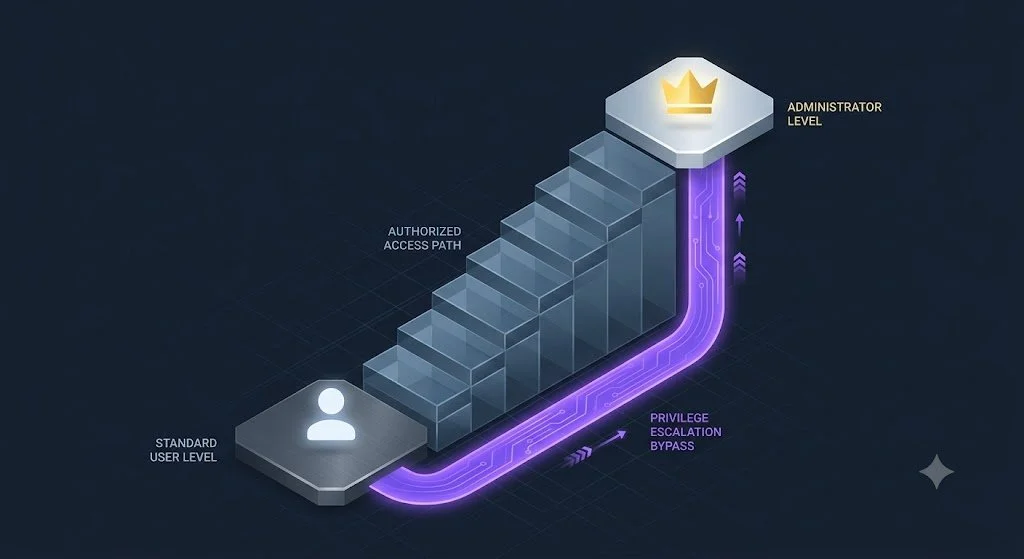
While horizontal escalation exposes peer data, Vertical Privilege Escalation compromises the integrity of the entire platform. Almost all modern LMS platforms feature a complex administrative interface meant to manage user enrolment, course material, and certificate issuance. This interface demands robust protection: Multi-Factor Authentication (MFA), strict password policies, immutable audit logs, and highly granular Role-Based Access Control (RBAC).
The Vertical Escalation Attack Path
(Standard restricted UI dashboard)
(Alters 'role_id' or 'user_id' in JSON payload)
(Direct backend communication ignores frontend checks)
(e.g., Unauthorised issuance of compliance certificate)
However, the underlying APIs powering these admin functions are frequently exposed. By directly querying restricted administrative endpoints, an authenticated standard user can bypass front-end UI restrictions. Lean Security engineers routinely execute vertical escalation to bypass mandatory coursework, alter grades, and illicitly trigger the issuance of highly regulated, officially sanctioned compliance certificates.
3. Insecure Cloud Storage (AWS S3 Bucket Misconfigurations)
The vast majority of modern LMS applications utilise native cloud storage solutions, such as Amazon S3 buckets, to host course materials, user uploads, and generated certificates. The security of these buckets is paramount.
Far too often, S3 buckets are provisioned with overly permissive access policies, rendering them either fully public or accessible to any authenticated user regardless of their enrolment status. When an S3 bucket containing sensitive ID verification uploads or raw payment data is left exposed, it transforms an LMS into a lucrative target for automated data scraping and ransomware extortion.
4. Flawed Authentication: The "Magic Link" Risk
To reduce user friction, many LMS platforms have adopted passwordless authentication via "Magic Links"—a URL sent via email that automatically logs the user in upon clicking. While convenient, the implementation is frequently disastrous.
A secure magic link requires three non-negotiable cryptographic controls: a cryptographically secure random token, a strict, short-lived expiry time (e.g., 15 minutes), and immediate invalidation after the first use. Lean Security frequently uncovers magic links that are entirely predictable, lack expiry windows, or can be reused indefinitely. If an attacker intercepts these links—often cached by corporate email gateways or exposed in server logs—they gain persistent, unauthenticated access to the student’s profile.
5. Payment Gateway Data Exposure
Corporate LMS environments frequently process direct payments for premium courses. While most platforms utilise third-party gateways (like Stripe or PayPal), the integration layer often leaks sensitive data. We frequently observe LMS APIs logging full credit card numbers or exposing extensive billing histories due to excessive data exposure in API responses. This directly violates Payment Card Industry Data Security Standard (PCI DSS) mandates.
Exploiting the Compliance Pipeline
During a recent Penetration Testing as a Service (PTaaS) deployment for a major Australian training provider, the Lean Security team targeted the platform’s certificate generation module. The LMS was responsible for issuing mandatory safety compliance certificates for the construction industry.
Our engineers identified an Insecure Direct Object Reference (IDOR) within the GraphQL API governing the course progression logic. While logged in as a standard student, we intercepted the API call meant to mark a single module as 'complete'. By manipulating the boolean value and the target user ID, we achieved vertical privilege escalation, bypassing all required video modules and quizzes. Furthermore, we manipulated a secondary, unauthenticated API endpoint used by the admin dashboard to forcefully generate a PDF compliance certificate bearing the official regulatory seal.
This engagement demonstrated that the risk was not just a data breach, but the complete destruction of the organisation's operational integrity and regulatory authority. Because this vulnerability was identified proactively via Lean Security’s continuous PTaaS model, the engineering team patched the API routing flaw before the platform launched to the public.
Validating Your Defensive Posture
Given the complexity of modern APIs, relying on standard automated scanners or a simple compliance checklist is entirely insufficient to protect highly sensitive student data and financial information. The only proven method to ensure your LMS is secure against these vectors is continuous, adversarial validation.
| Security Approach | Validation Method | LMS Risk Coverage |
|---|---|---|
| Traditional Compliance Checklists | Automated scans & policy reviews | Low (Consistently misses complex API logic flaws and IDOR vulnerabilities) |
| Annual Point-in-Time Pentest | Manual testing once a year | Medium (Creates dangerous visibility gaps between Agile development sprints) |
| PTaaS / Assumed Breach | Continuous, adversary-led red teaming | High (Validates RBAC and API logic dynamically alongside your deployment cycle) |
Frequently Asked Questions
What is Broken Access Control in an LMS?
Broken access control occurs when an application fails to properly enforce restrictions on what authenticated users can do. In an LMS, this often allows students to view other students' sensitive data (horizontal escalation) or access administrative functions like issuing certificates (vertical escalation).
How do insecure magic links lead to data breaches?
If a magic link lacks a short expiry time, is not invalidated after its first use, or uses predictable tokens, a threat actor who intercepts the link can hijack the user's session entirely, gaining access to all their personal and payment data without needing a password.
Why is penetration testing necessary for EdTech platforms?
EdTech platforms and LMS environments process highly sensitive PII, including USIs and financial data. Regular, rigorous penetration testing validates that security controls (like RBAC, API security, and S3 bucket permissions) are actually effective against real-world adversarial tactics, ensuring compliance with Australian privacy regulations.
Secure Your Educational Infrastructure
Do not wait for a regulatory audit or a public data breach to discover the vulnerabilities hiding in your LMS architecture. Lean Security provides elite Penetration Testing as a Service (PTaaS) tailored specifically for complex, data-heavy web applications.
Schedule a Technical Assessment
Strategic Risk of Clear-Text Privileged Credentials in 2026
Identity-centric threats continue to dominate the 2026 cybersecurity threat landscape. While enterprise organizations have heavily invested in Endpoint Detection and Response (EDR) agents, Zero Trust Network Access (ZTNA), and AI-driven behavioral analytics, adversaries consistently bypass these sophisticated perimeters through elementary operational oversights. A persistent and critical vulnerability remains the mismanagement of privileged identities—specifically, the abandonment of clear-text credentials on internal network shares.
The Hidden Attack Path: How Clear-Text Credentials on Shared Drives Drive Active Directory Compromise in 2026
Identity-centric threats continue to dominate the 2026 cybersecurity threat landscape. While enterprise organizations have heavily invested in Endpoint Detection and Response (EDR) agents, Zero Trust Network Access (ZTNA), and AI-driven behavioral analytics, adversaries consistently bypass these sophisticated perimeters through elementary operational oversights. A persistent and critical vulnerability remains the mismanagement of privileged identities—specifically, the abandonment of clear-text credentials on internal network shares.
The discovery of plaintext credentials within globally readable Server Message Block (SMB) shares is a direct symptom of technical debt and misaligned operational hygiene. When IT and DevOps teams utilize shared directories to store legacy deployment scripts, configuration files, or automated backup routines, they inadvertently provide threat actors with frictionless avenues for lateral movement and privilege escalation. Once an attacker extracts a privileged service account password from an unsecured share, the overarching security architecture is effectively nullified.
For Chief Information Security Officers (CISOs), Chief Technology Officers (CTOs), and Risk Managers navigating the stringent 2026 regulatory environment, the mandate is absolute: assuming breach is no longer a philosophical exercise, but an operational baseline. Defending the identity perimeter requires persistent, adversarial validation to identify the attack paths that vulnerability scanners structurally ignore.
The 2026 Regulatory & Threat Landscape: Compliance Under the Microscope
The Australian cybersecurity regulatory ecosystem has matured into a strict-liability environment. In 2026, legislative frameworks demand not merely the implementation of security controls, but continuous cryptographic and operational validation of their efficacy. Discovering privileged credentials stored in plaintext on a network file system represents a fundamental failure of identity governance, carrying severe compliance ramifications.
The expansion of the Security of Critical Infrastructure (SOCI) Act places unprecedented accountability on asset owners. The Act explicitly requires organizations to maintain a comprehensive risk management program, mandating proactive identification of lateral movement vectors. A breach facilitated by a publicly accessible privileged credential on an internal share directly violates SOCI’s requirements for systemic risk mitigation, triggering aggressive reporting timelines and potential regulatory intervention.
Furthermore, under the APRA CPS 234 prudential standard, APRA-regulated entities must maintain security capabilities commensurate with the evolving threat landscape. CPS 234 places the onus directly on the Board to ensure that internal testing methodologies adequately identify configuration flaws that could compromise the confidentiality and integrity of information assets. The failure to secure internal network shares against unauthorized enumeration constitutes a material control gap under this standard.
Simultaneously, the ASD Essential Eight maturity model underscores the critical nature of access control. Maturity Levels 2 and 3 mandate strict limitations on administrative privileges and robust application control. When a service account with administrative rights is exposed via a plaintext script, the foundational pillars of the Essential Eight are circumvented, rendering compliance assertions invalid.
| Regulatory Framework (2026) | Core Requirement Impacted | Consequence of Credential Exposure |
|---|---|---|
| SOCI Act | Positive Security Obligations (PSO) & Incident Response | Failure to demonstrate adequate cyber risk management; exposes critical infrastructure to systemic compromise and lateral movement. |
| APRA CPS 234 | Control Testing & Assurance | Demonstrates a failure in internal auditing and continuous control validation, potentially resulting in regulatory capital penalties. |
| ASD Essential Eight | Restricting Administrative Privileges | Provides adversaries with immediate, highly privileged execution capabilities, completely bypassing Maturity Level 3 access controls. |
Technical Breakdown: The Anatomy of Share-Based Lateral Movement
To understand the systemic risk posed by unsecured network shares, it is necessary to examine the precise mechanics of how an adversary escalates from an unprivileged, standard domain user to full Domain Administrator.
Phase 1: SMB Enumeration and Artifact Harvesting
Modern threat actors, as well as Red Teams simulating Advanced Persistent Threats (APTs), leverage automation to uncover high-value targets upon achieving initial access. From an assumed-breach position (e.g., a compromised workstation), the attacker operates within the context of a standard domain user. By default, Active Directory allows any authenticated user to query the directory and access network shares that lack explicit Discretionary Access Control List (DACL) restrictions.
Attackers utilize specialized scraping utilities such as Snaffler or custom PowerShell tooling to spider the internal network, recursively scanning SMB shares for files containing high-entropy strings, passwords, or cryptographic keys. The targets are typically legacy configuration files (web.config, unattend.xml), PowerShell deployment scripts (.ps1), or backup batch files (.bat).
Phase 2: Service Account Abuse
In many enterprise environments, IT administrators create service accounts to execute automated tasks such as database backups, software deployment, or Active Directory synchronization. To facilitate these automated tasks, the credentials for these service accounts are frequently hardcoded into the execution scripts stored on the shared drives.
These service accounts represent the ultimate prize for an adversary. They are structurally flawed in three critical ways:
- Password Permanence: Service account passwords are rarely rotated to prevent breaking legacy production services.
- MFA Exemption: Due to their automated nature, service accounts are generally exempt from Multi-Factor Authentication (MFA) requirements.
- Excessive Privileges: Administrators frequently over-provision these accounts, granting them highly privileged group memberships (e.g., Domain Admins, Backup Operators, or Account Operators) to ensure scripts run without permission errors.
Phase 3: BloodHound Execution and Attack Path Mapping
Upon extracting the clear-text credential, the adversary utilizes BloodHound—an application relying on graph theory—to map the precise privileges and lateral movement paths available to the compromised service account. By analyzing the Active Directory environment, the attacker can visually determine the shortest path to Domain Admin.
Phase 4: The DCSync Attack
If the compromised service account possesses the specific Active Directory replication privileges—specifically DS-Replication-Get-Changes and DS-Replication-Get-Changes-All—the attacker can execute a DCSync attack. By masquerading as a legitimate Domain Controller, the attacker's machine requests directory replication. The genuine Domain Controller responds by transmitting the NTDS.dit database containing the cryptographic hashes (NTLM) of every user and service account in the domain, including the krbtgt account.
At this juncture, the attacker achieves total domain dominance, enabling the creation of Golden Tickets for persistent, undetectable access. All of this is executed without dropping malware on the Domain Controller, rendering traditional endpoint security blind to the intrusion.
Mitigation & Validation: Closing the Visibility Gap
Trench Story: Anatomy of a Red Team Engagement
During a recent, highly constrained Red Team engagement executed by Lean Security for a prominent, mid-tier financial institution, the mechanics of this exact attack path were vividly demonstrated. Operating under the stringent requirements of a 2026 regulatory audit, the Lean Security team was tasked with validating the institution’s internal segmentation and zero-trust architecture.
The engagement commenced with an assumed-breach scenario, providing the Red Team with standard user access on a single VDI instance. Despite the deployment of an industry-leading, tightly configured EDR platform, the vulnerability did not lie in the endpoint, but in the environment’s legacy operational practices.
Executing a low-and-slow SMB enumeration strategy to evade behavioral detection, the Red Team discovered a read-only IT deployment share accessible to the Domain Users group. Nestled deeply within a nested folder structure from 2022 was a script named Automated_AD_Backup_v2.ps1. Inside this script lay the plaintext username and password for a service account designated for legacy directory snapshots.
The Red Team mapped the account’s privileges and identified that it held the Replicating Directory Changes permission. Operating entirely through encrypted remote management protocols (WinRM) to bypass lateral movement alarms, the team authenticated as the service account and executed a DCSync attack. Within four hours of initial access, Lean Security extracted the domain's credential database and achieved full Domain Administrator privileges, effectively compromising the organization's entire cryptographic trust model without triggering a single high-severity alert in the Security Operations Center (SOC).
Actionable Countermeasures
Organizations must adopt a proactive, multi-layered approach to eradicate this attack vector. Relying solely on EDR is insufficient against identity-based lateral movement.
- Implement Group Managed Service Accounts (gMSAs): Transition away from standard user accounts for services. gMSAs natively handle password management, rotating complex passwords automatically and eliminating the need for administrators to know, or hardcode, the credential.
- Continuous Secret Scanning: Deploy automated secret-scanning engines across all internal network shares, code repositories, and collaborative platforms (e.g., SharePoint, Confluence). These tools must utilize regular expressions and entropy checks to identify exposed API keys, passwords, and tokens.
- Strict SMB Access Controls (PoLP): Enforce the Principle of Least Privilege on all file servers. Remove the
Domain UsersandAuthenticated Usersgroups from share permissions. Utilize explicit security groups aligned with business requirements, and heavily restrict read-access to administrative IT shares. - Enforce Tiered Active Directory Architecture: Implement a strict Tiered Administration model. Ensure that service accounts executing tasks on lower-tier assets (Tier 1/Tier 2) cannot access Tier 0 assets (Domain Controllers, Identity Providers) or extract directory synchronization data.
Securing the Identity Perimeter with Lean Security
The persistent reality of the 2026 cybersecurity landscape is that sophisticated perimeters are frequently undone by internal operational debt. Defense-in-depth is an illusion if the foundational identity layer remains exposed via flat, unmonitored network shares. As regulatory frameworks like the SOCI Act, APRA CPS 234, and the ASD Essential Eight intensify their focus on objective control efficacy, organizations can no longer rely on theoretical security policies.
True resilience requires empirical validation. Automated vulnerability scanners fundamentally fail to contextualize how a misconfigured internal file share can lead to systemic Active Directory compromise. Only through continuous, adversarial testing can organizations identify and remediate the hidden attack paths that threat actors actively exploit.
Lean Security partners with enterprise organizations to deliver elite offensive security services tailored to the complex demands of the modern threat landscape. Through our continuous Penetration Testing as a Service (PTaaS) model and sophisticated Red Teaming engagements, we simulate advanced adversarial tactics to uncover critical vulnerabilities—from clear-text credentials in legacy shares to complex Active Directory misconfigurations—before they can be leveraged against your business.
Validate your controls, secure your identity perimeter, and achieve uncompromising compliance.
Engage with Lean Security today to fortify your organization against advanced lateral movement vectors: www.leansecurity.com.au.

The 2026 Shift from Annual Compliance to Continuous Penetration Testing and Red Teaming in Australia
Upgrade from annual pen tests to continuous penetration testing services in Australia. Discover 2026 red teaming trends, PTaaS, and expert security assessments.
Beyond the Checkbox: Why Continuous Penetration Testing & Red Teaming Are Essential in 2026
The cybersecurity landscape has reached a pivotal turning point in 2026. We are no longer living in an era where cyber threats evolve month by month; today, they evolve minute by minute. With the explosive rise of AI-assisted exploit chaining, sophisticated Phishing-as-a-Service (PHaaS), and automated vulnerability discovery, threat actors are moving at machine speed.
If your organisation relies solely on a traditional, once-a-year pen test to check a compliance box, you are inherently operating with a massive blind spot. By the time that static PDF report lands on your desk, your digital environment has already shifted, and new security weaknesses have likely emerged. In Australia, regulatory bodies and enterprise boards are waking up to this reality, sparking a massive shift toward continuous, intelligence-led offensive security.
Whether you are seeking a premier penetration testing service or looking to test your in-house defenders through a full-scale red team engagement, understanding how testing methodologies have evolved is crucial for protecting your bottom line. Let’s dive into the current state of penetration testing Australia and how you can stay ahead of the curve.
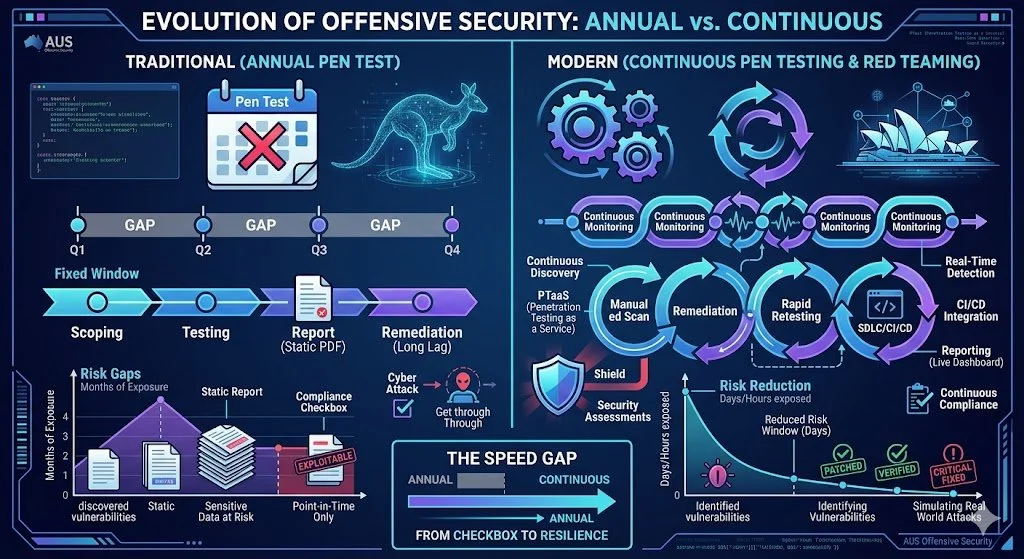
Evolution of offensive security: Annual vs Continuous
Why Annual Penetration Testing is Failing Modern Businesses
In the past, organisations scheduled a penetration test service once a year to satisfy auditors and renew their cyber insurance. While point-in-time assessments still hold value for specific baseline checks, they fail to account for the velocity of modern development. Every time your engineering team pushes a code update, launches a new microservice, or modifies a cloud configuration, your attack surface changes.
The "Speed Gap" and AI-Assisted Attacks
In 2026, attackers are heavily leveraging generative AI to automate reconnaissance and craft highly convincing, hyper-personalised lures. They chain together low-severity vulnerabilities to execute a devastating cyber attack. This creates a "speed gap" between rapid threat evolution and static, calendar-based testing cycles. If an exploitable flaw is introduced to your network in February, waiting until your annual test in November leaves your sensitive data exposed for nine months. A modern cyber security posture demands agility.
Evolving Australian Regulatory Pressures
The Australian regulatory environment is actively tightening to combat these threats. With the expansion of the Security of Critical Infrastructure (SOCI) Act, APRA CPS 234, and strict PCI DSS 4.0 enforcement, regulators no longer accept simple policy documentation. They require demonstrable technical validation of your security controls. Boards now expect quantified risk reduction, pushing organisations to partner with an elite penetration testing provider that can translate technical risks into business impact.
The Rise of Penetration Testing as a Service (PTaaS)
To bridge the speed gap, the industry is heavily adopting penetration testing as a service (PTaaS). This model represents a fundamental shift in how testing services are delivered.
Instead of a siloed engagement, a penetration test as a service integrates directly into your Software Development Life Cycle (SDLC) and CI/CD pipelines. This approach combines the scale of automated vulnerability scanning with the contextual intelligence of an expert human penetration tester.
When you engage reputable penetration testing service providers for PTaaS, you receive:
Continuous Monitoring: Rapid identification of new exposures in real-time.
On-Demand Retesting: The ability to instantly verify that a vulnerability has been successfully remediated by your development team.
Actionable Dashboards: Live insights into your risk posture rather than a static annual report.
By moving to continuous penetration testing services, Australian businesses reduce their window of exposure from months to mere days, ensuring exploitable vulnerabilities are patched before threat actors can weaponise them.
Red Teaming: Simulating Real World Attacks
While standard penetration test services focus on finding as many vulnerabilities as possible within a defined scope, red teaming takes a vastly different approach. Red teaming is about simulating real world attacks to test how well your people, processes, and technology respond to a determined, covert adversary.
A mature penetration testing service in australia will deploy a red team to mimic the exact Tactics, Techniques, and Procedures (TTPs) of known threat actors targeting your specific industry. This multi-layered assessment often occurs over weeks or months and tests the defensive capabilities (the "Blue Team") of your organisations.
Red teaming pushes beyond digital borders, often incorporating:
Advanced Social Engineering: Spear-phishing executives, voice cloning (vishing), and deepfake exploitation to bypass initial access controls.
Physical Breaches: Assessing facility security by attempting to clone badges, tailgate employees, or plant rogue devices on the corporate network.
Evasion Tactics: Testing if the Security Operations Centre (SOC) can detect lateral movement, privilege escalation, and data exfiltration without alerting the attackers.
For organisations with a mature security posture, red teaming provides the ultimate reality check.
Core Focus Areas for 2026: APIs, Cloud, and Identity
As perimeters dissolve and workforces remain distributed, threat actors have shifted their crosshairs. A comprehensive security strategy must prioritise the following critical areas:
1. API Penetration Testing Services
Application Programming Interfaces (APIs) are the backbone of modern digital architecture, connecting countless microservices and third-party apps. Unfortunately, they are also frequently under-tested and over-trusted. In 2026, APIs are essentially the backdoor to your data. Specialized API penetration testing services are crucial to identify broken object level authorisation (BOLA), mass assignment flaws, and rate-limiting failures that automated scanners completely miss.
2. Active Directory Penetration Testing Service
If a threat actor gains a foothold in your network, their next immediate goal is lateral movement and privilege escalation. Your Active Directory (AD) or Entra ID environment is the keys to the kingdom. An expert active directory penetration testing service uncovers misconfigurations, weak password policies, and excessive permissions that could allow an attacker to achieve total domain compromise.
3. Application Security
Your customer-facing applications are your most visible attack surface. Engaging dedicated web application testing and a robust mobile application penetration testing service ensures that your software is resilient against complex logic flaws, session hijacking, and insecure data storage. For organisations heavily invested in mobile ecosystems, engaging recurring mobile application penetration testing services is non-negotiable to protect consumer trust and comply with global privacy laws.
How Penetration Testing Involves Identifying Vulnerabilities
If you are new to the process, you might wonder what a thorough engagement looks like. Penetration testing involves a highly structured methodology to ensure safety, comprehensiveness, and accuracy.
Scoping and Rules of Engagement: The provider works collaboratively with you to define what systems are in bounds, what techniques are off-limits, and the ultimate goals of the assessment.
Reconnaissance & Threat Modelling: Testers gather open-source intelligence (OSINT) to understand your digital footprint, identifying exposed credentials or shadow IT assets.
Identifying Vulnerabilities: Using a blend of bespoke automated tooling and deep manual analysis, experts search for weak points.
Exploitation: The critical step. Testers actively exploit the findings to validate the risk. This proves whether a theoretical vulnerability can actually lead to unauthorised access.
Reporting and Remediation: You receive a prioritised, highly detailed report outlining the business impact of each flaw, alongside precise, actionable remediation guidance.
Understanding Penetration Testing Cost in Australia
Budgeting for security is a common concern. Penetration testing cost varies wildly depending on the size of your infrastructure, the depth of the assessment, and the prestige of the firm. Below is a high-level guide to help you budget for penetration testing sydney and across Australia in 2026.
| Service Type | Typical Scope | Estimated Cost (AUD) |
|---|---|---|
| Web / Mobile App Test | Single application, API endpoints, role-based access checks. | $8,000 - $25,000+ |
| Internal Network Test | Active Directory, workstations, internal servers, lateral movement. | $12,000 - $35,000+ |
| Cloud Infrastructure Test | AWS/Azure/GCP configurations, IAM roles, container security. | $15,000 - $40,000+ |
| Full Red Team Engagement | Multi-month simulation, physical security, social engineering, evasion. | $45,000 - $150,000+ |
| Continuous PTaaS | Ongoing SDLC integration, automated scanning, manual verification. | $3,000 - $10,000+ / month |
Note: These estimates are indicative. Always request a custom scoping call with your provider to get an accurate quote tailored to your environment.
Types of Penetration Tests You Should Consider
Depending on your maturity and specific security standards, there are several types of penetration tests to integrate into your strategy:
Black Box Testing: Testers are given zero prior knowledge of the environment, perfectly mimicking an external, unauthenticated attacker.
Grey Box Testing: Testers are provided with basic user credentials and partial knowledge. This is the most common and efficient approach for application penetration testing, simulating a malicious insider or a compromised user account.
White Box Testing: Testers have full access to source code and architecture diagrams. This provides the most comprehensive evaluation of your code base and underlying logic.
Securing Your Future Today
The question is no longer if your organisation will be targeted, but when, and whether your defences will hold up against an adversary operating at the speed of modern AI. Clinging to outdated, annual compliance-driven testing methodologies is a dangerous gamble with your company's reputation and intellectual property.
By embracing continuous testing models, robust API and cloud scrutiny, and realistic red teaming exercises, you transition your security posture from reactive to proactively resilient.
Ready to mature your security operations and close the speed gap? Contact our expert team today for a confidential scoping call and customised quote. Let’s collaborate to build a defence strategy that stands up to the reality of 2026.

5 Ways to Protect Your E-Commerce Site from Hackers in 2020
There are many steps you can take to ensure the safety of your website. Here’s a list of five of them:
According to the Australian Cyber Security Centre, the two major cybercrimes targeting Australians are online fraud and shopping scams.
In light of this, consumers are being asked to stay vigilant and report any potentially fraudulent activities to authorities. Meanwhile, businesses are looking to identify and correct weaknesses in their systems by employing methods like penetration testing services.
There are many steps you can take to ensure the safety of your website. Here’s a list of five of them:
1. Mandate Strong Passwords
One of the easiest (and most effective) steps a retailer can take to protect clients’ sensitive information is asking for a strong password. A complex password with a variety of alphabets and special characters makes it harder for hackers to crack it.
You can even take this a step further and ask for multi-factor authentication. This sets up two or more protective defences, thereby protecting your data better.
2. Back Up Data Regularly
Some hackers attack websites to delete data, with the primary motive being causing distress to the company and its customers. Others hack into systems to steal customer data, such as credit card information. If this happens your company may need to shut down its site to fix the situation.
Data might get lost or deleted in the process. But if you have backups available, the impact of the damage can be controlled.
3. Protect Yourself from DOS/DDOS
Denial of Service (DOS) or Distributed Denial of Service (DDOS), are cyberattacks that don’t require any internal access. They work by flooding the system with fake traffic until the servers overload—till the point of failure.
In simple terms, it lowers the speed of your website, making it difficult for customers to use it. The best way to protect yourself from DDOS attacks is by monitoring traffic.
4. Ensure Data Encryption
Any piece of data that your customers are inputting on your site needs to be encrypted. This includes not just credit card information, but also emails addresses and phone numbers. The reason being that this information can be used for phishing attacks.
What are phishing attacks? It involves a host of fraudulent practice, including sending emails pretending to represent reputable companies and asking for sensitive information. Even big companies like Facebook and Google have fallen victim to such attacks.
5. Perform Routine Checks
The best preventative measure is performing routine penetration checks. Keep checking your defences to make sure they are up to date and impenetrable. It’s always better to be prepared beforehand than have to deal with damages once they’ve been incurred.
More importantly, you risk turning away customers who feel your site isn’t reliable.
Lean Security is one of Australia’s leading penetration testing service providers, with over 10 years of experience in the IT security industry.
We’ve helped thousands of big and small businesses make their site more secure. To find out how we can help you, give us a call at +61 (2) 8078 6952 or message us here.

The Future of Penetration Testing: Declaring War on Modern Hacking Techniques
It has become SOP for organizations to conduct penetration testing and vulnerability scans on a regular basis. Such practice is even endorsed by most IT specialists since an attack could lead to disastrous outcomes. Penetration testing assesses an IT infrastructure’s security by safely exploiting vulnerabilities. These vulnerabilities may exist in incorrect configurations, hazardous end-user behavior, operating systems and application flaws.
Cyber-attacks have increased. Implementing different security measures is a must for businesses and institutions to ensure that their systems will never become susceptible to any type of penetration. Interruptions in the performance of applications or services can lead to negative press, financial losses, lost customer trust, penalties and fines. A study published by the Ponemon Institute revealed that the average cost of information breach for the affected organization is $3.5 million.
It has become SOP for organizations to conduct penetration testing and vulnerability scans on a regular basis. Such practice is even endorsed by most IT specialists since an attack could lead to disastrous outcomes. Penetration testing assesses an IT infrastructure’s security by safely exploiting vulnerabilities. These vulnerabilities may exist in incorrect configurations, hazardous end-user behavior, operating systems and application flaws.
Penetration testing can also help validate the efficiency of defensive mechanism. This process is best conducted by a third party. Ethical hackers are more familiar with possible vulnerabilities than IT professionals who are in charge of running the organization’s network. Their skill and occupation may be the same, but their desired outcome is different.
Importance of Penetration Testing
Also known ethical hacking, penetration testing is conducted by organizations to prevent any attempt to mess with their systems and breach their security. Those performing penetration testing will carry out what attack perpetrators perform, but their main goal is to pinpoint vulnerabilities. The hacking is performed as an important part of the penetration and the one doing it provides periodic reports of how a certain hacking activity is affecting the server security and the website, which is then sent to the organization for proper remediation management.
There are various reasons why organizations should conduct a penetration test.
- Determine if new bugs exist in recently updated software
- Confirm if current control is efficient and properly implemented to secure senior management and IT security handlers
- Determine the weak aspects in the hardware, software and among users in order to create better controls
- Test if the applications being used are vulnerable to attacks
- Develop a strong defense against potential attacks
Security threats haunt web masters every now and then. These problems may arise due to inaccurate configuration, disabling automatic updates and a network security hole in the system. A security breach often happens if proper measures are not taken. Penetration testing should only be conducted by an expert who is known for his integrity and credibility.
How Often Should a Penetration Test Be Performed?
Penetration testing must be conducted on a regular basis to guarantee more consistent network and IT security management. This process reveals how developing vulnerabilities or recently exposed threats may be taken advantage of by attackers. Aside from regularly scheduled assessments and analysis, penetration tests should also be conducted when applying security patches, moving to new office locations, changing end user policies, adding new network applications or infrastructure and applying modifications or upgrades to the existing applications or infrastructure used by the organization.