

Beyond the Patch: Why the Actively Exploited WSUS Vulnerability (CVE-2025-59287) Demands a Red Team Response in Australia
Actively exploited WSUS flaw CVE-2025-59287 (CVSS 9.8) threatens Australian businesses. Patching isn't enough. See why red teaming is essential to validate your security.
I. The Unseen Threat in Your Update Server: A "Keys to the Kingdom" Vulnerability
Within the complex architecture of enterprise security, the Windows Server Update Service (WSUS) stands as a ubiquitous and fundamentally trusted component. It is the silent workhorse operating in the background, the central nervous system for patch management, ensuring that thousands of endpoints receive the critical security updates necessary to maintain cyber hygiene and defend against an ever-evolving threat landscape. Organisations across Australia and the globe depend on its reliable function to close vulnerabilities and fortify their digital estates. This report, however, addresses a critical and alarming scenario: what happens when this trusted defender becomes the ultimate insider threat?
The emergence of CVE-2025-59287 represents not merely another software flaw, but a fundamental breach of the trust relationship between an organisation's security posture and its core management tools. An adversary who gains control over a WSUS server does not just compromise a single machine; they seize the "keys to the kingdom." They command the very mechanism responsible for distributing security and integrity across the network. This privileged position allows an attacker to turn the entire update infrastructure into a weapon, capable of deploying malicious code disguised as legitimate patches to any and every connected system. The psychological impact of such a compromise on security teams is profound. It weaponizes a tool they rely upon for defence, forcing them into a state where their own infrastructure must be treated with suspicion. This erosion of trust complicates every facet of incident response and recovery, handing a significant advantage to the adversary before the battle has even begun.
The threat posed by CVE-2025-59287—a critical, remotely exploitable, unauthenticated vulnerability now being actively used by attackers—is therefore not a problem to be delegated solely to system administrators. Its potential for catastrophic business disruption, from widespread ransomware deployment to silent espionage, elevates it to a strategic risk that demands the immediate attention of technical and business leadership. This analysis will deconstruct the vulnerability, trace its alarming evolution from a flawed patch to a weaponized exploit, and argue that for Australian organisations, the only path to true resilience lies beyond reactive patching and in the realm of proactive, adversary-emulation-based security validation.
II. Deconstructing CVE-2025-59287: The Anatomy of a Critical Flaw
To fully grasp the severity of CVE-2025-59287, it is essential to understand both the role of WSUS in a typical enterprise environment and the precise technical mechanics of the vulnerability itself.
WSUS Architecture in the Enterprise
WSUS operates on a hierarchical model. A central "Upstream Server" connects to Microsoft's update servers over the internet to download patches. Internal "Downstream Servers" then connect to this upstream server to receive and distribute those patches to client workstations and servers within the local network. This architecture is designed for efficiency and control, but it creates a powerful central point of distribution. A compromise of the upstream server can have a cascading effect, potentially compromising every downstream server and, by extension, every client they manage. This structure makes WSUS an incredibly attractive target for adversaries seeking to bypass network segmentation and achieve widespread lateral movement.
Technical Deep Dive
The vulnerability is rooted in a classic but severe software security flaw known as "Deserialization of Untrusted Data," catalogued as CWE-502. The attack unfolds through a precise sequence of events targeting the WSUS reporting web services:
The Attack Vector: A remote, unauthenticated attacker sends a specially crafted network request to the WSUS server. This request targets the
GetCookie()endpoint and contains a maliciousAuthorizationCookieobject.The Mechanism: The WSUS server receives this malicious cookie. It proceeds to decrypt the cookie's data using an AES-128-CBC cipher and then deserializes the resulting object using the
BinaryFormattermethod. The critical failure occurs here: the server performs this deserialization without properly validating that the resulting data is safe or of an expected type.The Result: By providing a malicious object, the attacker tricks the server into executing arbitrary code in the context of the WSUS service, which typically runs with high-level SYSTEM privileges.
This exploit is particularly egregious because Microsoft itself has long deprecated the use of BinaryFormatter, explicitly warning developers that the method is inherently unsafe when used with untrusted input due to its inability to prevent this exact type of attack. Its continued presence in a critical, internet-facing component represents a significant and exploitable engineering oversight.
Quantifying the Risk
The technical details translate into a risk profile that represents a worst-case scenario for a network-based vulnerability. The Common Vulnerability Scoring System (CVSS) provides a clear, data-driven assessment of its severity.

CVE-2025-59287
The CVSS vector string is particularly telling for technical leaders:
Attack Vector: Network (AV:N): The vulnerability can be exploited remotely over a network.
Attack Complexity: Low (AC:L): It requires no special conditions or complex techniques to exploit.
Privileges Required: None (PR:N): The attacker does not need any credentials or prior access.
User Interaction: None (UI:N): The attack requires no action from a user, such as clicking a link or opening a file.
Impact: High (C:H, I:H, A:H): Successful exploitation leads to a complete loss of Confidentiality, Integrity, and Availability of the targeted WSUS server.
This combination confirms that CVE-2025-59287 is a remotely executable, unauthenticated, and trivial-to-exploit vulnerability that results in a full system compromise.
III. A Timeline of Crisis: From Flawed Patch to Active Exploitation
The story of CVE-2025-59287 is not just one of a critical vulnerability, but also a case study in the dangers of a flawed patching process and the rapid pace at which modern threats evolve. The timeline of events created a critical window of exposure, leaving even diligent organisations vulnerable.
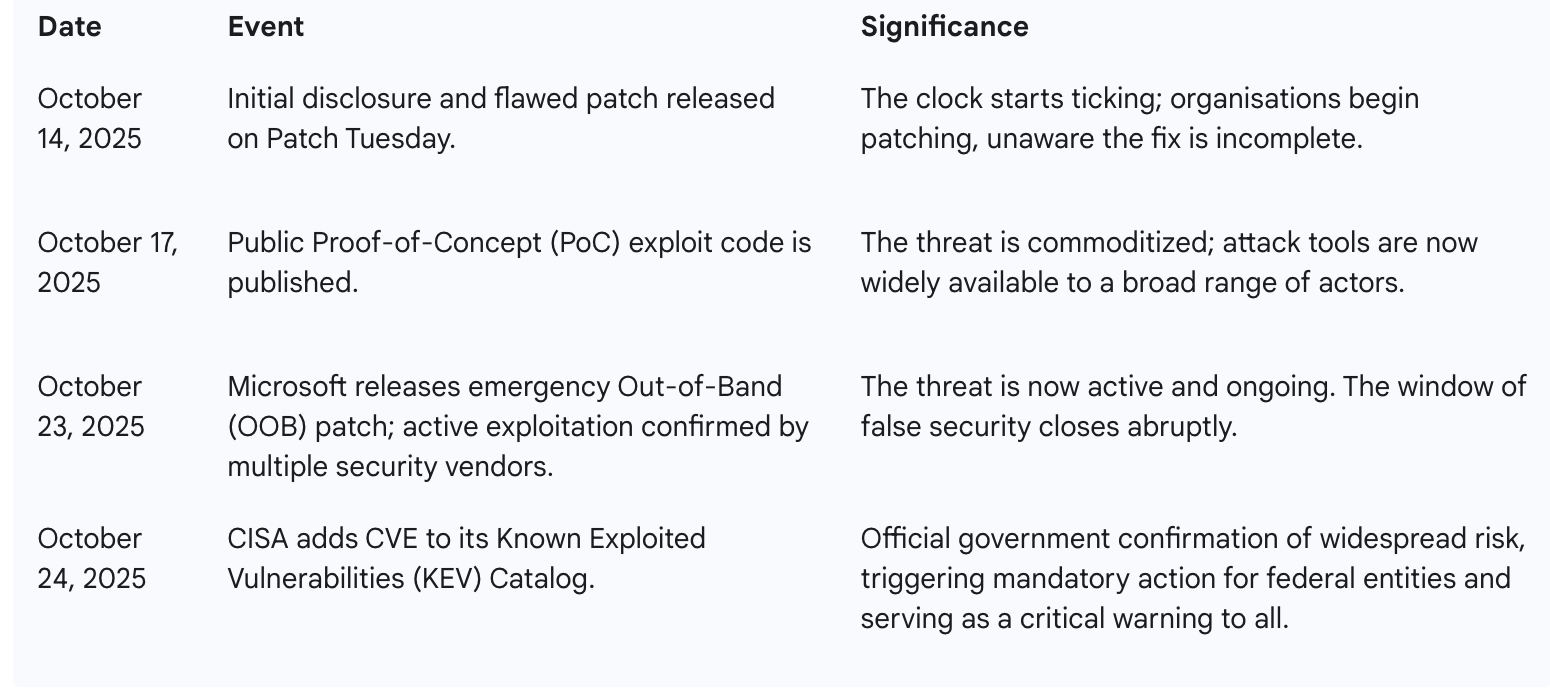
CVE-2025-59287 timeline
Official government confirmation of widespread risk, triggering mandatory action for federal entities and serving as a critical warning to all.
This sequence of events powerfully illustrates the "patching paradox" and the inherent weakness of a purely compliance-centric security model. An organisation that prides itself on its key performance indicators for patch deployment—for instance, applying all critical patches within a 14-day window—would have acted promptly after the October 14th Patch Tuesday. They would have deployed the initial update, and their vulnerability scanners and compliance reports would have marked CVE-2025-59287 as "remediated."
However, because that initial patch was incomplete, this state of compliance was a dangerous illusion. The organisation was, in fact, still completely vulnerable. The period between October 14 and the release of the emergency patch on October 23 was a window of false security. During this time, the publication of a PoC exploit on October 17 dramatically lowered the technical barrier for attackers.8 When active exploitation began on October 23, these "compliant" organisations were just as exposed as those who had not patched at all.
This real-world failure demonstrates that security cannot be measured by checklists or the speed of patch deployment alone. True security is not a theoretical state of compliance but an empirically validated state of resilience. It proves that mitigating controls must be tested to confirm they are actually effective, not just present. Without this validation, organisations are operating on faith—a faith that, in this case, was misplaced, leaving them exposed to a critical, actively exploited threat.
IV. The Attacker's Playbook: How CVE-2025-59287 is Being Weaponised
The theoretical risk of CVE-2025-59287 rapidly became a practical reality. Security researchers observed attackers exploiting the vulnerability in the wild, providing a clear view of their initial tactics and objectives.
In-the-Wild Exploitation
Initial reports from security firms like Huntress described the attacks as simple "point-and-shoot" techniques, underscoring the low complexity of the exploit following the release of the PoC. The observed post-exploitation activity focused on immediate reconnaissance. Attackers, having gained SYSTEM-level access on the WSUS server, were seen spawning Command Prompt and PowerShell processes directly from the IIS worker process (w3wp.exe) or the WSUS service binary (wsusservice.exe).
They executed basic commands to map the compromised environment, such as net user /domain to enumerate all user accounts in the Active Directory domain, and ipconfig /all to gather detailed network configuration data.1 The output of these commands was then exfiltrated to an attacker-controlled remote server.1 This behaviour is a clear indicator that attackers are using the initial WSUS compromise as a beachhead to understand the network's structure, identify high-value targets, and plan their next move.
The Red Team Perspective: Simulating the Full Attack Chain
While the observed attacks focused on reconnaissance, a sophisticated adversary—or a red team emulating one—would leverage the unique position of a compromised WSUS server to execute a far more devastating attack chain. The strategic goal is not just to compromise the WSUS server itself, but to use it as a master key to unlock the entire network. This is accomplished by abusing the core functionality of WSUS for lateral movement, a technique well-documented by offensive security researchers and encapsulated in tools like SharpWSUS.
The full attack chain would proceed as follows:
Initial Compromise: The attacker gains their initial foothold by exploiting CVE-2025-59287, achieving remote code execution with SYSTEM privileges on the primary WSUS server.
Internal Reconnaissance and Target Identification: From the compromised server, the attacker enumerates all computers managed by WSUS. This provides a comprehensive list of potential targets across the network, including domain controllers, database servers, and critical application hosts.
Target Isolation: To avoid detection and collateral damage, the attacker creates a new, innocuous-sounding update group on the WSUS server (e.g., "Critical Server Patching Pilot"). They then move their high-value target, such as a domain controller, into this isolated group.3
Malicious Update Creation: The attacker crafts a malicious "update" package. A key constraint of this technique is that the payload must be a legitimate, Microsoft-signed binary to avoid suspicion. However, this is a low hurdle, as numerous signed binaries can be used for malicious purposes (a technique known as Living-off-the-Land). The attacker can use a tool like
PsExec.exeorMsiExec.exeto execute a secondary payload, such as a command to create a new administrative user or deploy ransomware.Deployment and Execution: The attacker approves this malicious update for deployment only to the isolated group containing the high-value target. They then simply wait for the target machine's scheduled check-in time. When the domain controller connects to WSUS to request updates, it will download and execute the malicious package, believing it to be a legitimate patch from a trusted internal source.
The strategic impact of this attack path cannot be overstated. Modern network security is built on the principle of segmentation—separating critical assets into protected zones to contain breaches. However, WSUS, by its very nature, is designed to traverse these segments. Firewall rules are almost always configured to allow clients from all network zones to communicate with the central WSUS server on ports 8530 and 8531. An attacker who controls the WSUS server inherits this privileged network position. They can use the trusted WSUS protocol as a covert channel to push malicious code into otherwise inaccessible, highly secured network segments, rendering years of segmentation efforts completely useless. The WSUS server becomes a network chokepoint, where a single point of failure leads to the systemic compromise of the entire enterprise.
V. The Australian Imperative: Placing the WSUS Threat in Local Context
While CVE-2025-59287 is a global threat, its implications are particularly acute within the Australian cybersecurity landscape, which is characterized by increasing attacks and a stringent regulatory environment for critical infrastructure.
Connecting to the National Threat Landscape
The Australian Signals Directorate's (ASD) Australian Cyber Security Centre (ACSC) Annual Cyber Threat Report 2024-25 paints a stark picture of the environment in which Australian organisations operate. The report highlights a staggering 83% increase in notifications of potentially malicious cyber activity issued by the ACSC. It underscores the persistent and growing threat from both state-sponsored actors and sophisticated cybercriminals who are relentlessly targeting Australian governments, businesses, and critical infrastructure.13
Crucially, the report identifies "compromised assets, networks, or infrastructure" as the most frequently reported type of cybersecurity incident, accounting for 55% of incidents affecting critical infrastructure. The exploitation of CVE-2025-59287 aligns perfectly with this trend, providing adversaries with a direct and highly effective method for achieving widespread network compromise. The ability to gain control of a central management tool like WSUS is precisely the kind of high-impact capability that these threat actors seek.
Implications for Critical Infrastructure (SOCI Act)
For the growing number of Australian organisations governed by the Security of Critical Infrastructure (SOCI) Act 2018, this vulnerability poses a direct and significant challenge to their compliance and operational resilience obligations. The SOCI Act mandates that responsible entities establish and maintain a risk management program (RMP) that identifies and mitigates hazards, including cyber threats and supply chain vulnerabilities.
A vulnerability in a foundational software distribution platform like WSUS must be viewed as a critical software supply chain risk. An attacker who compromises WSUS can disrupt the integrity of the entire software update process, which is a cornerstone of cyber defence. For operators of essential services—in sectors like energy, healthcare, communications, and finance—a compromised WSUS server could be used to deploy disruptive malware, leading to significant operational downtime, service outages, and a clear failure to meet SOCI Act obligations. For entities responsible for Systems of National Significance (SoNS), the threat is even more severe. An adversary could use a compromised WSUS server to gain persistent access to the nation's most vital assets, directly threatening Australia's economic stability and national security.
This context transforms the WSUS vulnerability from a mere technical issue into a potential tool for "grey zone" warfare. The ACSC has explicitly warned that state-sponsored actors are actively working to position themselves for potential disruptive attacks at times of strategic advantage. A compromised WSUS server is the perfect vector for such an operation. An adversary could use it to deploy a dormant payload—such as a logic bomb, a wiper, or a persistent backdoor—disguised as a routine update. This malicious capability could be pre-positioned across an entire critical infrastructure network, remaining latent and undetected until activated. This scenario moves beyond data theft and cybercrime into the realm of national resilience and sovereignty, aligning directly with the most serious threats identified by the ASD.
VI. Your Strategic Response: Moving from Reactive Patching to Proactive Defence
A threat of this magnitude requires a response that is layered, disciplined, and extends beyond immediate remediation. A comprehensive strategy must move from tactical triage to proactive validation and, ultimately, to the strategic resilience that can only be achieved through adversarial emulation.
Layer 1: Immediate Tactical Mitigation (The "Stop the Bleeding" Phase)
This phase is about immediate, decisive action to contain the threat, based on the official guidance from Microsoft and CISA. These steps are non-negotiable and must be treated with the highest priority.
Action 1: Patch Immediately. Apply the correct out-of-band (OOB) security update to all affected Windows Server versions. The relevant updates include KB5070881, KB5070882, KB5070883, KB5070884, and others corresponding to specific server versions. This OOB update supersedes the flawed patch from the October 14th Patch Tuesday.
Action 2: Reboot. A system reboot is required after the patch is installed to ensure the mitigation is fully applied and the system is protected.
Action 3: Use Workarounds if Patching is Delayed. In situations where immediate patching is not feasible due to operational constraints, Microsoft has provided temporary workarounds. These include completely disabling the WSUS Server Role on the affected server or, more surgically, blocking all inbound traffic to TCP ports 8530 and 8531 at the host firewall.1 It is critical to understand that these actions will render the WSUS server non-operational, preventing clients from receiving any updates.
Layer 2: Proactive Security Validation (The "Confirm and Harden" Phase)
Completing the tactical mitigation is only the first step. The "patch and pray" approach is insufficient given the active exploitation of this vulnerability. Technical leaders must challenge their teams with the critical follow-up question: "How do we know we are truly safe?"
Action 4: Hunt for Compromise. Operate under the assumption of a breach. Security teams must proactively hunt for Indicators of Compromise (IOCs) related to the observed in-the-wild attacks. This includes searching logs for suspicious PowerShell or Command Prompt execution originating from the
w3wp.exeorwsusservice.exeprocesses, and analyzing network traffic for unusual outbound connections from WSUS servers to unknown domains.1Action 5: Validate Patch Deployment and Configuration. Use vulnerability management and asset inventory systems to confirm that the correct OOB patch has been successfully deployed across the entire fleet of WSUS servers. This is also the time to conduct a thorough configuration review of all WSUS servers, ensuring that management access is restricted to trusted administrative networks and that host firewall rules are hardened to minimize the attack surface.
Layer 3: Adversary Emulation (The "Build True Resilience" Phase)
This is the most critical phase for achieving long-term, verifiable security. The only way to be certain that defences can withstand a sophisticated, multi-stage attack leveraging a compromised WSUS server is to simulate that exact attack in a controlled, objective-driven manner.
Action 6: Commission a Red Team Engagement. A specialized red team engagement provides empirical evidence of an organisation's security posture against this real-world threat.19 Such an exercise would not stop at a simple vulnerability scan. It would simulate the adversary's complete playbook, including:
Attempting to validate the patch's effectiveness against the known exploit for CVE-2025-59287.
Executing the post-exploitation tactics, techniques, and procedures (TTPs), specifically emulating the abuse of WSUS for lateral movement as described in the SharpWSUS methodology.
Testing the Security Operations Centre's (SOC) and blue team's ability to detect and respond to the specific artifacts of this attack, such as the creation of suspicious update groups, the deployment of non-standard update packages, or the presence of unexpected signed binaries in the WSUS content directory.
This process moves security from a theoretical state based on compliance to an empirically tested reality. It provides leadership with genuine, evidence-based confidence in their organisation's resilience against the threats they are most likely to face.

Adversary Emulation phases
VII. Executive Briefing: Key Actions for Australian Business Leaders
The critical vulnerability in the Windows Server Update Service, CVE-2025-59287, represents a clear and present danger to Australian organisations. This is not a routine security flaw; it is a strategic risk that weaponizes a core IT management asset, turning a trusted defender into a potential single point of catastrophic failure. Active exploitation in the wild, combined with a CVSS score of 9.8, necessitates an urgent and comprehensive response that goes beyond standard patching protocols. For business and technical leaders, the following actions are imperative.
Acknowledge the Severity: Recognise that CVE-2025-59287 is a critical, actively exploited threat that fundamentally undermines the trust in your core IT infrastructure. Direct your teams to treat this with the highest level of urgency.
Mandate Immediate and Correct Patching: Instruct your technical teams to apply Microsoft's specific emergency out-of-band patch for CVE-2025-59287 across all WSUS instances without delay. Ensure they understand that the initial October 14th patch was insufficient and must be superseded.
Question Your Assumptions: Move beyond a compliance mindset. The critical question is not simply "Did we patch?" but "How have we validated that the patch is effective and that no prior compromise occurred?" Demand evidence of proactive threat hunting and configuration validation.
Invest in Adversarial Validation: The weaponization of trusted infrastructure is a hallmark of sophisticated attacks. The only way to truly know if your defences, detection capabilities, and response procedures can withstand this attack is to test them. Commission an independent penetration test or red team engagement focused specifically on simulating this attack chain to gain empirical evidence of your organisation's security posture.
Review Your SOCI Act Obligations: If your organisation is a critical infrastructure operator under the SOCI Act, this vulnerability has direct implications for your mandated risk management program. Engage with your compliance and security teams to review how this software supply chain threat impacts your operational resilience and ensure your mitigation strategies are sufficient to meet your legal and regulatory obligations.

APIs Under Attack: Why Your Digital Core Needs Penetration Testing
API penetration testing helps Australian businesses protect sensitive data and strengthen resilience by identifying hidden weaknesses before attackers strike.
Every business today relies on digital connections. Applications share data, mobile services link to platforms, and cloud environments run operations. At the centre of this ecosystem are Application Programming Interfaces (APIs). They act as the channels through which your systems exchange data and deliver value to customers.
While APIs have become indispensable, they have also become attractive targets for attackers. They manage sensitive customer information, business transactions, and backend processes. A single weak API can act as a direct gateway into your most valuable systems. This risk makes API penetration testing one of the most important defences for modern organisations.
Why APIs Have Become Targets
Attackers are always looking for weaknesses. APIs provide them with opportunities because they are exposed, widely used, and often complex. In Australia, the Australian Cyber Security Centre (ACSC) receives thousands of incident reports each year, many of which involve applications or data breaches. APIs are often the underlying cause.
Some common reasons APIs attract attacks include:
● Data concentration: APIs often transmit sensitive customer data.
● Rapid integration: New features and third-party services are constantly added, increasing complexity.
● Misconfiguration: Poor authentication or access controls allow unauthorised entry.
● Lack of visibility: Many organisations underestimate how many APIs they have in operation.
This combination makes APIs the perfect target. Without structured testing, vulnerabilities remain hidden until exploited.
What is API Penetration Testing?
API penetration testing is the practice of simulating real-world attacks on your APIs to identify vulnerabilities before criminals can use them. It goes beyond automated scans. Skilled testers apply both tools and manual analysis to replicate the techniques attackers would use.
During testing, specialists attempt to:
● Break authentication and authorisation systems.
● Inject malicious input into endpoints.
● Exploit weak encryption or insecure communications.
● Chain small flaws across endpoints to create larger breaches.
The result is a clear picture of how secure your APIs truly are. Instead of relying on assumptions or surface-level checks, you receive evidence-based findings with practical steps for remediation.
Common API Weaknesses

APIs fail for many reasons, but testing frequently identifies the same categories of weaknesses:
Broken Authentication
When login processes are misconfigured, attackers may gain access with little resistance. Weak session handling, missing tokens, or default passwords are common errors.
Insecure Data Transmission
Unencrypted traffic allows attackers to intercept sensitive data. APIs that fail to use secure protocols expose customer and business information in transit.
Excessive Data Exposure
Poorly designed endpoints may return more data than required. Attackers can request additional fields, gaining access to confidential records.
Lack of Rate Limiting
APIs that do not restrict request volumes allow attackers to flood systems or attempt brute-force attacks without resistance.
Improper Error Handling
Detailed error messages may reveal database structures or configuration details. Attackers can use this information to refine their attacks.
Each weakness alone may appear minor. Together, they provide attackers with a path to compromise your systems.
How API Penetration Testing is Performed
The process of API penetration testing follows a structured approach designed to provide clarity, safety, and measurable results.
Scoping
The first step defines what will be tested. This includes identifying the APIs, the level of access provided, and the objectives.
Reconnaissance
Testers map the API, reviewing documentation, endpoints, and parameters. This creates a blueprint of how the system functions.
Exploitation
Simulated attacks are performed against authentication, input handling, and data processes. Testers attempt to exploit flaws in the same way an attacker would.
Post-Exploitation
If access is gained, testers assess how deep the compromise can go. This stage demonstrates the potential impact on business operations.
Reporting
You receive a plain-English report that explains each issue, its risk rating, and steps for remediation. The report is not only technical but also tied to business consequences.
Why Automated Scans Fall Short
Automated tools have value, but they are not enough. Scanners may identify obvious issues, but they cannot understand business logic or exploit chained vulnerabilities.
For example, a scanner may report missing input validation. Only human-led testing can demonstrate how this flaw allows attackers to bypass authorisation and extract entire customer datasets. API penetration testing bridges this gap by combining automation with expertise.
The Business Impact of API Security
Weak APIs do not only represent technical problems, but they also affect your entire business.
● Reputation: Customers lose trust when their data is exposed.
● Financial loss: Breaches may lead to compensation costs, downtime, and recovery expenses.
● Compliance: Failure to protect data may result in fines under Australian regulations.
● Operations: Attacks that disrupt APIs can bring core services to a halt.
Testing provides visibility over these risks. By identifying weaknesses early, you control the narrative, not the attacker.
Benefits of Regular Testing
The value of API penetration testing is not just in identifying vulnerabilities but in strengthening your long-term security posture. Regular testing allows you to:
● Detect new weaknesses introduced by updates or integrations.
● Verify that previous issues have been remediated.
● Provide assurance to customers, investors, and regulators.
● Support continuous improvement in your security program.
In short, testing becomes part of your ongoing defence strategy, rather than a one-time project.
Why Australian Businesses Should Act Now

Cybercrime in Australia is growing in scale and cost. The ACSC reported an average of one cybercrime incident every six minutes in 2023–24. With APIs driving mobile apps, e-commerce platforms, and other services, attackers are increasingly targeting them.
Businesses that delay testing place themselves at unnecessary risk. By investing in API penetration testing, you protect customer trust and demonstrate responsible governance. In a competitive environment, security becomes not only a defence but a market differentiator.
Building Security into Strategy

Your APIs will continue to grow in number and complexity as your business expands. Each new service, integration, or mobile application adds more endpoints. Security must grow alongside this expansion.
Embedding API penetration testing into your development cycle helps detect weaknesses before they reach production. This reduces remediation costs and prevents incidents that damage your reputation.
Security is not a barrier to innovation. It is the foundation that allows you to innovate with confidence. Strong security practices also build trust with stakeholders, strengthen compliance efforts, and provide long-term resilience. By maintaining a consistent testing program, you create stability across your technology environment. Ultimately, protecting APIs becomes a continuous process that supports both business growth and digital reliability.
Lean Security: Your Partner in API Protection
APIs are your digital core, and their protection requires more than automated scans. Regular API penetration testing helps safeguard your systems, customer trust, and compliance position. By combining network penetration testing, mobile application security testing, managed internal vulnerability scanning, and broader web security testing, you build a resilient defence against real-world threats.
As a Sydney-based penetration testing company, Lean Security delivers more than reports. We provide human-led testing, clear explanations, and actionable solutions. Our team specialises in penetration testing methods, application security testing, web security audit, and advanced services.
Contact Lean Security to discuss how our penetration testing company can protect your APIs, applications, and networks.

IT Security Audit Services: Turning Compliance into a Competitive Advantage
IT security audit services help Australian businesses build trust, credibility, and compliance. See how audits strengthen reputation and provide lasting business advantage.
In a digital-first economy, customers, regulators, and investors expect organisations to guard sensitive data. Compliance obligations in Australia are strict, with frameworks such as the Privacy Act 1988 and the Notifiable Data Breaches (NDB) scheme, as well as industry-specific rules, including APRA CPS 234, for financial institutions. While these regulations set minimum requirements, many businesses still see compliance as a burden.
In reality, IT security audit services are more than a checklist. They are a tool for building customer trust, protecting brand reputation, and creating a competitive edge. By turning compliance into a strength, businesses can position themselves as reliable, transparent, and security-focused in a crowded market.
What IT Security Audits Involve
IT security audit services evaluate your organisation’s technology, policies, and processes against industry standards and regulatory frameworks. In Australia, this often includes alignment with ISO/IEC 27001, PCI DSS, and the Australian Government’s Information Security Manual (ISM).
A security audit checks:
● Access controls and identity management
● Network and system configurations
● Incident response procedures
● Encryption standards and data handling policies
● Vendor and third-party risk management
● Compliance with Australian data protection requirements
Audits are not only about identifying gaps. They also provide recommendations to improve resilience and demonstrate to stakeholders that you are serious about security.
Compliance as the Starting Point
Regulatory compliance is mandatory for many Australian organisations. Financial firms must adhere to APRA CPS 234, while healthcare providers face obligations under the My Health Records Act. Retailers handling credit card payments must follow PCI DSS.
IT security audit services provide documented proof that compliance obligations are being met. For example, PCI DSS audits verify whether your systems handle payment data securely. This reduces the risk of penalties, legal issues, or reputational harm from breaches.
But compliance alone does not guarantee safety. Audits that go beyond minimum requirements help organisations prepare for threats that regulations may not fully address.
Why Australian Businesses Should Treat Audits as a Strategic Investment

1. Building Customer Trust
Australians are increasingly concerned about privacy. According to the Office of the Australian Information Commissioner (OAIC), privacy complaints and data breach notifications have risen steadily in recent years. Customers want assurance that their data is handled responsibly.
By using IT security audit services, you send a clear message: protecting data is a priority. This transparency builds trust and can directly influence customer loyalty and retention. Strong privacy protection through regular audits also shows regulators and partners that your organisation respects national compliance standards. This strengthens your position in the market.
2. Strengthening Business Credibility
Audits provide evidence of security maturity. Displaying compliance with standards like ISO/IEC 27001 or PCI DSS can differentiate your business from competitors. In industries where contracts depend on supplier security posture, such as government procurement or large enterprise supply chains, passing an audit can be the deciding factor in winning work. When your audit results are presented clearly, they become a business credential that demonstrates reliability and professionalism to customers and stakeholders alike.
3. Reducing Business Risks
Audits help identify weaknesses before attackers do. For example, infrastructure vulnerability scanning and managed internal vulnerability scanning are often part of audit processes. They detect misconfigurations or outdated software that criminals could exploit. Fixing these issues early reduces the risk of costly breaches. This limits downtime, reduces incident response costs, and prevents reputational damage that could otherwise impact customer trust and business continuity.
Types of Audits and Security Assessments

Australian businesses can access different types of audits depending on their industry and risks.
● Web security audit: Evaluates websites and applications for weaknesses like injection flaws or insecure authentication.
● Application security testing: Reviews both web and mobile applications, ensuring they are resistant to attacks. This includes mobile application security testing.
● Network penetration testing: Simulates an attacker trying to break into company networks. It assesses how well defences hold up under real-world attacks.
● Web application penetration testing: Focuses on critical customer-facing platforms. This often involves a web application scanner and manual testing by experts.
● Source code security assessment in the cloud: Reviews code for hidden flaws in applications hosted on AWS, Azure, or GCP.
These assessments go beyond compliance. They show whether your security controls work in practice.
IT Security Audits and Managed Services
Many Australian firms combine audits with managed security services for ongoing protection. A one-off audit provides a snapshot, but risks change constantly. New vulnerabilities appear daily, and attackers adapt their methods.
By partnering with a managed services provider, businesses can complement audits with:
● Managed web vulnerability scanning to track new threats
● Managed network services for secure connectivity
● Continuous vulnerability scanning service that detects risks in real time
This combination allows businesses to prove compliance and maintain a strong defence long after the audit ends.
Audits as a Tool for Continuous Improvement

An audit report is not just a certificate. It is a guide for improvement. The recommendations may include:
● Updating authentication methods
● Implementing stronger encryption
● Conducting regular risk assessment
● Adopting security testing techniques that simulate attacker behaviour
Organisations that treat audit reports as a roadmap for progress see long-term benefits. They improve resilience, avoid repeated incidents, and create a culture where security is part of everyday operations.
Turning Compliance into Competitive Advantage
The Australian market is competitive across industries. From financial services to healthcare, customers and partners have choices. Security can be a deciding factor.
For example:
● A retailer that demonstrates strong website security testing will win more consumer trust than one that barely meets compliance.
● A software provider offering web security testing and proof of regular web security scanning will be more attractive to enterprise buyers.
● A financial services firm that invests in managed security testing can prove to regulators and clients that it takes its obligations seriously.
Audits provide the evidence needed to showcase these strengths. By embedding security into brand identity, compliance becomes a competitive asset, not just a requirement.
How to Select the Right Audit Partner in Australia

When choosing a partner for IT security audit services, look for:
1. Local expertise: A provider based in Australia understands local compliance requirements and threat conditions.
2. Certified professionals: Certifications such as CREST, OSCP, and CISSP demonstrate capability.
3. Manual and automated testing: Automated tools like a vulnerability scanner are helpful, but manual analysis is needed to catch complex flaws.
4. Clear reporting: The best audit partners deliver findings in plain English, not technical jargon.
5. Ongoing support: Beyond the audit, support with remediation strengthens outcomes.
Sydney-based firms like Lean Security combine these elements, offering a partnership that prioritises clarity, results, and trust.
Trust Lean Security for Lasting Business Credibility
At Lean Security, we believe that compliance should be more than a box-ticking exercise. With the right approach, IT security audit services become a foundation for credibility and competitive strength. By combining audits with advanced testing, organisations protect their reputation, satisfy regulators, and build lasting trust with customers.
Our Sydney-based team of experts conducts penetration testing to simulate real-world attacks. As one of the trusted penetration testing companies in Australia, we also provide application security testing, web application penetration testing, and infrastructure vulnerability scanning services.
Contact us today to discuss how our auditing and testing services can help your organisation turn compliance into a competitive advantage!

Managed Internal Vulnerability Scanning: Your Business’s First Line of Defence Against Insider Threats
Discover how managed internal vulnerability scanning protects your business from insider threats by detecting weaknesses before attackers exploit them.
When most businesses think of cyber threats, they imagine external hackers trying to break through firewalls or exploit weak passwords. But what about the risks that come from inside your organisation? Insider threats, whether from careless employees, misconfigured systems, or malicious actors with access to your network, often pose the most immediate danger.
This is where managed internal vulnerability scanning(MIVS) comes in. Acting as your business’s first line of defence, internal scans detect weaknesses from within before attackers can exploit them. By identifying misconfigurations, outdated software, and overlooked security gaps, MIVS helps companies strengthen their defences proactively rather than waiting for a costly breach.
Let’s break down why internal vulnerability scanning is essential, common mistakes businesses make without it, and how it protects your organisation from insider-driven risks.
1. Understanding Insider Threats: The Hidden Risk Within
External attacks make the headlines, but insider threats are equally dangerous. These risks often come from:
· Negligent employees who click on phishing links or reuse weak passwords.
· Misconfigured systems that grant more access than intended.
· Disgruntled staff who intentionally misuse their privileges.
Without proper scanning, these vulnerabilities go unnoticed until it’s too late. Managed internal vulnerability scanning provides visibility where it matters most — inside your walls.
2. What Is Managed Internal Vulnerability Scanning?
MIVS is an automated, continuous process where internal systems are scanned for weaknesses. Unlike traditional penetration tests that simulate external attacks, MIVS focuses on threats that arise from inside the organisation.
It identifies:
· Weak or misconfigured user accounts.
· Outdated software and unpatched systems.
· Poorly secured endpoints and devices.
· Access rights that don’t align with business needs.
By managing this process for you, a trusted security partner ensures vulnerabilities are flagged, reported, and remediated before insiders or attackers can exploit them.
3. Why Internal Scanning Matters More Than Ever
Today’s businesses operate in complex environments, like hybrid workplaces, cloud-based platforms, and distributed teams. This opens up more internal vulnerabilities than ever before.
Key reasons internal scanning is vital:
Remote Work Expansion: Employees accessing corporate systems from unsecured home networks create new risks.
Cloud Growth: Misconfigured cloud storage or permissions often go undetected.
Third-Party Access: Vendors, contractors, and partners often have more access than they need.
Internal vulnerability scanning provides a safety net against these risks, ensuring you don’t overlook the weak points inside your ecosystem.

4. Common Vulnerabilities Found Through Internal Scans
You might think your systems are secure until an internal scan reveals otherwise. Some of the most common issues discovered include:
· Unpatched software vulnerabilities left open for months.
· Excessive user privileges that allow employees to access data they don’t need.
· Shadow IT — devices or applications installed without IT’s knowledge.
· Weak internal passwords reused across multiple systems.
· Misconfigured firewalls and access points that expose sensitive data.
Each of these vulnerabilities is a potential doorway for insider threats or external attackers who gain access through stolen credentials.
5. The Role of Managed Services in Vulnerability Scanning
While businesses can attempt internal scans themselves, managing the process in-house is resource-intensive and often inconsistent. That’s why outsourcing to a managed internal vulnerability scanning provider makes sense.
Managed services bring:
Expertise: Security professionals know what to look for and how to interpret results.
Consistency: Scans are run on schedule without relying on stretched IT staff.
Actionable Reporting: Instead of a long technical report, you get clear remediation steps.
Proactive Alerts: Vulnerabilities are flagged as soon as they appear.
This ensures nothing slips through the cracks, even as your IT environment evolves.
6. How Internal Scanning Fits into Your Security Strategy
MIVS is not a standalone solution — it works best as part of a broader cybersecurity framework. Together with:
· Penetration Testing for simulating real-world attacks.
· Endpoint Security to safeguard devices.
· Network Monitoring for real-time threat detection.
· Employee Training to reduce human error.
Internal vulnerability scanning provides the visibility you need to patch weak points before they’re exploited.

7. The Cost of Ignoring Internal Scanning
What happens if you overlook internal vulnerabilities? The risks are costly:
Data Breaches: Sensitive data falls into the wrong hands.
Regulatory Fines: Non-compliance with standards like GDPR, HIPAA, or PCI DSS.
Operational Disruption: Insider threats can halt operations, costing thousands per day.
Reputation Damage: Clients and partners lose trust after a breach.
The cost of proactive scanning is far less than the fallout from ignoring insider threats.
8. Best Practices for Effective Internal Vulnerability Scanning
To get the most out of MIVS, businesses should:
Schedule Regular Scans — vulnerabilities change as systems evolve.
Prioritise Risks — not all vulnerabilities pose equal danger. Focus on high-impact issues first.
Integrate With Patch Management — quickly update software and systems after scans.
Review User Access — reduce unnecessary privileges to limit insider threats.
Partner With Specialists — a managed provider ensures accuracy and consistency.
When done right, internal vulnerability scanning becomes a proactive shield against insider-driven risks.
9. How Lean Security Helps
At Lean Security, we specialise in helping organisations uncover and remediate hidden vulnerabilities before they turn into costly breaches. Our managed internal vulnerability scanning service is designed to:
· Provide continuous, automated detection of internal weaknesses.
· Deliver clear, actionable reports your team can act on immediately.
· Ensure compliance with industry regulations and standards.
· Reduce the burden on in-house IT staff.
By combining cutting-edge scanning tools with expert guidance, we give businesses the confidence that their internal security posture is strong and resilient.
10. Future-Proofing Against Insider Threats
Cybersecurity threats evolve, but insider risks remain constant. Whether caused by error, neglect, or malicious intent, they can only be mitigated with proactive detection. Managed internal vulnerability scanning ensures your business is never blindsided by weaknesses hidden in plain sight.
The best defence against insider threats isn’t reacting after the damage is done — it’s preventing them altogether.

Choose Lean Security
Don’t leave your organisation exposed to insider threats and overlooked vulnerabilities. At Lean Security, we make internal protection simple, effective, and proactive with our managed internal vulnerability scanning service. By continuously monitoring your internal systems, identifying hidden weaknesses, and providing clear remediation strategies, we help you prevent insider-driven risks before they escalate.
Whether you’re aiming to stay compliant, protect sensitive data, or safeguard your reputation, our penetration testing company gives you the tools and expertise to stay ahead of threats. Strengthen your first line of defence today — contact us to schedule your managed security testing now.

Oracle EBS Zero-Day CVE-2025-61882: Australian Threat
Critical Oracle EBS zero-day CVE-2025-61882 actively exploited. Australian firms face data theft. Move beyond patching to proactive red teaming & security.
Crown Jewels Under Siege: Deconstructing the Oracle EBS Zero-Day and the New Reality for Australian Enterprises
The Illusion of the Secure Core
For decades, Enterprise Resource Planning (ERP) systems have been the digital heart of major organisations—the secure, centralised vaults for finance, human resources, and supply chain logistics. Systems like Oracle E-Business Suite (EBS) are not just applications; they are the operational nervous system, the presumed-impenetrable core behind layers of perimeter defence. In late 2025, that illusion was shattered.
A critical zero-day vulnerability, later designated CVE-2025-61882, demonstrated that these digital fortresses were not only vulnerable but could be compromised from the public internet without so much as a password. The perpetrators were the notorious Cl0p ransomware group, but their attack was not a typical disruptive encryption campaign. Instead, they executed a stealthy, months-long operation focused on a single objective: the exfiltration of corporate crown jewels for the purpose of extortion.
This incident is a stark illustration of a strategic evolution in cyber extortion. While some threat actors continue to focus on operational disruption through encryption, sophisticated groups now recognise that the sensitive data within ERP systems is often far more valuable than any ransom they could demand for a decryption key. The primary business risk is no longer system downtime but catastrophic data breach, leading to severe regulatory fines under legislation like the Privacy Act , loss of competitive advantage, and irreparable brand damage.
The most critical detail for security leaders is the timeline. The attackers began exploiting this vulnerability as a zero-day as early as August 2025. Oracle, the vendor, did not release an emergency patch until October 4, 2025. For at least two months, Australian organisations were exposed to a critical, actively exploited vulnerability for which no defence, no patch, and no signature existed. This reality check invalidates outdated security models and forces a difficult question upon every CISO: if patching and prevention failed, what would it take to detect and respond to such an attack?
Anatomy of a Sophisticated Compromise: A Technical Deep Dive into CVE-2025-61882
To comprehend the strategic implications of this breach, it is essential to understand the technical elegance of the exploit. The compromise was not a brute-force attack but a multi-stage chain of vulnerabilities that allowed attackers to bypass defences and gain complete control of the target system. This deep technical understanding reveals the attacker's mindset and demonstrates why traditional, signature-based defences were rendered ineffective.
The vulnerability, CVE-2025-61882, resides within the BI Publisher Integration module of Oracle EBS, affecting versions 12.2.3 through 12.2.14. It carries a CVSS 3.1 base score of 9.8 (Critical), a rating reserved for the most severe flaws. The vector string, AV:N/AC:L/PR:N/UI:N/S:U/C:H/I:H/A:H, translates to a nightmare scenario for defenders: it can be exploited remotely over a network (AV:N), requires low technical complexity (AC:L), needs no prior privileges or authentication (PR:N), requires no interaction from a user (UI:N), and results in a complete loss of confidentiality (C:H), integrity (I:H), and availability (A:H).
The attack unfolded through a sophisticated exploit chain:
Initial Foothold via SSRF and CRLF Injection: The attackers first targeted public-facing web components of the EBS suite. They used a Server-Side Request Forgery (SSRF) vulnerability, which essentially tricks the server into making web requests to arbitrary destinations on the attacker's behalf. By combining this with Carriage-Return Line-Feed (CRLF) Injection, they could manipulate the headers of these server-initiated requests. This is analogous to tricking a trusted internal mailroom clerk into crafting and sending a malicious package to a sensitive internal department, bypassing all external security checks. This technique allowed them to reach internal endpoints that were never intended to be exposed to the internet.
Payload Delivery via XSL Template Injection: Once they established this internal communication channel, the attackers abused a legitimate function within the BI Publisher: the XDO Template Manager. They used their SSRF-forged request to instruct the system to fetch and process an Extensible Stylesheet Language (XSL) file from an attacker-controlled server. Because the XSLT engine within EBS is powerful and can execute code, this malicious template acted as the payload delivery mechanism, ultimately leading to Remote Code Execution (RCE) on the underlying server.
Stealthy Persistence in the Database: To maintain long-term access, the attackers did not simply drop files on the disk, which might be detected by endpoint security tools. Instead, they used the application's own functionality to write their malicious templates directly into the EBS database, specifically within the
XDO_TEMPLATES_BandXDO_LOBStables. This made their foothold extremely difficult to detect, as it resided within the application's data layer, and allowed them to re-execute their payload at will.
This multi-stage process highlights a critical weakness in many security postures: a failure to inspect and validate traffic that appears to be internal or originates from a trusted application component. The attackers turned the system's own features against it, bypassing perimeter controls and leaving minimal forensic evidence.
| Attribute | Detail |
|---|---|
| CVE Identifier | CVE-2025-61882 |
| Vulnerability Type | Unauthenticated Remote Code Execution (RCE) |
| Affected Component | Oracle Concurrent Processing (BI Publisher Integration) |
| Affected Versions | Oracle E-Business Suite 12.2.3 – 12.2.14 |
| CVSS 3.1 Score | 9.8 (Critical) |
| CVSS Vector | $AV:N/AC:L/PR:N/UI:N/S:U/C:H/I:H/A:H$ |
| Key Attack Primitives | Server-Side Request Forgery (SSRF), CRLF Injection, XSL Template Injection |
| Added to CISA KEV Catalog | October 6, 2025 |
The Australian Fallout: Why This Is a Local Crisis, Not Just a Global Headline
While CVE-2025-61882 was a global event, its implications are particularly acute for Australia. The Australian government, through the Australian Signals Directorate's Australian Cyber Security Centre (ASD's ACSC), issued a critical alert on October 7, 2025, explicitly warning Australian organisations of the threat and urging them to apply the emergency patch. This official validation underscores the severity and relevance of the vulnerability to the national interest.
This single alert does not exist in a vacuum. It lands within a national threat landscape that is already at a heightened state of alert. ASIO's 2025 annual threat assessment warns that espionage and foreign interference are at "extreme levels" and that the threat of high-impact sabotage against the nation's critical infrastructure is likely to worsen over the next five years. With the ASD reporting that one in every ten cybersecurity incidents already targets critical infrastructure, the compromise of a foundational ERP system like Oracle EBS represents a materialisation of these exact fears.
The attack on Oracle EBS systems represents a dangerous convergence of threats. Although perpetrated by a financially motivated cybercrime group, the target—core enterprise systems that underpin critical infrastructure—is identical to the targets of sophisticated state-sponsored Advanced Persistent Threat (APT) groups. The tactics, techniques, and procedures (TTPs) are also blurring; the use of a zero-day exploit, a long dwell time for reconnaissance, and stealthy data exfiltration are hallmarks of nation-state operations. For an Australian CISO at a financial institution, utility provider, or healthcare organisation, the line between defending against cybercriminals and defending against state actors has effectively vanished. The attack vectors are converging, and a successful extortion attack could be just as damaging to national security as a dedicated espionage campaign.
This convergence is occurring against a backdrop of surging hostile activity. Data breaches involving Australian organisations surged by 48% in the first ten months of 2025 compared to the previous year, with 71% of these breaches attributed to ransomware and extortion groups. The sectors most frequently targeted—Professional Services, IT, Healthcare, Finance, and Energy & Utilities—are precisely those most reliant on the integrity and availability of large-scale ERP systems like Oracle EBS. For Australian security leaders, this is not a distant threat; it is a clear and present danger aimed directly at their core operations.
Beyond Emergency Patching: The Dangerous Gap Between Compliance and Resilience
The immediate response to the CVE-2025-61882 disclosure was a global scramble to apply Oracle's emergency patch. While necessary, this reactive measure obscures a far more dangerous truth: for the organisations breached, patching was irrelevant. The exploitation began in August, while the patch only became available in October. For over two months, compromised organisations were technically "compliant"—no patch was available to be deployed—but they were profoundly insecure, actively bleeding their most sensitive data.
This incident exposes the "Compliance Mirage": the dangerous gap between an organisation's security posture as measured by compliance metrics and its actual resilience against a determined adversary. Modern attackers deliberately weaponise this gap. They seek out zero-day vulnerabilities or abuse legitimate system functions precisely because these methods bypass the signature-based scanners and compliance checklists that dominate many security programs.
The two-month dwell time in the Oracle incident is a compressed, high-velocity example of a much larger systemic failure within the Australian cybersecurity landscape. According to the CyberCX 2025 Threat Report, the average time-to-detect (TTD) for espionage-related incidents in Australia has now reached a staggering 404 days. This is not an accident; it is the result of a deliberate attacker strategy. This extended dwell time is the goal, providing an unrestricted period for reconnaissance, privilege escalation, lateral movement, and the methodical exfiltration of data, all while remaining beneath the radar of compliance-focused security tools.
This systemic weakness in detection and response is deeply felt by the nation's security leaders. A recent report from Proofpoint found that an alarming 76% of Australian CISOs admit their organisations are unprepared to respond to a material cyberattack. They are operating with a significant visibility gap, and the 404-day TTD is the direct consequence. The Oracle EBS breach proves that an organisation can have a green dashboard on its vulnerability scanner while its crown jewels are being stolen. The focus must shift from a periodic, compliance-driven checklist to a continuous, evidence-based validation of defensive capabilities.
Hardening the Core: A Proactive Framework for Defending Business-Critical Applications
The lessons from CVE-2025-61882 demand a fundamental shift in mindset: from a futile attempt to prevent every breach to a strategy of "assuming breach" and engineering for resilience. This requires moving beyond reactive patching and embracing a proactive framework of continuous security validation. For business-critical applications like Oracle EBS, this framework must include several layers of proactive defence.
1. Continuous Attack Surface Management (ASM): The Oracle EBS vulnerability was exploitable because the affected component was accessible from the internet. The first principle of modern defence is that you cannot protect what you do not know exists. Continuous ASM provides a real-time, attacker's-eye view of an organisation's internet-facing assets, identifying exposed systems, forgotten legacy applications, and misconfigured cloud services before adversaries can exploit them.
2. Adversary Emulation and Red Teaming: It is no longer sufficient to ask if a system is patched. The critical question is whether your security operations can detect and respond to the TTPs of a group like Cl0p. Adversary emulation exercises simulate the exact, multi-stage attack chains used in the wild—from initial SSRF exploitation to data exfiltration—to test the efficacy of the entire security ecosystem, including people, processes, and technology.
3. In-Depth Application Penetration Testing: Automated scanners and periodic infrastructure tests are not enough to secure complex, bespoke applications like ERPs. Deep-dive application penetration testing moves beyond searching for known CVEs to actively probing for business logic flaws, authentication bypasses, and unique, "zero-day" vulnerabilities in the application's code and configuration. This is the only way to find the unknown flaws before attackers do.
4. Proactive Threat Hunting: Waiting for a SIEM alert means the defence is already behind. Proactive threat hunting assumes attackers are already inside the network and actively searches for the faint signals of their presence. In the case of the Oracle breach, a proactive hunt could have involved querying the EBS database for the creation of anomalous templates in the XDO_TEMPLATES_B table, as recommended by incident responders. This is a tangible, proactive step that could have identified the compromise during the long dwell time.
5. Incident Response Preparedness: With 76% of Australian CISOs feeling unprepared for a major incident, bolstering response capabilities is paramount. This involves more than just having a plan on paper. It requires regular tabletop exercises, playbook development for critical systems like ERPs, and retaining expert incident response teams to ensure that when a breach occurs, the reaction is swift, decisive, and effective at minimising business impact.
| Challenge Highlighted by CVE-2025-61882 | Outdated Reactive Approach (Compliance-Focused) | Modern Proactive Solution (Resilience-Focused) |
|---|---|---|
| Unknown Internet Exposure | Annual, point-in-time vulnerability scans. | Continuous Attack Surface Management to maintain a real-time inventory of exposed assets. |
| Exploitation of Unknown (Zero-Day) Flaws | Waiting for vendor patches and CVE alerts. | In-depth Application Penetration Testing to discover business logic flaws and unknown vulnerabilities. |
| Long Attacker Dwell Time | Relying on EDR/SIEM alerts based on known signatures. | Proactive Threat Hunting for IOCs and Adversary Emulation to test detection of novel TTPs. |
| Inability to Respond to a Major Incident | Ad-hoc incident response, developing the plan during a crisis. | Incident Response Readiness, including tabletop exercises and pre-defined playbooks for critical systems. |
| Sophisticated, Multi-Stage Attacks | Siloed security tools and perimeter-based defences. | Red Teaming to test the entire security ecosystem's ability to withstand a determined, multi-stage attack. |
The CISO's Mandate: From Reactive Firefighting to Strategic Resilience
The compromise of Oracle E-Business Suite via CVE-2025-61882 is more than a technical failure; it is a strategic inflection point for Australian security leaders. It serves as a powerful, board-level case study that encapsulates the primary challenges of the modern threat landscape: sophisticated adversaries, the weaponisation of zero-days, and the inadequacy of a compliance-only security posture.
The core lessons are undeniable. Business-critical ERP systems are high-value targets. Patching, while essential, is not a strategy against zero-day threats. The true measure of security is not the strength of the perimeter but the speed of detection and response, and the long attacker dwell times prevalent in Australia indicate a systemic failure on this front.
This reality lands on the shoulders of Australian CISOs who are already under immense pressure. They navigate an increasingly complex web of regulations, from the Security of Critical Infrastructure Act to new rules for smart devices and ransomware reporting. They also face a crisis of burnout within their teams, with 78% of organisations reporting issues driven by increased threat activity and a lack of resources.
Yet, this incident also provides a catalyst for change. With 80% of Australian organisations planning to increase their cybersecurity budgets, CISOs have an opportunity to argue for a strategic reallocation of resources. The narrative of CVE-2025-61882 provides the perfect justification to shift investment away from purely preventative, compliance-based tools and toward proactive validation services that build genuine, measurable resilience.
The mandate for the modern CISO is clear. The defining question is no longer "Are we patched and compliant?" but "How quickly would we detect and respond to an attack like the one that compromised Oracle EBS?" Answering that question requires moving beyond assumptions and embracing a culture of continuous testing, validation, and preparedness. It requires partnering with experts who can simulate real-world attacks and provide an unvarnished assessment of an organisation's true defensive capabilities. The next zero-day is not a matter of if, but when. The time to prepare is now.