

Daily Threat Briefing: Australia - 12 January 2026
The Australian cyber threat landscape for Monday, 12 January 2026, is dominated by the fallout from the "MongoBleed" vulnerability and a coordinated surge in attacks targeting the healthcare and SaaS sectors. Over the weekend, threat actors have accelerated the weaponisation of critical flaws in workflow automation tools and API gateways. The Australian Signals Directorate’s Australian Cyber Security Centre (ASD’s ACSC) has observed intensified scanning activity, and several high-profile domestic breaches have been confirmed.
Executive Summary
The Australian cyber threat landscape for Monday, 12 January 2026, is dominated by the fallout from the "MongoBleed" vulnerability and a coordinated surge in attacks targeting the healthcare and SaaS sectors. Over the weekend, threat actors have accelerated the weaponisation of critical flaws in workflow automation tools and API gateways. The Australian Signals Directorate’s Australian Cyber Security Centre (ASD’s ACSC) has observed intensified scanning activity, and several high-profile domestic breaches have been confirmed.
Sector-Specific Threat Analysis
1. Healthcare: Under Siege from Ransomware and API Flaws The healthcare sector remains the primary target this week.
- Manage My Health (MMH) Update: Following the initial breach notification, the "Kazu" ransomware gang has escalated their extortion attempts, threatening to leak 400,000 patient files if a $60k ransom is not paid. Approximately 6-7% of the platform's 1.8 million users are affected, with stolen data including medical correspondence and discharge summaries.
- Laidley Family Doctors: In a separate incident, the Queensland-based clinic has been listed on the dark web leak site of the "Anubis" ransomware gang. The group claims to have exfiltrated sensitive patient history and Medicare details.
- IoMT Vulnerability: We are tracking active exploitation of Broken Object Level Authorization (BOLA) flaws in HL7 interface engines used to connect Internet of Medical Things (IoMT) devices. Attackers are attempting to intercept patient telemetry data directly from bedside monitors.
2. SaaS Providers: "Critical" n8n RCE & MongoBleed SaaS platforms are facing a dual threat from infrastructure and application-level vulnerabilities.
- n8n Workflow Automation: A maximum-severity vulnerability (CVE-2026-21858, CVSS 10.0) allows unauthenticated remote code execution (RCE) in self-hosted n8n instances. Attackers are exploiting this to take full control of automation servers. A secondary authenticated RCE (CVE-2026-21877) is also being leveraged against compromised accounts.
- "MongoBleed" (CVE-2025-14847): This unauthenticated memory leak in MongoDB servers continues to be a major vector. Threat actors are scraping server memory to extract session tokens and PII from SaaS backends without requiring login credentials.
3. FinTech: AI-Driven Vishing & Insurer Breach
- Prosura Data Breach: Australian insurer Prosura has taken its self-service portal offline following a breach exposing customer driving licences and policy data. This incident highlights the risk of "identity aggregation" targets.
- "DeepVoice" Campaign: A sophisticated social engineering campaign is targeting Australian neo-banks. Attackers are utilising AI-generated voice clones of C-suite executives to bypass voice biometric authentication and authorise fraudulent high-value transfers.
4. Education / EdTech: AI Supply Chain Risk
- Langflow Exploitation: EdTech platforms utilising the Langflow AI orchestration tool are being targeted via CVE-2025-3248. This vulnerability allows unauthorised Python code injection, effectively poisoning the "AI supply chain" and granting attackers access to underlying Large Language Model (LLM) data pipelines.
- LMS Ransomware: A new ransomware strain is targeting third-party plugins in Learning Management Systems (LMS), disrupting summer semester coursework for several tertiary institutions.
5. Government: Supply Chain & Perimeter Defence
- DFAT Disclosure: A critical vulnerability within the Department of Foreign Affairs and Trade (DFAT) was responsibly disclosed by an ethical hacker, preventing potential diplomatic data exposure.
- WatchGuard Firebox: Government networks remain on high alert regarding CVE-2025-14733. Active exploitation of this perimeter vulnerability is being used as a beachhead for lateral movement into secure zones.
6. IoT: Telematics Targeted
- Netstar Australia: The telematics provider has been listed by the "Black Shrantac" ransomware group. The alleged theft of GPS fleet tracking data poses significant operational risks to logistics and transport organisations relying on real-time monitoring.
Critical Vulnerabilities to Patch Immediately
- CVE-2026-21858: n8n Workflow Automation (Unauthenticated RCE) - CVSS 10.0
- CVE-2025-14847: MongoDB Server ("MongoBleed") - Memory Leak
- CVE-2025-3248: Langflow AI (Code Injection)
- CVE-2025-14733: WatchGuard Firebox (Auth Bypass)
Recommendations Organisations are urged to prioritise patching internet-facing automation tools and databases immediately. For FinTech and Healthcare entities, reviewing API gateway configurations for BOLA vulnerabilities and implementing phishing-resistant MFA (such as FIDO2 keys) is critical to countering the current wave of AI-enhanced attacks.
Contact us for a quote for penetration testing service or adversary simulation.

The ToolShell Crisis: Why Your SharePoint Server Is a Ticking Time Bomb
The Australian Cyber Security Centre has issued urgent warnings about actively exploited vulnerabilities in Microsoft SharePoint Server (CVE-2025-53770) that enable unauthenticated remote code execution. With Chinese state-aligned actors and ransomware groups already compromising Australian organisations, this threat represents an immediate and severe risk to business-critical data and infrastructure.
The ToolShell Crisis: Why Your SharePoint Server Is a Ticking Time Bomb
Executive Summary: The Australian Cyber Security Centre has issued urgent warnings about actively exploited vulnerabilities in Microsoft SharePoint Server (CVE-2025-53770) that enable unauthenticated remote code execution. With state-aligned actors and ransomware groups already compromising Australian organisations, this threat represents an immediate and severe risk to business-critical data and infrastructure.

What Is the ToolShell Vulnerability?
The cybersecurity community is confronting one of the most severe Microsoft SharePoint vulnerabilities in recent memory. Tracked as CVE-2025-53770 and colloquially known as “ToolShell”, this critical flaw enables unauthenticated attackers to execute arbitrary code on vulnerable on-premises SharePoint servers, with a CVSS severity score of 9.8.
The vulnerability stems from insecure deserialisation of untrusted data within SharePoint’s authentication mechanisms. When an attacker sends a specially crafted request to the /_layouts/15/ToolPane.aspx endpoint, the server processes malicious serialised objects, effectively bypassing authentication controls and executing commands with system-level privileges.
Key Technical Characteristics
- Attack Vector: Network-based, requires no user interaction
- Authentication: None required (unauthenticated exploitation)
- Impact: Complete system compromise and data breach
- Affected Versions: SharePoint Server 2016, 2019, and Subscription Edition
- Not Affected: SharePoint Online (Microsoft 365 cloud version)
Microsoft confirmed active exploitation in July 2025, and the ACSC immediately issued an “act now” alert to Australian organisations. The vulnerability is part of a broader attack chain that includes multiple SharePoint flaws, collectively creating an exploitation pathway that can even bypass partially applied patches.
Why Australian Organisations Are at High Risk
Australian businesses face disproportionate exposure to this threat due to several local factors that amplify both the likelihood of attack and the potential consequences of compromise.
Widespread On-Premises Deployment
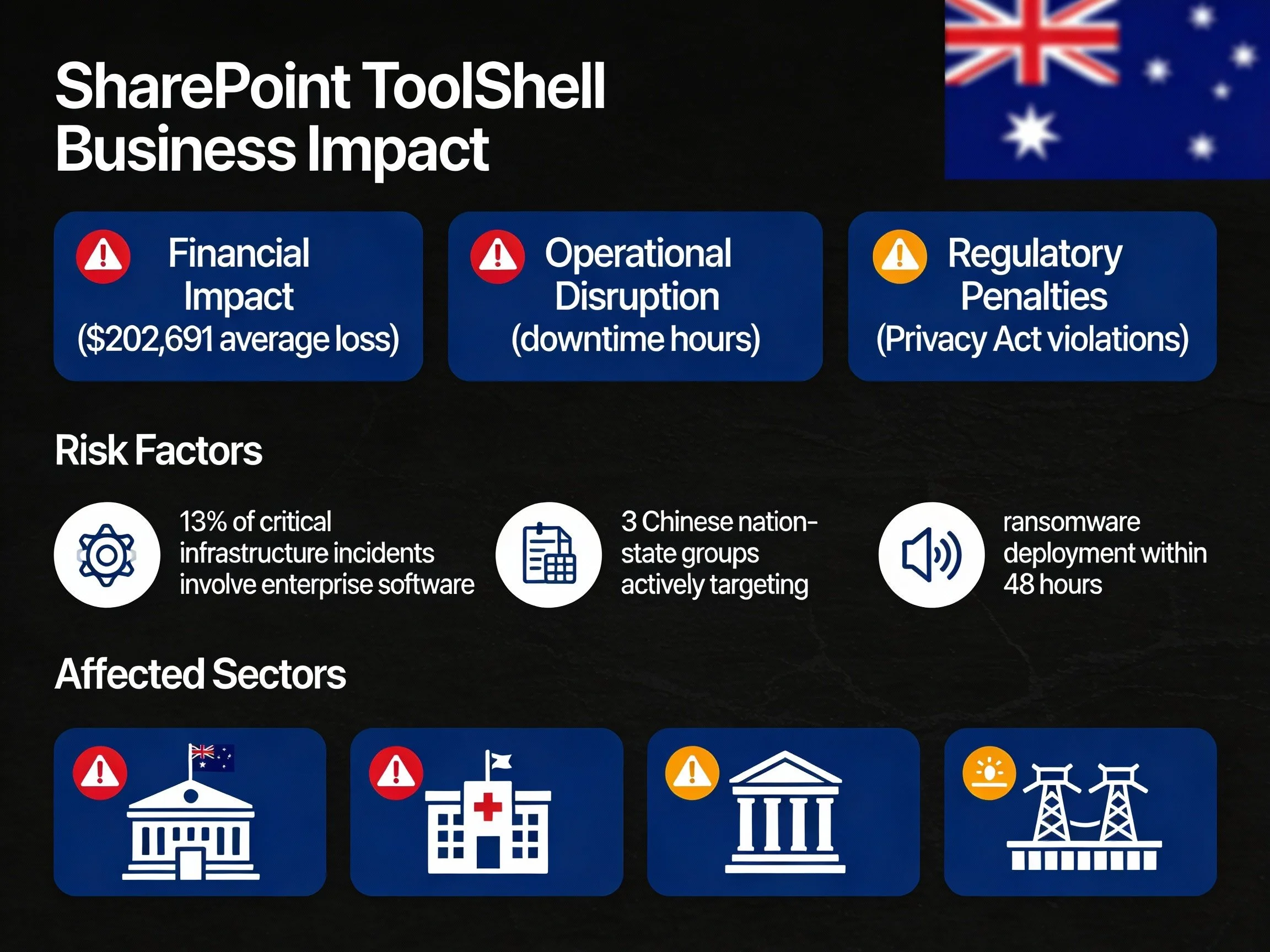
Many Australian enterprises, particularly in government, healthcare, finance, and critical infrastructure, maintain on-premises SharePoint installations for compliance, data sovereignty, or legacy integration reasons. The ACSC has identified these sectors as primary targets, with a significant proportion of critical incidents now involving enterprise collaboration platforms.
Active Targeting by Sophisticated Actors
Exploitation has been linked to multiple nation-state groups alongside criminal ransomware operations. These actors are using ToolShell to gain initial footholds before deploying ransomware and conducting long-term espionage. The same techniques observed against overseas governments and Fortune 500 entities are now being applied to Australian organisations.
Regulatory and Compliance Pressure
With strengthened Privacy Act reforms and higher penalty regimes in force, organisations now face enhanced regulatory scrutiny and potential civil action for serious data breaches. A successful SharePoint compromise exposing customer or employee data can trigger:
- Regulatory investigations under privacy and sector-specific regimes
- Class actions and civil litigation for privacy harms
- Reputational damage impacting customer and investor confidence
The Business Impact of SharePoint Compromise
The consequences extend far beyond the initial server breach. SharePoint’s deep integration with the Microsoft ecosystem turns compromise into an enterprise-wide crisis.
Data Exfiltration and Intellectual Property Theft
Attackers gain immediate access to:
- Confidential business documents and strategic plans
- Financial records, contracts, and payroll data
- Customer databases and personally identifiable information
- Intellectual property and proprietary research
Lateral Movement and Network Propagation
Once inside, threat actors use SharePoint as a beachhead to:
- Harvest credentials and tokens from memory and configuration stores
- Move laterally to domain controllers and line-of-business applications
- Deploy ransomware across file servers and endpoints
- Establish persistent backdoors for long-term access
Operational Disruption and Financial Loss
SharePoint underpins internal collaboration and document workflows. Its compromise can disrupt:
- Day-to-day operations and project delivery
- Customer and supplier communications
- Regulatory reporting and board reporting cycles
- Finance, HR, and procurement processes
For large Australian organisations, the direct financial cost per serious cyber incident typically reaches six figures, excluding long-term brand and trust erosion.
How Attackers Are Exploiting This Flaw
Understanding the attack methodology is critical to appreciating why traditional controls often fail and why penetration testing services wide must simulate this specific threat.
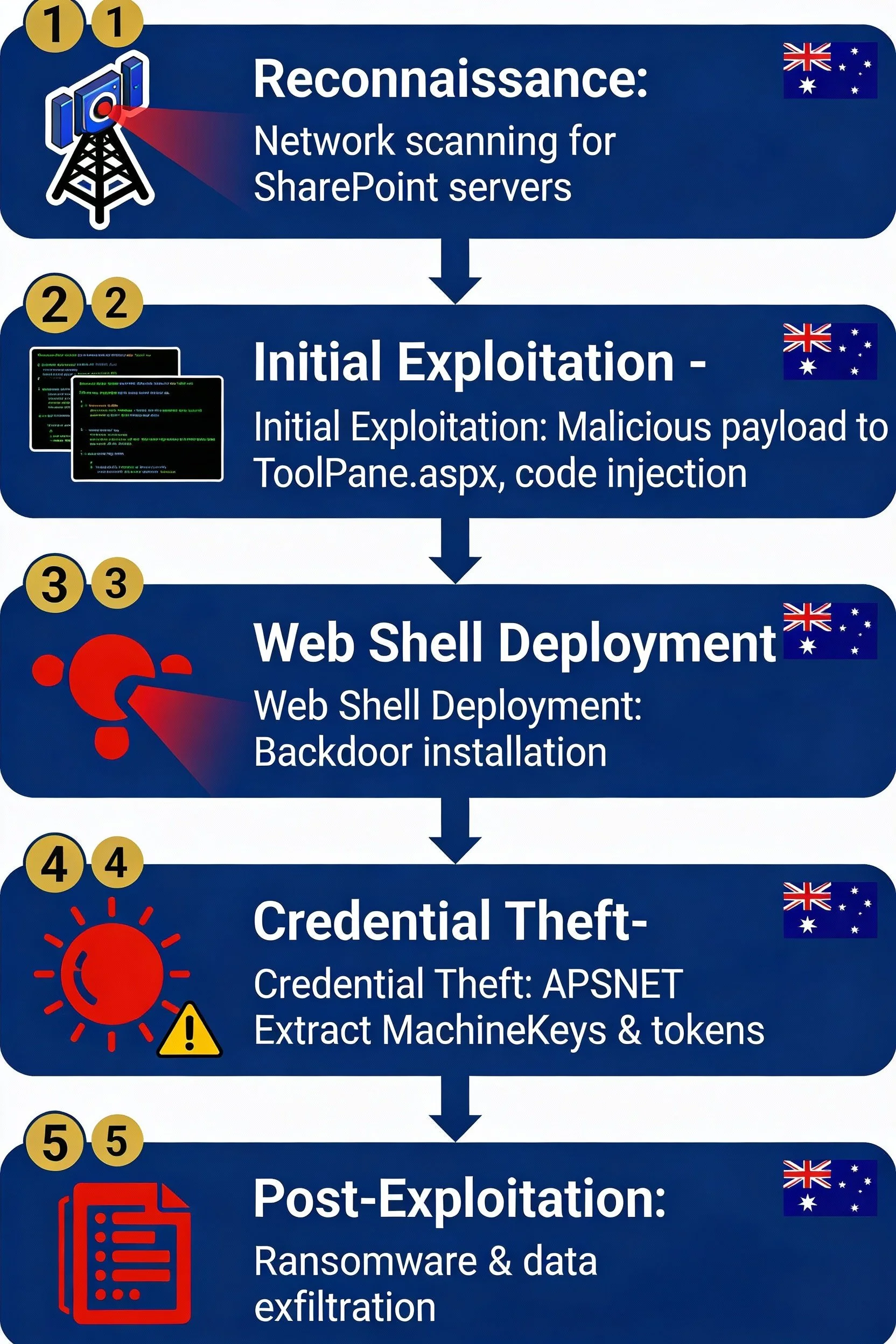
Phase 1: Reconnaissance and Targeting
Attackers conduct wide-scale internet scanning to identify exposed SharePoint endpoints. Target lists are curated to include government, financial services, healthcare, education, and critical infrastructure entities across Australia and the broader region.
Phase 2: Initial Exploitation
The attacker sends a crafted POST request to ToolPane.aspx containing a malicious serialised payload generated with off-the-shelf tooling. This exploits the deserialisation flaw, allowing code execution within the SharePoint worker process—no credentials required.
Phase 3: Web Shell Deployment
Upon successful exploitation, the attacker deploys a web shell (often named similarly to spinstall0.aspx) into the SharePoint layouts directory. This provides persistent, remote command execution over HTTPS, blending into normal traffic.
Phase 4: Credential and Key Theft
From the compromised server, the web shell is used to extract:
- ASP.NET MachineKeys used to sign authentication cookies
- Service account credentials and cached tokens
- Configuration secrets and connection strings
With MachineKeys, attackers can forge valid authentication cookies and maintain access even after passwords are changed.
Phase 5: Post-Exploitation and Ransomware
Finally, actors deploy ransomware, exfiltrate data for double extortion, and pivot into Microsoft 365, Teams, and OneDrive environments where trust relationships are weakly segmented.
Detection Challenges for Internal Security Teams
Many Australian organisations lack the depth of logging, telemetry, and expertise needed to spot ToolShell exploitation in time. This is where targeted external penetration testing and internal penetration testing become critical validation tools.
Evasion Techniques
Attackers deliberately design payloads to evade:
- Signature-based antivirus solutions
- Generic intrusion detection systems
- Baseline log analysis without SharePoint-specific rules
Limited Visibility in Application Layer
Malicious activity executes inside legitimate SharePoint worker processes (w3wp.exe), making it appear as standard application behaviour. Without an application security assessment capability, subtle indicators such as odd PowerShell child processes or unusual file writes are easily missed.
Patch Bypass Capabilities
Perhaps most concerning, ToolShell can bypass earlier security updates when configuration and key rotation steps are mishandled. Organisations that rely solely on patch status reports may believe they are protected while remaining critically exposed.
Why Traditional Security Measures Are Insufficient
The ToolShell crisis exposes fundamental gaps in many organisations’ defensive assumptions.
Vulnerability Scanning vs. Penetration Testing
Standard vulnerability scanners report missing patches but cannot reliably validate exploitability, detect patch bypasses, or assess the end-to-end kill chain. This is the core limitation in the vulnerability assessment vs pen test debate.
Key takeaway: A “green” vulnerability scan report does not mean your SharePoint environment is safe from ToolShell-style attacks.
Limitations of Patch Management Alone
Microsoft’s emergency updates require careful, multi-step implementation:
- Timely installation across all SharePoint instances
- Rotation of cryptographic keys and secrets
- Validation that exploitation attempts are effectively blocked
- Coordination with change management and outage windows
Perimeter Defence Failure
Firewalls, web application firewalls, and IPS often cannot block this attack because it:
- Uses legitimate HTTPS traffic over standard ports
- Targets normal SharePoint endpoints and paths
- Involves encrypted and obfuscated payloads
Key takeaway: Perimeter controls alone are insufficient. Validation via realistic attack simulation is required.
The Critical Role of Penetration Testing
This threat landscape makes it abundantly clear why penetration testing is important. Only adversarial simulation can confirm whether your SharePoint deployment withstands real-world attack techniques.
External Penetration Testing
External penetration testing focused on SharePoint should:
- Identify all internet-exposed SharePoint instances and versions
- Attempt ToolShell exploitation chains in a controlled, safe manner
- Validate patch effectiveness and identify bypass conditions
- Assess how far an attacker can move from SharePoint into the broader network
Internal Penetration Testing
Internal penetration testing then assesses post-exploitation risk, including:
- Privilege escalation paths from SharePoint service accounts
- Detection of credential theft and lateral movement
- Ransomware deployment scenarios
- Effectiveness of monitoring and incident response processes
Red Team Assessment Services
Red team assessment services provide full kill-chain validation by:
- Emulating ToolShell tactics, techniques, and procedures (TTPs)
- Testing SOC detection, triage, and escalation
- Validating containment and eradication procedures
- Delivering board-ready reporting that translates technical findings into business risk
Immediate Actions for Australian Businesses
Organisations should treat this as a 24–48 hour response window. The following checklist can support rapid mitigation.
Emergency Mitigation Checklist
| Action | Priority | Timeline |
|---|---|---|
| Identify all on-premises SharePoint servers | Critical | Within 4 hours |
| Disconnect internet-facing SharePoint servers (where feasible) | Critical | Immediately |
| Apply latest SharePoint security updates | Critical | Within 24 hours |
| Rotate ASP.NET MachineKeys and relevant credentials | High | Within 48 hours |
Hunt for spinstall*.aspx or other suspicious web shells |
Critical | Within 4 hours |
| Review SharePoint IIS logs for exploitation indicators | High | Within 24 hours |
Compromise Assessment
If exploitation is suspected, organisations should:
- Engage incident response specialists immediately
- Preserve forensic images of affected systems
- Analyse web, security, and endpoint logs for anomalous activity
- Assess potential data exfiltration and regulatory notification obligations
Long-Term Security Strategy
Beyond immediate containment, organisations should evolve their security posture to reduce exposure to similar vulnerabilities.
Adopt a Proactive Security Model
- Schedule quarterly external penetration testing of all internet-facing assets
- Conduct annual internal penetration testing focused on identity and lateral movement
- Run biannual red team exercises emulating nation-state-level TTPs
- Maintain continuous vulnerability assessment with exploitability validation
Implement ACSC Essential Eight
Aligning with the ACSC Essential Eight maturity model strengthens resilience against similar attacks by improving patching, access control, application hardening, and backup practices.
Cloud Migration Considerations
Because ToolShell affects on-premises SharePoint only, organisations should reassess platform strategy:
- Evaluate feasibility of migrating workloads to SharePoint Online
- Review data sovereignty and compliance requirements in the Australian context
- Budget for cloud penetration testing and post-migration security assessments
Conclusion: Act Now or Pay Later
The ToolShell vulnerability represents a clear and present danger to Australian organisations running on-premises SharePoint. With sophisticated actors actively compromising systems and deploying ransomware, the question is not whether you are on a target list, but whether your defences will hold.
Penetration testing services Australia wide must now treat SharePoint exploitation testing as a standard component of every engagement. The cost of a focused application security assessment is minor compared to the financial, legal, and reputational impact of a significant data breach.
Key takeaway for boards and CISOs: Do not rely on patch status alone. Only realistic, threat-informed testing of your SharePoint environment will provide assurance that ToolShell-style attacks are effectively mitigated.
Secure Your SharePoint Environment Today
Our Australian penetration testing team specialises in adversarial simulation of emerging threats like ToolShell. We provide:
- Emergency SharePoint compromise assessments
- ToolShell exploitation testing and patch validation
- Comprehensive red team exercises emulating nation-state techniques
- Board-level reporting that clearly articulates business risk and remediation priorities
- 24/7 incident response support for active and suspected intrusions
Call to action: Contact our security specialists today to schedule an urgent assessment of your SharePoint environment. Validate your defences before an attacker validates them for you.

Weekly Threat Briefing: Automation Platforms Under Siege & The Rise of AI Jailbreaks (11 Jan 2026)
Welcome to this week's threat briefing. As we settle into 2026, the Australian cyber landscape is already heating up with critical exploits targeting the very automation tools that drive our efficiency. From unauthenticated remote code execution in popular workflow platforms to the industrialisation of AI jailbreaking, this week has highlighted that "set and forget" is no longer a viable security strategy.
Welcome to this week's threat briefing. As we settle into 2026, the Australian cyber landscape is already heating up with critical exploits targeting the very automation tools that drive our efficiency. From unauthenticated remote code execution in popular workflow platforms to the industrialisation of AI jailbreaking, this week has highlighted that "set and forget" is no longer a viable security strategy.
Here is your deep dive into the threats shaping the last 7 days.
Critical Vulnerability Spotlight: The n8n RCE
The most alarming development this week (8 Jan 2026) is the discovery of a critical unauthenticated Remote Code Execution (RCE) vulnerability in the n8n workflow automation platform (tracked as CVE-2026-21858).
- The Risk: n8n is widely used by SaaS providers and tech-forward organisations to glue together APIs and services. This vulnerability allows an attacker to execute arbitrary code on the host server without needing to log in.
- Impact: For organisations using n8n to orchestrate sensitive data flows (e.g., connecting CRM data to billing systems), a compromise here effectively hands over the keys to your entire API ecosystem.
- Action: If you run self-hosted instances of n8n, patch immediately. Isolate these instances from the public internet where possible.
Sector-Specific Threat Analysis
SaaS & APIs: The Gateway Under Fire
Following the n8n disclosure, the IBM API Connect platform also came under scrutiny this week. On 6 January, warnings were issued regarding a critical vulnerability (CVE-2025-13915) that is now being actively probed.
- Observation: We are seeing a shift where attackers are moving away from brute-forcing front doors and instead targeting the "middleware" and API gateways that manage trust.
- Advice: Review your API gateway logs for anomalous traffic patterns, specifically inspecting for injection attempts in header fields.
Retail & FinTech: The Initial Access Bazaar
A new report released this week by Cyble on the ANZ Threat Landscape has revealed a disturbing trend for 2026: Retail organisations now account for 34% of all Initial Access Broker (IAB) sales, followed closely by the Banking, Financial Services, and Insurance (BFSI) sector.
- The Threat: Cybercriminals are not just stealing credit cards; they are selling "footholds" into corporate networks.
- Actor Profile: The threat group "Warlock" has been identified as a key player, leveraging unpatched on-premises SharePoint vulnerabilities to establish persistence before selling access to ransomware affiliates.
Healthcare: Data Rich, Security Poor
While no massive new breach was declared this specific week, intelligence indicates that the Morpheus ransomware group is actively re-tooling to target healthcare interoperability standards (like FHIR APIs). The digitisation of patient records remains a double-edged sword; ensure your third-party integrations are strictly scoped.
Government: The Scam Relocation
The Australian Cyber Security Centre (ACSC) and regional partners have tracked a significant movement of organised scam syndicates. As of 5 January, intelligence suggests these groups are relocating operations from Myanmar to Cambodia (specifically Malai province).
- Relevance: Expect a new wave of highly sophisticated, socially engineered "pig butchering" scams targeting Australian government employees and contractors. These often begin via innocuous messages on encrypted messaging apps.
Emerging Tech: AI Systems & The "Storm"
The intersection of AI and cybersecurity is no longer theoretical. The threat actor tracked as Storm-2139 continues to demonstrate capability in "AI Jailbreaking".
- Method: By compromising Azure OpenAI accounts via stolen credentials, they are modifying guardrails to generate illicit content and bypass safety filters.
- Corporate Risk: If your organisation relies on "wrapper" applications around LLMs, be aware that attackers are actively looking for prompt injection vulnerabilities to manipulate your AI's output or exfiltrate data.
IoT & Infrastructure: WatchGuard Exploitation
Finally, reports from late December into this week confirm active exploitation of WatchGuard Firebox devices (CVE-2025-14733). These edge devices are often the first line of defence; if unpatched, they become the attacker's beachhead.
Summary & Recommendations
The theme for January 2026 is clear: Interconnectivity is the vulnerability. Whether it is an automation tool like n8n, an API gateway, or a third-party vendor access point, the "glue" holding your stack together is under attack.
Immediate Priorities:
- Patch n8n and IBM API Connect instances immediately.
- Audit specific egress traffic from your automation servers—they should only talk to known endpoints.
- Refresh anti-phishing training for staff regarding "relationship" scams (pig butchering), particularly in government and defence sectors.
Contact us for a quote for penetration testing service or adversary simulation.

Daily Threat Briefing: Australia - 10 January 2026
The last 24 hours have seen a significant escalation in automated attacks targeting Australian infrastructure, with a marked pivot towards exploiting API logic flaws and AI-integrated systems. Our threat intelligence analysts have observed a coordinated campaign targeting the Healthcare and FinTech sectors, alongside persistent probing of Government IoT endpoints. Below is a detailed analysis of the critical threats observed on 9–10 January 2026.
Overview
The last 24 hours have seen a significant escalation in automated attacks targeting Australian infrastructure, with a marked pivot towards exploiting API logic flaws and AI-integrated systems. Our threat intelligence analysts have observed a coordinated campaign targeting the Healthcare and FinTech sectors, alongside persistent probing of Government IoT endpoints. Below is a detailed analysis of the critical threats observed on 9–10 January 2026.
Sector-Specific Threat Analysis
1. Healthcare: IoMT API Vulnerability Exploited We have detected active exploitation of a newly disclosed vulnerability in a widely used HL7 interface engine, commonly utilised by Australian hospitals to connect Internet of Medical Things (IoMT) devices.
- The Threat: Threat actors are leveraging Broken Object Level Authorization (BOLA) flaws in the API to access patient telemetry data directly from bedside monitors.
- Impact: Privacy breaches of sensitive patient data and potential manipulation of device alert thresholds.
- Action: Healthcare organisations must review API gateway configurations and enforce strict rate limiting and authentication checks immediately.
2. FinTech: AI-Driven "DeepVoice" Vishing A sophisticated social engineering campaign is targeting Australian neo-banks and wealth management firms.
- The Threat: Attackers are using AI-generated voice clones (Deepfakes) of C-level executives to authorise fraudulent high-value transfers. These attacks are bypassing traditional voice biometric authentication methods used in telephone banking.
- Impact: Significant financial loss and reputational damage.
- Action: Implement multi-factor authentication (MFA) that does not rely solely on voice or SMS, such as FIDO2 hardware tokens, for high-value transactions.
3. SaaS & Cloud Providers: "Shadow AI" Exfiltration Our telemetry indicates a surge in attacks targeting unmanaged AI development environments hosted on AWS and Azure.
- The Threat: Developers are inadvertently exposing API keys and training datasets in public repositories. Adversaries are scanning for these "Shadow AI" instances to inject malicious prompts (Prompt Injection) to exfiltrate proprietary code and customer data.
- Impact: Intellectual property theft and compromise of downstream SaaS applications.
- Action: SaaS providers should audit their cloud environments for unauthorised AI model deployments and enforce strict egress filtering.
4. eCommerce: Headless Commerce API Skimming Australian retail platforms utilising headless commerce architectures are under attack.
- The Threat: Attackers are injecting malicious JavaScript into third-party API integrations (e.g., "Buy Now, Pay Later" widgets) to skim credit card data before it is tokenised.
- Impact: Customer financial data theft (Magecart-style evolution).
- Action: Implement Content Security Policy (CSP) headers rigorously and utilise Subresource Integrity (SRI) for all third-party scripts.
5. Education / EdTech: Learning Management System (LMS) Ransomware Several Australian tertiary institutions have reported disrupted access to LMS platforms in the last 12 hours.
- The Threat: A new ransomware strain is targeting vulnerabilities in third-party plugins within popular LMS ecosystems. The attack vector involves uploading a malicious payload disguised as a course assignment file.
- Impact: Disruption of summer semester coursework and student data encryption.
- Action: Disable unused plugins and enforce strict file type validation on all upload endpoints.
6. Government: Critical Infrastructure IoT Scanning The Australian Cyber Security Centre (ACSC) context suggests heightened scanning activity from state-sponsored actors targeting legacy IoT sensors in water and energy sectors.
- The Threat: Exploitation of default credentials in older SCADA-connected IoT gateways.
- Impact: Potential for operational technology (OT) disruption.
- Action: Isolate OT networks from the public internet and rotate all default credentials immediately.
Emerging Vulnerabilities & Technical Focus
- API Security (BOLA/IDOR): The dominant vector this week. Automated tools are rapidly identifying endpoints that lack proper authorisation checks for accessing resource IDs.
- AI System Poisoning: We are observing the first "in-the-wild" attempts to poison RAG (Retrieval-Augmented Generation) databases, causing internal AI chatbots to serve malicious links to employees.
Conclusion
The threat landscape in Australia is evolving rapidly, with AI and APIs becoming the primary battleground. Organisations must move beyond traditional perimeter defences and adopt a "verify explicitly" approach to all API traffic and AI interactions.
Contact us for a quote for penetration testing service or adversary simulation.

Daily Threat Briefing: MongoBleed, DFAT Data Exposure, and Critical SaaS Vulnerabilities
The first week of 2026 has concluded with a flurry of critical alerts, creating a high-pressure environment for Australian security teams. Over the last 24 hours, the threat landscape has been dominated by a significant memory leak vulnerability in a widely used database system, a high-profile government disclosure, and critical flaws in automation platforms.
The first week of 2026 has concluded with a flurry of critical alerts, creating a high-pressure environment for Australian security teams. Over the last 24 hours, the threat landscape has been dominated by a significant memory leak vulnerability in a widely used database system, a high-profile government disclosure, and critical flaws in automation platforms.
For organisations in Healthcare, FinTech, and Government, the message is clear: the attack surface is expanding, and unauthenticated access remains a primary vector. Here is your deep dive into the threats shaping today’s security posture.
Healthcare & eCommerce: The "MongoBleed" Crisis (CVE-2025-14847)
The most urgent threat for the Healthcare and eCommerce sectors today is the active exploitation of CVE-2025-14847, colloquially dubbed "MongoBleed." This critical unauthenticated memory leak vulnerability affects MongoDB servers, a core component for many patient record systems and online inventory platforms.
- The Threat: Attackers can read fragments of the server's memory without credentials.
- Impact: For Healthcare providers, this risks the exposure of unstructured patient data (PII/PHI) in real-time. eCommerce platforms face the leakage of customer session tokens and payment fragments.
- Status: Active exploitation has been observed in the wild. Immediate patching and memory analysis are required.
Government: DFAT Vulnerability & Ethical Hacking Win
In the government sector, a significant security gap within the Department of Foreign Affairs and Trade (DFAT) was brought to light. In a rare positive turn, this "critical vulnerability" was responsibly disclosed by ethical hacker Jacob Riggs rather than being exploited by nation-state actors.
While the flaw could have exposed sensitive diplomatic data, this incident underscores the immense value of Vulnerability Disclosure Programs (VDPs) for public sector resilience. Agencies are urged to accelerate VDP adoption to catch these gaps before adversaries do.
SaaS & FinTech: Critical Automation & API Flaws
Two major vulnerabilities have surfaced affecting the SaaS and FinTech sectors, highlighting the risks in our interconnected digital supply chains:
n8n Workflow Automation (CVE-2026-21858): Alerted just yesterday (08 January), a Critical Unauthenticated Remote Code Execution (RCE) vulnerability has been discovered in the n8n workflow automation platform. This flaw (CVSS 10.0) allows attackers to execute arbitrary code via form-based workflows.
- Risk: SaaS providers and FinTech firms using n8n for backend automation are at immediate risk of full server compromise.
IBM API Connect (CVE-2025-13915): A new Authentication Bypass vulnerability has been identified in IBM API Connect. For FinTech organisations relying on this gateway for secure transaction processing, this flaw could allow unauthorised access to backend APIs, bypassing standard security controls.
AI Systems & IoT: Emerging Vectors
- AI Systems: We are tracking a code injection vulnerability in Langflow (CVE-2025-3248), an AI development tool. As EdTech and SaaS platforms increasingly integrate AI agents, this flaw presents a novel entry point for attackers to hijack model behaviour.
- IoT Infrastructure: The WatchGuard Firebox vulnerability (CVE-2025-14733) remains under active exploitation. Threat actors are leveraging this to gain initial access to corporate networks, often serving as a beachhead for ransomware deployment.
Strategic Advice
The recurring theme of these last 24 hours is unauthenticated access. Whether it is the memory leak in MongoDB or the RCE in n8n, attackers are bypassing the "front door" entirely. We recommend all Australian organisations prioritise external attack surface management (EASM) scans today to identify exposed instances of these affected technologies.
Contact us for a quote for penetration testing service or adversary simulation.