

Daily Threat Briefing: Russian Sanctions, Defence Supply Chain Breaches & The Zero-Day Surge
The last 24 hours have seen a significant escalation in the Australian cyber threat landscape. The Federal Government has moved from defence to offence with landmark sanctions against Russian cybercrime infrastructure, while the private sector grapples with active zero-day exploitation across major enterprise platforms. From defence contractors to healthcare providers, no sector has been left untouched this week.
Here is your deep dive into the threats shaping the Australian cyber environment today.
Executive Summary
The last 24 hours have seen a significant escalation in the Australian cyber threat landscape. The Federal Government has moved from defence to offence with landmark sanctions against Russian cybercrime infrastructure, while the private sector grapples with active zero-day exploitation across major enterprise platforms. From defence contractors to healthcare providers, no sector has been left untouched this week.
Here is your deep dive into the threats shaping the Australian cyber environment today.
Top Story: Government Strikes Back at "Bulletproof" Hosters
In a coordinated effort with the US and UK, the Australian Government has imposed financial sanctions and travel bans on two Russian entities—Media Land LLC and ML. Cloud LLC—and their operators. These entities are accused of providing "bulletproof hosting" services that act as the backbone for ransomware gangs and phishing campaigns targeting Australian critical infrastructure.
- Impact: This marks a shift in strategy, targeting the supply chain of cybercriminals themselves.
- Observation: Expect potential retaliatory DDoS or low-level disruptions from pro-Russian hacktivist auxiliaries in the coming days.
Critical Vulnerability Alert: The "Zero-Day Blitz"
A flurry of critical vulnerabilities has been weaponised in the wild over the last 24 hours. Security teams must prioritise the following patches immediately:
- Citrix NetScaler (CVE-2025-5777): Dubbed "Citrix Bleed 2," this critical flaw is being exploited by advanced threat actors to bypass authentication.
- Fortinet FortiWeb (CVE-2025-58034 & CVE-2025-64446): Active exploitation is confirmed for these Command Injection and Authentication Bypass vulnerabilities. Attackers are executing malicious code via crafted HTTP requests.
- Windows Kernel (CVE-2025-62215): A local Elevation of Privilege (EoP) zero-day allows attackers with low-level access to gain SYSTEM privileges. This is a key component in current ransomware kill chains.
- Cisco ISE (CVE-2025-20337): Exploited as a zero-day to deploy custom malware.
Recommendation: Immediate patching is non-negotiable. If patching is not possible for Citrix or Fortinet appliances, isolate them from the public internet immediately.
Sector Watch
🛡️ Defence & Government
The "soft underbelly" of the defence supply chain has been exposed. IKAD Engineering, a naval contractor involved in the Hunter Class frigate and Collins Class submarine programs, confirmed a breach where threat actors maintained access for five months.
- Threat Actor: The J Group ransomware gang.
- Lesson: Third-party risk management is critical. Even non-classified environments can reveal sensitive operational context to adversaries.
🏥 Healthcare
Australian healthcare continues to bleed data.
- DBG Health: The Morpheus ransomware group has claimed responsibility for a significant breach, leaking employee passport scans and patient data.
- Spectrum Medical Imaging: Targeted by INC Ransom, exfiltrating financial and medical records.
- Sydney Centre for Ear, Nose & Throat: Currently notifying patients of a compromised email account leading to data exposure.
🎓 Education
Western Sydney University (WSU) has confirmed a major data breach spanning from June to September 2025. Attackers accessed Tax File Numbers (TFNs) and health information, highlighting the persistence of threat actors within academic networks before detection.
💰 FinTech & SaaS
ASIC has officially declared cyber resilience a top enforcement priority for 2025. This comes as financial institutions report a surge in AI-powered phishing.
- Emerging Tactic: Attackers are using generative AI to craft hyper-realistic phishing lures that bypass traditional "bad grammar" detection filters, specifically targeting SaaS administrators to hijack API keys.
Emerging Tech Threat: Mobile Spyware
A sophisticated commercial spyware campaign dubbed "LANDFALL" has been uncovered targeting Samsung Galaxy devices.
- Vector: The malware exploits a zero-day in Samsung’s image-processing library (CVE-2025-21042) via malicious WhatsApp image files.
- Target: High-value individuals in corporate and government sectors.
Actionable Advice for the Weekend
- Audit External Attack Surface: With the Citrix and Fortinet flaws active, scan your public-facing IP space for exposed administrative interfaces.
- Review Vendor Access: The IKAD Engineering breach is a reminder to audit the privileges of third-party contractors.
- Brief Staff on AI Phishing: Remind employees that impeccable grammar and personalisation are no longer proof of legitimacy in emails.
Contact us for a quote for penetration testing service or adversary simulation.

Daily Threat Briefing: Defence Supply Chain Sieged, Russian Hosts Sanctioned & Critical Fortinet Zero-Days
The Australian cyber threat landscape has intensified over the last 24 hours with significant geopolitical moves and critical infrastructure attacks. The Federal Government, in coordination with the US and UK, has officially sanctioned Russian "bulletproof" hosting providers facilitating ransomware campaigns against Australian targets. Meanwhile, the defence supply chain is under scrutiny following a confirmed breach at a major naval contractor, and network defenders are racing to patch actively exploited zero-days in Fortinet and Citrix appliances.
Here is your daily deep dive into the threats shaping our digital environment.
Executive Summary The Australian cyber threat landscape has intensified over the last 24 hours with significant geopolitical moves and critical infrastructure attacks. The Federal Government, in coordination with the US and UK, has officially sanctioned Russian "bulletproof" hosting providers facilitating ransomware campaigns against Australian targets. Meanwhile, the defence supply chain is under scrutiny following a confirmed breach at a major naval contractor, and network defenders are racing to patch actively exploited zero-days in Fortinet and Citrix appliances.
Here is your daily deep dive into the threats shaping our digital environment.
Sector Intelligence
Government & Defence: Supply Chain in the Crosshairs
The most critical update today involves IKAD Engineering, a key contractor for the Hunter Class frigate and Collins Class submarine programs. The J Group ransomware gang has claimed responsibility for a breach, alleging they maintained undetected access for five months—a "staycation in the defence supply chain"—before exfiltrating 800GB of data. While IKAD states no classified data was lost, this highlights a severe visibility gap in third-party risk management.
Simultaneously, the Australian Government has imposed sanctions on Media Land LLC and ML.Cloud, along with key individuals Aleksandr Volosovik and Kirill Zatolokin. These entities are accused of providing the backend infrastructure for ransomware groups like Qilin and Medusa, which have relentlessly targeted Australian schools and hospitals this year.
- Threat Actor Watch: Volt Typhoon (China-nexus) continues to probe Australian critical infrastructure, specifically telecommunications and energy grids, likely for pre-positioning rather than immediate disruption.
SaaS & Cloud Providers: The Fortinet Crisis
SaaS providers and enterprises using Fortinet FortiWeb WAFs must act immediately. A critical vulnerability (CVE-2025-64446) is being actively exploited in the wild. This path traversal flaw allows unauthenticated attackers to create administrative accounts via the API, effectively handing over full control of the device.
- Impact: Full device compromise, potential lateral movement into cloud environments.
- Status: CISA has mandated US federal agencies patch this by today, 21 November 2025. Australian organisations should follow suit immediately.
Healthcare: Relentless Ransomware
Healthcare remains the most targeted sector in 2025, accounting for 17% of all significant cyber incidents. The sanctions against Russian hosting firms are a direct response to attacks on this sector, but operational risks remain high. Hospitals are advised to review their exposure to the Citrix NetScaler zero-day (CVE-2025-5777), which is currently being used to deploy ransomware payloads.
FinTech & DeFi: Smart Contract Failures
The decentralised finance (DeFi) sector has seen over $3.1 billion in losses this year. In the last 24 hours, analysis has surfaced regarding the Abracadabra protocol hack ($1.8m loss), caused by a state management flaw in a smart contract. For Australian FinTechs, this reinforces the need for rigorous code audits and formal verification before deployment, especially as high-speed chains like Solana gain traction.
IoT & Mobile: Commercial Spyware
A sophisticated spyware campaign dubbed "LANDFALL" has been uncovered targeting Samsung Galaxy devices. It exploits a zero-day in the image-processing library (CVE-2025-21042). The malware is delivered via malicious DNG files on WhatsApp, affecting high-profile targets in the corporate and government sectors.
Vulnerability Watch: Critical Exploits
We are tracking the following vulnerabilities actively exploited in the Australian wild:
Fortinet FortiWeb (CVE-2025-64446)
- Type: Path Traversal / Auth Bypass.
- Severity: Critical (CVSS 9.8).
- Action: Update to version 8.0.2+ immediately. If patching is impossible, disable the management interface on public-facing IPs.
Windows Kernel (CVE-2025-62215)
- Type: Privilege Escalation.
- Severity: High.
- Context: Actively used by attackers to gain SYSTEM privileges after initial foothold (often via phishing).
Fortinet FortiWeb (CVE-2025-58034)
- Type: OS Command Injection.
- Severity: Critical.
- Context: Often chained with the auth bypass above to execute arbitrary code.
Pen Tester’s Perspective: The Rise of "Agentic" Threats
By Lean Security
The breach of IKAD Engineering is a textbook example of why perimeter defences are insufficient. The attackers didn't just smash and grab; they dwelt. They understood the network better than the administrators.
Furthermore, we are seeing a shift towards Agentic AI in offensive operations. Automated agents are now capable of chaining vulnerabilities (like the Fortinet auth bypass followed by command injection) at machine speed, drastically reducing the "time-to-compromise."
Recommendation: Organisations must move beyond annual compliance checks.
- Simulate the Supply Chain Breach: Don't just test your perimeter; test your reaction when a trusted vendor is compromised.
- API Security: The Fortinet exploit targeted an API endpoint. Ensure your API security testing covers logic flaws and authorisation bypasses, not just standard injections.
- Hunt for Persistence: If you run FortiWeb, assume compromise. Check logs for new, unrecognised admin accounts created in the last 30 days.
Contact us for a quote for penetration testing service or adversary simulation.

Australia Cyber Threat Update: Bulletproof Hosting Crackdown & Critical Fortinet/Cisco Exploits
Australia faces a crackdown on bulletproof hosting and active exploitation of critical Fortinet & Cisco vulnerabilities. Learn to protect your organization from these urgent cyber threats.
Executive Summary
The Australian cyber threat landscape for the last 24 hours has been dominated by a coordinated international response to resilient cybercrime infrastructure and the escalation of attacks against edge devices. The Australian Signals Directorate’s Australian Cyber Security Centre (ASD’s ACSC), in conjunction with global partners (CISA, FBI, NCSC-UK), released pivotal guidance yesterday targeting "Bulletproof Hosting" providers. Meanwhile, critical vulnerabilities in Fortinet and Cisco appliances are seeing active exploitation, posing severe risks to Australian organisations relying on these perimeter defence technologies.
Top Strategic Development: Crackdown on Bulletproof Hosting
Sectors Impacted: Government, FinTech, Critical Infrastructure
In a major release on 19 November 2025, the ACSC joined international agencies to publish "Bulletproof Defense: Mitigating Risks From Bulletproof Hosting Providers." Bulletproof hosting (BPH) services are the backbone of the cybercrime economy, allowing ransomware gangs and phishing operators to host malicious content with impunity.
- The Threat: BPH providers knowingly ignore abuse complaints and facilitate high-volume phishing campaigns and C2 (Command and Control) infrastructure.
- Action Required: Australian network defenders and ISPs are urged to review the new guidance to identify and block traffic to and from known BPH IP ranges. This is a critical step for Government and FinTech sectors to reduce the attack surface for ransomware and fraud.
Critical Vulnerabilities Under Active Exploitation
Organisations using web application firewalls (WAFs) and secure gateways must urgently review the following exploits highlighted in the last 24 hours:
1. Fortinet FortiWeb – Critical Authentication Bypass
- CVE: CVE-2025-64446 (CVSS 9.1)
- Status: Active Exploitation Confirmed (Added to CISA KEV on 14 Nov 2025, widely targeted in the last 24 hours).
- Impact: This critical vulnerability allows unauthenticated remote attackers to bypass authentication and gain administrative control over FortiWeb appliances.
- Relevance: High risk for SaaS providers and eCommerce platforms using FortiWeb to protect customer data.
- Recommendation: Patch immediately. If patching is not possible, restrict management interface access to trusted internal IPs only.
2. Cisco ASA & FTD – State-Sponsored Targeting
- CVEs: CVE-2025-20333 (CVSS 9.9) and CVE-2025-20362
- Threat Actor: Linked to UAT4356/Storm-1849 (State-sponsored activity).
- Context: Despite patches being available, telemetry indicates approximately 48,000 appliances globally remain unpatched. Threat actors are chaining these vulnerabilities to establish persistent footholds in corporate networks.
- Sector Risk: Government and Education networks are frequent targets for this type of espionage-focused campaign.
3. WatchGuard Firebox & IoT Risks
- Observation: Security researchers have identified over 54,000 exposed WatchGuard Firebox devices as of mid-November 2025.
- IoT Threat: A new botnet is aggressively recruiting end-of-life GeoVision devices.
- Takeaway: IoT and edge security remains a weak point. Organisations with distributed branches (e.g., Healthcare clinics, retail chains) must audit their perimeter footprint for unmanaged or end-of-life devices.
Sector-Specific Threat Intelligence
- Healthcare: Following the trend of high-impact ransomware attacks (such as the MediSecure incident earlier in the decade), the sector remains a priority target. The new BPH guidance is crucial here—blocking BPH infrastructure can prevent the initial callback of ransomware payloads often used against hospitals.
- Education (EdTech): With the academic year wrapping up, schools and universities are facing increased phishing attempts disguised as administrative notices. The exploitation of Cisco VPN vulnerabilities is a specific vector being used to penetrate university research networks.
- FinTech: A new alert from the ACSC (13 Nov 2025) regarding scammers impersonating police to steal cryptocurrency remains highly relevant. FinTech platforms should warn users about this social engineering tactic, which often involves "urgent" requests to move funds to "safe" wallets.
Penetration Tester’s Perspective
From an offensive security standpoint, the current environment is volatile. Attackers are moving faster than defenders can patch. The FortiWeb bypass (CVE-2025-64446) is particularly dangerous because it compromises the very device meant to secure your web applications.
During our recent engagements, we have observed that API security remains a blind spot. With the rise of AI-driven attacks, automated scripts are now capable of probing APIs for logic flaws much faster than human analysts. Ensure your APIs are not just behind a WAF, but also rigorously tested for Broken Object Level Authorisation (BOLA) and other logic vulnerabilities.
Contact us for a quote for penetration testing service or adversary simulation.

CISA Alert: LANDFALL Spyware Hits Australian BYOD Devices
A zero-click vulnerability, CVE-2025-21042, in millions of Samsung devices is being actively exploited to install "LANDFALL," a commercial-grade spyware. This threat, now on CISA's KEV catalog , transforms an executive's personal device into a silent corporate surveillance tool, completely bypassing your MDM and EDR. For Australian organisations with BYOD policies, this is a critical, reportable data breach scenario under the NDB scheme.
Understanding the Threat: CVE-2025-21042 and the LANDFALL Spyware
For Australian CISOs and IT Directors, the enterprise perimeter no longer ends at the firewall. It ends in the pockets of your C-suite. The recent CISA alert for CVE-2025-21042 has elevated a theoretical risk into an actively exploited reality, with profound implications for Australian businesses.
This isn't a minor consumer-grade bug. This is a supply chain-style compromise of your most trusted, high-value assets: your executive team.
What is CVE-2025-21042?
Tracked as CVE-2025-21042, this is a critical (CVSS 8.8-9.8) out-of-bounds write vulnerability in a core image processing library (libimagecodec.quram.so) on a vast range of high-end Samsung Galaxy devices.
Its primary vector is a "zero-click" exploit. This is the apex predator of vulnerabilities. An attacker simply sends a specially crafted Digital Negative (DNG) image file via a messaging app like WhatsApp. The victim does not need to open the image, click a link, or interact in any way. The device's operating system processes the image preview, triggering the vulnerability and leading to remote code execution (RCE) with system-level privileges.
The Payload: "LANDFALL" Commercial-Grade Spyware
The vulnerability is merely the delivery mechanism. The payload, dubbed "LANDFALL," is a sophisticated, modular, commercial-grade spyware framework engineered for one purpose: total surveillance.
Research from Palo Alto Networks' Unit 42 confirms LANDFALL grants attackers complete control. Its capabilities include:
Audio Surveillance: Recording all microphone audio and phone calls, silently capturing board meetings, legal discussions, and M&A strategy sessions.
Data Exfiltration: Stealing all photos, contacts, SMS messages, and call logs.
Location Tracking: Continuous, real-time monitoring of the victim's movements.
Stealth and Persistence: LANDFALL is designed to evade detection and maintain access even after reboots, giving attackers a persistent foothold.
This toolkit is not the work of common criminals; it's associated with Private-Sector Offensive Actors (PSOAs)—mercenary groups that sell these capabilities to the highest bidder for corporate and state-level espionage.
Business Impact Analysis: The Australian BYOD Liability
This vulnerability was actively exploited for at least seven months (from July 2024 to February 2025) before Samsung's patch in April 2025. On November 10, 2025, CISA added it to the Known Exploited Vulnerabilities (KEV) catalog, mandating a fix by December 1 for federal agencies—a clear signal of its severity and active threat status.
For Australian leaders, this presents a catastrophic governance failure.
Your Executive's Pocket: The New Attack Surface
In Australia, Samsung holds over 25% of the mobile market , with over 9 million users. Many of these are the exact flagship Galaxy S22, S23, S24, and Z Fold devices targeted by this exploit.
In a corporate BYOD (Bring Your Own Device) environment, that personal phone is a trusted endpoint. It is used to check corporate email, access the VPN, join Teams/Zoom calls, and review sensitive documents. When compromised by LANDFALL, that device becomes a vector for a devastating corporate data breach. The ACSC has long warned that BYOD introduces new risks that require careful consideration and risk management, which this exploit directly targets.
A Corporate Data Breach on a Personal Device
The compromise of an executive's phone is not a personal matter. The exfiltration of corporate data (e.g., strategic plans, financial forecasts, client data) from that device is a clear-cut "eligible data breach" under the Office of the Australian Information Commissioner's (OAIC) Notifiable Data Breaches (NDB) scheme.
Your organisation is legally required to assess and report this breach. This introduces severe complications:
Legal Liability: How can you prove what data was not taken? The "employee records exemption" does not apply to the sensitive corporate data, client PII, or market-sensitive information discussed in a board meeting recorded by the spyware.
Reputational Damage: A breach originating from your C-suite's devices signals a fundamental failure of security and governance.
Detection Failure: The most critical question is: How would you even know?
Why Your MDM and EDR Are Blind to This Threat
This is the gap that PSOAs and LANDFALL exploit. Australian CISOs investing in robust security stacks are being failed by a critical blind spot.
Mobile Device Management (MDM): MDM and Unified Endpoint Management (UEM) solutions are governance tools, not security tools. They are designed to enforce policies, push patches, and wipe lost devices. On a BYOD device, their visibility is intentionally limited by employee privacy concerns. An MDM cannot inspect an image parsing library in real-time. It can only (slowly) report if the device is patched, which is useless against a zero-day exploit.
Endpoint Detection & Response (EDR): Your EDR is on the corporate laptop, not the executive's personal phone.
Network Monitoring: The exploit occurs on the device itself. The exfiltrated data is siphoned off over HTTPS on non-standard ports , blending in with thousands of other app connections from a mobile device, making it invisible to traditional network firewalls.
For seven months, this vulnerability was a zero-day. Patching was not an option. Detection was the only possible defence. Your stack was blind, and you were exposed.
How Red Teaming Exposes This Vulnerability
A standard penetration test will check if your external-facing servers are patched. It will not tell you if you could withstand a LANDFALL-style attack.
This threat requires an adversary-centric approach. Our red team engagements move beyond simple vulnerability scanning to simulate the tactics, techniques, and procedures (TTPs) of the PSOAs behind this attack.
Simulating the Mobile-Originated Breach Scenario
We answer the one question your board should be asking: "Can we detect and respond to a zero-click compromise of our executive team?"
A standard pen test checks a list of known vulnerabilities. Our mobile-originated red team engagement simulates the entire attack chain:
Targeted Reconnaissance: We identify high-value targets (e.g., C-suite, finance, legal) and their specific devices, just as a real attacker would.
Adversary Emulation: We emulate the TTPs of an actor like the one deploying LANDFALL, focusing on social engineering vectors and client-side exploits targeting mobile devices.
Payload & Exfiltration: We use a non-destructive, benign payload to simulate a zero-click compromise. The objective is to gain access and begin exfiltrating data.
Testing Your Detection: The real test begins now. Is your SOC blind? Does your SIEM generate an alert? Does your incident response team know how to contain a threat originating from a personal BYOD device? Can they differentiate malicious traffic from the "noise" of 300 other apps?
Our Methodology: Assume You Are Breached
Your MDM will fail to stop a zero-day. Your network perimeter will be bypassed. The battle is one of detection and response.
Our methodology provides the only realistic assessment of your resilience to this modern, mobile-first threat. We provide a clear, actionable report that moves beyond "patch this" and delivers a strategic roadmap for building resilience.
This isn't just about CVE-2025-21042. It's about the next zero-click exploit, and the one after that. Do not wait for a journalist's phone call to find out your most sensitive conversations are being auctioned by mercenaries.
Secure your enterprise. Contact Lean Security today for a confidential Red Team briefing.

Beyond the Patch: Why the Actively Exploited WSUS Vulnerability (CVE-2025-59287) Demands a Red Team Response in Australia
Actively exploited WSUS flaw CVE-2025-59287 (CVSS 9.8) threatens Australian businesses. Patching isn't enough. See why red teaming is essential to validate your security.
I. The Unseen Threat in Your Update Server: A "Keys to the Kingdom" Vulnerability
Within the complex architecture of enterprise security, the Windows Server Update Service (WSUS) stands as a ubiquitous and fundamentally trusted component. It is the silent workhorse operating in the background, the central nervous system for patch management, ensuring that thousands of endpoints receive the critical security updates necessary to maintain cyber hygiene and defend against an ever-evolving threat landscape. Organisations across Australia and the globe depend on its reliable function to close vulnerabilities and fortify their digital estates. This report, however, addresses a critical and alarming scenario: what happens when this trusted defender becomes the ultimate insider threat?
The emergence of CVE-2025-59287 represents not merely another software flaw, but a fundamental breach of the trust relationship between an organisation's security posture and its core management tools. An adversary who gains control over a WSUS server does not just compromise a single machine; they seize the "keys to the kingdom." They command the very mechanism responsible for distributing security and integrity across the network. This privileged position allows an attacker to turn the entire update infrastructure into a weapon, capable of deploying malicious code disguised as legitimate patches to any and every connected system. The psychological impact of such a compromise on security teams is profound. It weaponizes a tool they rely upon for defence, forcing them into a state where their own infrastructure must be treated with suspicion. This erosion of trust complicates every facet of incident response and recovery, handing a significant advantage to the adversary before the battle has even begun.
The threat posed by CVE-2025-59287—a critical, remotely exploitable, unauthenticated vulnerability now being actively used by attackers—is therefore not a problem to be delegated solely to system administrators. Its potential for catastrophic business disruption, from widespread ransomware deployment to silent espionage, elevates it to a strategic risk that demands the immediate attention of technical and business leadership. This analysis will deconstruct the vulnerability, trace its alarming evolution from a flawed patch to a weaponized exploit, and argue that for Australian organisations, the only path to true resilience lies beyond reactive patching and in the realm of proactive, adversary-emulation-based security validation.
II. Deconstructing CVE-2025-59287: The Anatomy of a Critical Flaw
To fully grasp the severity of CVE-2025-59287, it is essential to understand both the role of WSUS in a typical enterprise environment and the precise technical mechanics of the vulnerability itself.
WSUS Architecture in the Enterprise
WSUS operates on a hierarchical model. A central "Upstream Server" connects to Microsoft's update servers over the internet to download patches. Internal "Downstream Servers" then connect to this upstream server to receive and distribute those patches to client workstations and servers within the local network. This architecture is designed for efficiency and control, but it creates a powerful central point of distribution. A compromise of the upstream server can have a cascading effect, potentially compromising every downstream server and, by extension, every client they manage. This structure makes WSUS an incredibly attractive target for adversaries seeking to bypass network segmentation and achieve widespread lateral movement.
Technical Deep Dive
The vulnerability is rooted in a classic but severe software security flaw known as "Deserialization of Untrusted Data," catalogued as CWE-502. The attack unfolds through a precise sequence of events targeting the WSUS reporting web services:
The Attack Vector: A remote, unauthenticated attacker sends a specially crafted network request to the WSUS server. This request targets the
GetCookie()endpoint and contains a maliciousAuthorizationCookieobject.The Mechanism: The WSUS server receives this malicious cookie. It proceeds to decrypt the cookie's data using an AES-128-CBC cipher and then deserializes the resulting object using the
BinaryFormattermethod. The critical failure occurs here: the server performs this deserialization without properly validating that the resulting data is safe or of an expected type.The Result: By providing a malicious object, the attacker tricks the server into executing arbitrary code in the context of the WSUS service, which typically runs with high-level SYSTEM privileges.
This exploit is particularly egregious because Microsoft itself has long deprecated the use of BinaryFormatter, explicitly warning developers that the method is inherently unsafe when used with untrusted input due to its inability to prevent this exact type of attack. Its continued presence in a critical, internet-facing component represents a significant and exploitable engineering oversight.
Quantifying the Risk
The technical details translate into a risk profile that represents a worst-case scenario for a network-based vulnerability. The Common Vulnerability Scoring System (CVSS) provides a clear, data-driven assessment of its severity.

CVE-2025-59287
The CVSS vector string is particularly telling for technical leaders:
Attack Vector: Network (AV:N): The vulnerability can be exploited remotely over a network.
Attack Complexity: Low (AC:L): It requires no special conditions or complex techniques to exploit.
Privileges Required: None (PR:N): The attacker does not need any credentials or prior access.
User Interaction: None (UI:N): The attack requires no action from a user, such as clicking a link or opening a file.
Impact: High (C:H, I:H, A:H): Successful exploitation leads to a complete loss of Confidentiality, Integrity, and Availability of the targeted WSUS server.
This combination confirms that CVE-2025-59287 is a remotely executable, unauthenticated, and trivial-to-exploit vulnerability that results in a full system compromise.
III. A Timeline of Crisis: From Flawed Patch to Active Exploitation
The story of CVE-2025-59287 is not just one of a critical vulnerability, but also a case study in the dangers of a flawed patching process and the rapid pace at which modern threats evolve. The timeline of events created a critical window of exposure, leaving even diligent organisations vulnerable.
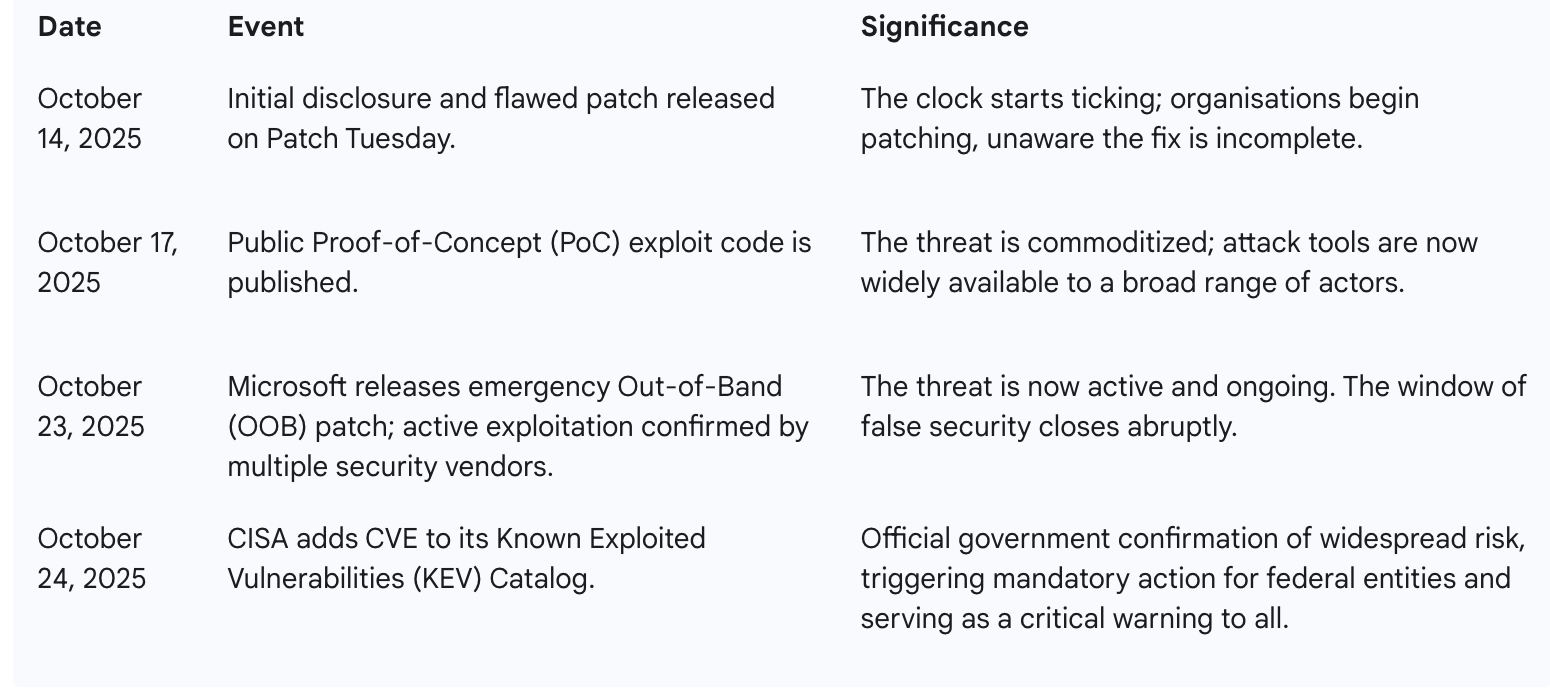
CVE-2025-59287 timeline
Official government confirmation of widespread risk, triggering mandatory action for federal entities and serving as a critical warning to all.
This sequence of events powerfully illustrates the "patching paradox" and the inherent weakness of a purely compliance-centric security model. An organisation that prides itself on its key performance indicators for patch deployment—for instance, applying all critical patches within a 14-day window—would have acted promptly after the October 14th Patch Tuesday. They would have deployed the initial update, and their vulnerability scanners and compliance reports would have marked CVE-2025-59287 as "remediated."
However, because that initial patch was incomplete, this state of compliance was a dangerous illusion. The organisation was, in fact, still completely vulnerable. The period between October 14 and the release of the emergency patch on October 23 was a window of false security. During this time, the publication of a PoC exploit on October 17 dramatically lowered the technical barrier for attackers.8 When active exploitation began on October 23, these "compliant" organisations were just as exposed as those who had not patched at all.
This real-world failure demonstrates that security cannot be measured by checklists or the speed of patch deployment alone. True security is not a theoretical state of compliance but an empirically validated state of resilience. It proves that mitigating controls must be tested to confirm they are actually effective, not just present. Without this validation, organisations are operating on faith—a faith that, in this case, was misplaced, leaving them exposed to a critical, actively exploited threat.
IV. The Attacker's Playbook: How CVE-2025-59287 is Being Weaponised
The theoretical risk of CVE-2025-59287 rapidly became a practical reality. Security researchers observed attackers exploiting the vulnerability in the wild, providing a clear view of their initial tactics and objectives.
In-the-Wild Exploitation
Initial reports from security firms like Huntress described the attacks as simple "point-and-shoot" techniques, underscoring the low complexity of the exploit following the release of the PoC. The observed post-exploitation activity focused on immediate reconnaissance. Attackers, having gained SYSTEM-level access on the WSUS server, were seen spawning Command Prompt and PowerShell processes directly from the IIS worker process (w3wp.exe) or the WSUS service binary (wsusservice.exe).
They executed basic commands to map the compromised environment, such as net user /domain to enumerate all user accounts in the Active Directory domain, and ipconfig /all to gather detailed network configuration data.1 The output of these commands was then exfiltrated to an attacker-controlled remote server.1 This behaviour is a clear indicator that attackers are using the initial WSUS compromise as a beachhead to understand the network's structure, identify high-value targets, and plan their next move.
The Red Team Perspective: Simulating the Full Attack Chain
While the observed attacks focused on reconnaissance, a sophisticated adversary—or a red team emulating one—would leverage the unique position of a compromised WSUS server to execute a far more devastating attack chain. The strategic goal is not just to compromise the WSUS server itself, but to use it as a master key to unlock the entire network. This is accomplished by abusing the core functionality of WSUS for lateral movement, a technique well-documented by offensive security researchers and encapsulated in tools like SharpWSUS.
The full attack chain would proceed as follows:
Initial Compromise: The attacker gains their initial foothold by exploiting CVE-2025-59287, achieving remote code execution with SYSTEM privileges on the primary WSUS server.
Internal Reconnaissance and Target Identification: From the compromised server, the attacker enumerates all computers managed by WSUS. This provides a comprehensive list of potential targets across the network, including domain controllers, database servers, and critical application hosts.
Target Isolation: To avoid detection and collateral damage, the attacker creates a new, innocuous-sounding update group on the WSUS server (e.g., "Critical Server Patching Pilot"). They then move their high-value target, such as a domain controller, into this isolated group.3
Malicious Update Creation: The attacker crafts a malicious "update" package. A key constraint of this technique is that the payload must be a legitimate, Microsoft-signed binary to avoid suspicion. However, this is a low hurdle, as numerous signed binaries can be used for malicious purposes (a technique known as Living-off-the-Land). The attacker can use a tool like
PsExec.exeorMsiExec.exeto execute a secondary payload, such as a command to create a new administrative user or deploy ransomware.Deployment and Execution: The attacker approves this malicious update for deployment only to the isolated group containing the high-value target. They then simply wait for the target machine's scheduled check-in time. When the domain controller connects to WSUS to request updates, it will download and execute the malicious package, believing it to be a legitimate patch from a trusted internal source.
The strategic impact of this attack path cannot be overstated. Modern network security is built on the principle of segmentation—separating critical assets into protected zones to contain breaches. However, WSUS, by its very nature, is designed to traverse these segments. Firewall rules are almost always configured to allow clients from all network zones to communicate with the central WSUS server on ports 8530 and 8531. An attacker who controls the WSUS server inherits this privileged network position. They can use the trusted WSUS protocol as a covert channel to push malicious code into otherwise inaccessible, highly secured network segments, rendering years of segmentation efforts completely useless. The WSUS server becomes a network chokepoint, where a single point of failure leads to the systemic compromise of the entire enterprise.
V. The Australian Imperative: Placing the WSUS Threat in Local Context
While CVE-2025-59287 is a global threat, its implications are particularly acute within the Australian cybersecurity landscape, which is characterized by increasing attacks and a stringent regulatory environment for critical infrastructure.
Connecting to the National Threat Landscape
The Australian Signals Directorate's (ASD) Australian Cyber Security Centre (ACSC) Annual Cyber Threat Report 2024-25 paints a stark picture of the environment in which Australian organisations operate. The report highlights a staggering 83% increase in notifications of potentially malicious cyber activity issued by the ACSC. It underscores the persistent and growing threat from both state-sponsored actors and sophisticated cybercriminals who are relentlessly targeting Australian governments, businesses, and critical infrastructure.13
Crucially, the report identifies "compromised assets, networks, or infrastructure" as the most frequently reported type of cybersecurity incident, accounting for 55% of incidents affecting critical infrastructure. The exploitation of CVE-2025-59287 aligns perfectly with this trend, providing adversaries with a direct and highly effective method for achieving widespread network compromise. The ability to gain control of a central management tool like WSUS is precisely the kind of high-impact capability that these threat actors seek.
Implications for Critical Infrastructure (SOCI Act)
For the growing number of Australian organisations governed by the Security of Critical Infrastructure (SOCI) Act 2018, this vulnerability poses a direct and significant challenge to their compliance and operational resilience obligations. The SOCI Act mandates that responsible entities establish and maintain a risk management program (RMP) that identifies and mitigates hazards, including cyber threats and supply chain vulnerabilities.
A vulnerability in a foundational software distribution platform like WSUS must be viewed as a critical software supply chain risk. An attacker who compromises WSUS can disrupt the integrity of the entire software update process, which is a cornerstone of cyber defence. For operators of essential services—in sectors like energy, healthcare, communications, and finance—a compromised WSUS server could be used to deploy disruptive malware, leading to significant operational downtime, service outages, and a clear failure to meet SOCI Act obligations. For entities responsible for Systems of National Significance (SoNS), the threat is even more severe. An adversary could use a compromised WSUS server to gain persistent access to the nation's most vital assets, directly threatening Australia's economic stability and national security.
This context transforms the WSUS vulnerability from a mere technical issue into a potential tool for "grey zone" warfare. The ACSC has explicitly warned that state-sponsored actors are actively working to position themselves for potential disruptive attacks at times of strategic advantage. A compromised WSUS server is the perfect vector for such an operation. An adversary could use it to deploy a dormant payload—such as a logic bomb, a wiper, or a persistent backdoor—disguised as a routine update. This malicious capability could be pre-positioned across an entire critical infrastructure network, remaining latent and undetected until activated. This scenario moves beyond data theft and cybercrime into the realm of national resilience and sovereignty, aligning directly with the most serious threats identified by the ASD.
VI. Your Strategic Response: Moving from Reactive Patching to Proactive Defence
A threat of this magnitude requires a response that is layered, disciplined, and extends beyond immediate remediation. A comprehensive strategy must move from tactical triage to proactive validation and, ultimately, to the strategic resilience that can only be achieved through adversarial emulation.
Layer 1: Immediate Tactical Mitigation (The "Stop the Bleeding" Phase)
This phase is about immediate, decisive action to contain the threat, based on the official guidance from Microsoft and CISA. These steps are non-negotiable and must be treated with the highest priority.
Action 1: Patch Immediately. Apply the correct out-of-band (OOB) security update to all affected Windows Server versions. The relevant updates include KB5070881, KB5070882, KB5070883, KB5070884, and others corresponding to specific server versions. This OOB update supersedes the flawed patch from the October 14th Patch Tuesday.
Action 2: Reboot. A system reboot is required after the patch is installed to ensure the mitigation is fully applied and the system is protected.
Action 3: Use Workarounds if Patching is Delayed. In situations where immediate patching is not feasible due to operational constraints, Microsoft has provided temporary workarounds. These include completely disabling the WSUS Server Role on the affected server or, more surgically, blocking all inbound traffic to TCP ports 8530 and 8531 at the host firewall.1 It is critical to understand that these actions will render the WSUS server non-operational, preventing clients from receiving any updates.
Layer 2: Proactive Security Validation (The "Confirm and Harden" Phase)
Completing the tactical mitigation is only the first step. The "patch and pray" approach is insufficient given the active exploitation of this vulnerability. Technical leaders must challenge their teams with the critical follow-up question: "How do we know we are truly safe?"
Action 4: Hunt for Compromise. Operate under the assumption of a breach. Security teams must proactively hunt for Indicators of Compromise (IOCs) related to the observed in-the-wild attacks. This includes searching logs for suspicious PowerShell or Command Prompt execution originating from the
w3wp.exeorwsusservice.exeprocesses, and analyzing network traffic for unusual outbound connections from WSUS servers to unknown domains.1Action 5: Validate Patch Deployment and Configuration. Use vulnerability management and asset inventory systems to confirm that the correct OOB patch has been successfully deployed across the entire fleet of WSUS servers. This is also the time to conduct a thorough configuration review of all WSUS servers, ensuring that management access is restricted to trusted administrative networks and that host firewall rules are hardened to minimize the attack surface.
Layer 3: Adversary Emulation (The "Build True Resilience" Phase)
This is the most critical phase for achieving long-term, verifiable security. The only way to be certain that defences can withstand a sophisticated, multi-stage attack leveraging a compromised WSUS server is to simulate that exact attack in a controlled, objective-driven manner.
Action 6: Commission a Red Team Engagement. A specialized red team engagement provides empirical evidence of an organisation's security posture against this real-world threat.19 Such an exercise would not stop at a simple vulnerability scan. It would simulate the adversary's complete playbook, including:
Attempting to validate the patch's effectiveness against the known exploit for CVE-2025-59287.
Executing the post-exploitation tactics, techniques, and procedures (TTPs), specifically emulating the abuse of WSUS for lateral movement as described in the SharpWSUS methodology.
Testing the Security Operations Centre's (SOC) and blue team's ability to detect and respond to the specific artifacts of this attack, such as the creation of suspicious update groups, the deployment of non-standard update packages, or the presence of unexpected signed binaries in the WSUS content directory.
This process moves security from a theoretical state based on compliance to an empirically tested reality. It provides leadership with genuine, evidence-based confidence in their organisation's resilience against the threats they are most likely to face.

Adversary Emulation phases
VII. Executive Briefing: Key Actions for Australian Business Leaders
The critical vulnerability in the Windows Server Update Service, CVE-2025-59287, represents a clear and present danger to Australian organisations. This is not a routine security flaw; it is a strategic risk that weaponizes a core IT management asset, turning a trusted defender into a potential single point of catastrophic failure. Active exploitation in the wild, combined with a CVSS score of 9.8, necessitates an urgent and comprehensive response that goes beyond standard patching protocols. For business and technical leaders, the following actions are imperative.
Acknowledge the Severity: Recognise that CVE-2025-59287 is a critical, actively exploited threat that fundamentally undermines the trust in your core IT infrastructure. Direct your teams to treat this with the highest level of urgency.
Mandate Immediate and Correct Patching: Instruct your technical teams to apply Microsoft's specific emergency out-of-band patch for CVE-2025-59287 across all WSUS instances without delay. Ensure they understand that the initial October 14th patch was insufficient and must be superseded.
Question Your Assumptions: Move beyond a compliance mindset. The critical question is not simply "Did we patch?" but "How have we validated that the patch is effective and that no prior compromise occurred?" Demand evidence of proactive threat hunting and configuration validation.
Invest in Adversarial Validation: The weaponization of trusted infrastructure is a hallmark of sophisticated attacks. The only way to truly know if your defences, detection capabilities, and response procedures can withstand this attack is to test them. Commission an independent penetration test or red team engagement focused specifically on simulating this attack chain to gain empirical evidence of your organisation's security posture.
Review Your SOCI Act Obligations: If your organisation is a critical infrastructure operator under the SOCI Act, this vulnerability has direct implications for your mandated risk management program. Engage with your compliance and security teams to review how this software supply chain threat impacts your operational resilience and ensure your mitigation strategies are sufficient to meet your legal and regulatory obligations.