
Australian Daily Cyber Threat Briefing: Weaponised AI, Cloud Breaches, and API Exploitation
As a senior penetration tester analysing adversary behaviour on the frontlines, I am observing an unprecedented level of volatility in the Australian cyber threat landscape. Welcome to our daily threat briefing for 26 March 2026. Over the last 24 hours, the window between vulnerability disclosure and active exploitation has collapsed to mere hours. Driven by autonomous automation, threat actors are aggressively bypassing traditional perimeters, heavily exploiting cloud misconfigurations, and capitalising on critical zero-day vulnerabilities in web applications, APIs, and emerging AI systems.
As a senior penetration tester analysing adversary behaviour on the frontlines, I am observing an unprecedented level of volatility in the Australian cyber threat landscape. Welcome to our daily threat briefing for 26 March 2026. Over the last 24 hours, the window between vulnerability disclosure and active exploitation has collapsed to mere hours. Driven by autonomous automation, threat actors are aggressively bypassing traditional perimeters, heavily exploiting cloud misconfigurations, and capitalising on critical zero-day vulnerabilities in web applications, APIs, and emerging AI systems.
Here is my technical analysis of the current threats, prominent actors, and active exploits impacting Australian organisations across key sectors.
Sector Threat Analysis
Healthcare & IoT The Australian healthcare sector remains under intense siege from ransomware syndicates. Over the past 24 hours, we have been tracking the active compromise of health management software providers by groups such as INC Ransom and DragonForce. Unpatched Internet of Things (IoT) medical devices continue to serve as the initial foothold, as they often lack robust Endpoint Detection and Response (EDR) capabilities. With the newly enforced Cyber Security (Security Standards for Smart Devices) Rules 2025 officially banning universal default passwords, our penetration testing methodologies show that adversaries are pivoting from trivial credential stuffing to uncovering complex hardware, firmware, and API logic flaws.
SaaS Providers & Government Supply chain vulnerabilities have taken centre stage following a major cloud data breach involving a global legal intelligence SaaS provider. This incident exposed highly sensitive client data across numerous Australian federal agencies and law firms. The threat actor successfully breached the provider's AWS environment by exploiting front-end vulnerabilities and abusing cloud Identity and Access Management (IAM) misconfigurations. Furthermore, the Australian Cyber Security Centre (ACSC) has flagged the active exploitation of Cisco SD-WAN appliances (CVE-2026-20127) by state-sponsored actors, allowing them to bypass traditional perimeter defences entirely and embed persistent backdoors in government infrastructure.
eCommerce & FinTech Digital retail and financial services are facing cascading disruptions. The FinTech sector was recently rocked by a catastrophic breach at an alternative lending platform, exposing over 140 gigabytes of sensitive data and hundreds of thousands of applications due to a misconfigured MongoDB Atlas cluster. Concurrently, in the eCommerce space, the Kairos ransomware group has disrupted point-of-sale (POS) systems and digital supply chains. Attackers are aggressively targeting undocumented "shadow" APIs in payment gateways, exploiting Broken Object Level Authorisation (BOLA) to siphon customer data.
Education/EdTech Threat actors are heavily targeting the education sector by leveraging AI-driven Phishing-as-a-Service (PHaaS) frameworks. They are executing sophisticated Adversary-in-the-Middle (AiTM) attacks to seamlessly bypass basic Multi-Factor Authentication (MFA), compromising student and faculty credentials to gain lateral movement into university research networks and SaaS applications.
Exploited Vulnerabilities Spotlight: Web Apps, APIs, Cloud & AI
From an offensive security standpoint, the technical attack surface is shifting rapidly:
- Web Applications & Cloud: We are tracking the active exploitation of front-end exploits like "React2Shell". When combined with the abuse of legitimate cloud identities—where 35% of cloud incidents now involve valid credentials—attackers can camouflage malicious actions within standard operational traffic, making detection exceptionally difficult.
- APIs: APIs remain the most porous attack vector for Australian organisations. Missing authentication and BOLA flaws are heavily exploited, allowing adversaries to bypass web application firewalls and conduct mass data extraction.
- AI Systems: The attack surface for embedded AI tooling is expanding at an alarming rate. We are observing the active exploitation of critical vulnerabilities like CVE-2026-21858 ("Ni8mare"), an unauthenticated Remote Code Execution (RCE) flaw in workflow orchestration platforms relied upon by SaaS providers. Additionally, attackers are weaponising prompt injection techniques designed to mislead AI-driven triage and execute OS commands via improper input sanitisation.
Conclusion
The threat landscape in Australia is unforgiving. Adversaries are no longer scaling through workforce size, but through autonomous AI. To defend against these compressed attack timelines, organisations must adopt an "assume breach" mentality, rigorously test their web applications and APIs, audit cloud permissions, and secure their AI integrations against emerging exploitation techniques.
Contact us for a quote for penetration testing service or adversary simulation.
Australian Cyber Threat Briefing: AI Exploits, Ransomware Escalation, and New IoT Mandates
Welcome to today's threat briefing for 25 March 2026. As a senior penetration tester actively engaged in defending Australian networks, I am observing an unprecedented level of volatility in our local threat landscape. Over the last 24 hours, adversary behaviour has demonstrated a rapid shift towards exploiting misconfigured cloud environments, weaponising artificial intelligence, and aggressively targeting critical supply chains.
Welcome to today's threat briefing for 25 March 2026. As a senior penetration tester actively engaged in defending Australian networks, I am observing an unprecedented level of volatility in our local threat landscape. Over the last 24 hours, adversary behaviour has demonstrated a rapid shift towards exploiting misconfigured cloud environments, weaponising artificial intelligence, and aggressively targeting critical supply chains.
Below is an analysis of the current threats, prominent threat actors, and emerging vulnerabilities impacting Australian organisations across key industry sectors.
Sector Threat Analysis
Healthcare & Government The Australian Cyber Security Centre (ACSC), in coordination with Five Eyes partners, has issued urgent warnings regarding the INC Ransom group (also tracked as Tarnished Scorpion). This Ransomware-as-a-Service (RaaS) syndicate is actively targeting Australian healthcare networks and professional services, exploiting perimeter vulnerabilities to encrypt and exfiltrate highly sensitive patient data. Simultaneously, a major cloud breach at SaaS provider LexisNexis has exposed legal and government client data, highlighting systemic supply chain risks that both federal agencies and the private sector must urgently address.
FinTech & eCommerce Cloud security remains a critical failing point. The recent breach of the Aussie FinTech platform youX, which exposed 141 gigabytes of data and over 600,000 loan applications, was traced back to an unprotected, internet-facing MongoDB Atlas cluster. Meanwhile, corporate governance is under strict regulatory scrutiny—ASIC recently handed down a historic $2.5 million penalty to a financial services firm for cybersecurity governance failures. In the eCommerce sector, we are observing a spike in AI-powered voice cloning and deepfakes being used to bypass biometric payment verification and execute highly convincing Business Email Compromise (BEC) fraud.
Education & EdTech The education sector remains under heavy fire. The KillSec hacking group recently claimed a cyber attack on an Australian private education institution, following closely on the heels of the massive Victorian Department of Education data breach that impacted 1,700 government schools. EdTech SaaS providers must urgently modernise their authentication pathways and enforce robust Zero Trust architecture, as initial access brokers are actively trading compromised student and faculty credentials on dark web forums.
IoT (Internet of Things) The regulatory landscape fundamentally shifted earlier this month with the active enforcement of Australia's Cyber Security (Security Standards for Smart Device) Rules 2025. This legislation officially bans universal default passwords and mandates clear vulnerability disclosure mechanisms for manufacturers. However, as penetration testers, we still see botnets actively exploiting legacy IoT devices in enterprise environments to establish persistent footholds and launch distributed attacks.
Exploited Vulnerabilities: Web Apps, APIs, Cloud, and AI Systems
Adversary tactics have shifted heavily towards infrastructure orchestration and application layers. Security teams must prioritise the following vectors:
- Web Applications & APIs: Threat actors are ruthlessly targeting API gateways. We are currently tracking the active exploitation of CVE-2026-21858 (dubbed "Ni8mare"), a CVSS 10.0 unauthenticated Remote Code Execution (RCE) vulnerability in the n8n workflow platform. Because SaaS providers heavily rely on this tool to orchestrate APIs and AI agents, this zero-day flaw provides attackers with a direct avenue to compromise backend systems.
- Cloud Deployments: The FinTech incidents observed this week exemplify the catastrophic damage caused by cloud misconfigurations. Automated scanning tools deployed by cybercriminal syndicates are identifying and exploiting internet-facing, unauthenticated cloud storage buckets and databases within minutes of deployment.
- AI Systems: Beyond using generative AI to craft sophisticated Adversary-in-the-Middle (AiTM) phishing kits, we are seeing attackers target AI models directly. Threat actors are hijacking AI hosting services to compromise users, and prompt injection attacks against customer-facing AI chatbots are rising. Additionally, internal staff inadvertently spilling proprietary data and intellectual property into public-facing AI models remains a top behavioural risk for Australian enterprises.
Conclusion
The speed at which threat actors are weaponising zero-day vulnerabilities and leveraging AI means that reactive defences are no longer sufficient. Australian organisations must adopt proactive security measures, continuous exposure management, and robust DevSecOps practices to secure their web applications, cloud infrastructure, and connected devices.
Contact us for a quote for penetration testing service or adversary simulation.
Australian Daily Cyber Threat Briefing: AI Exploits, API Abuse, and Evolving Ransomware
As a senior penetration tester, I continually analyse the tactics, techniques, and procedures (TTPs) deployed against Australian organisations. Over the last 24 hours, our threat intelligence and incident response telemetry have highlighted a highly volatile landscape. We are witnessing aggressive automated exploitation of cloud environments, rampant API abuse, and novel attacks against integrated AI systems. The 2026 Armis Cyberwarfare Report recently noted that Australia is experiencing a surging volume of cyberwarfare attacks, underscoring the urgent need for a proactive, "assume breach" mentality.
Executive Summary - 24 March 2026 As a senior penetration tester, I continually analyse the tactics, techniques, and procedures (TTPs) deployed against Australian organisations. Over the last 24 hours, our threat intelligence and incident response telemetry have highlighted a highly volatile landscape. We are witnessing aggressive automated exploitation of cloud environments, rampant API abuse, and novel attacks against integrated AI systems. The 2026 Armis Cyberwarfare Report recently noted that Australia is experiencing a surging volume of cyberwarfare attacks, underscoring the urgent need for a proactive, "assume breach" mentality.
Sector Threat Analysis
- Healthcare: The Australian healthcare sector remains under intense siege from sophisticated ransomware syndicates. The Australian Cyber Security Centre (ACSC) and international Five Eyes agencies recently issued an urgent joint warning regarding the INC Ransom group. Operating a Ransomware-as-a-Service (RaaS) model, this threat actor has successfully breached multiple Australian healthcare and professional services organisations, leveraging purchased credentials and spear-phishing.
- SaaS Providers: SaaS platforms are grappling with compounding failures in identity and access control. Misconfigurations in AWS IAM roles and overly permissive API keys are leading to severe tenant isolation flaws. Recent telemetry highlights the active exploitation of critical authentication bypasses in cloud single sign-on (SSO) APIs, which act as a master key for adversaries to hijack multi-tenant environments.
- eCommerce: The eCommerce and hospitality sectors are battling destructive ransomware and modernised supply chain attacks. The 'Kairos' ransomware group recently disrupted operations at the Seagrass Boutique Hospitality Group. Furthermore, attackers are deploying advanced Magecart-style scripts in third-party widgets to intercept payment data seamlessly, explicitly designed to evade standard behavioural detection mechanisms.
- FinTech: Cyber resilience is now a strict regulatory expectation in Australia. The Federal Court recently imposed a landmark AUD 2.5 million penalty on an Australian financial services firm for cybersecurity governance failures—the first civil penalty of its kind under the Corporations Act. Technologically, FinTechs are facing a wave of sophisticated Broken Object Level Authorisation (BOLA) attacks targeting B2B APIs to access unauthorised financial records.
- Education / EdTech: Educational institutions and EdTech platforms are prime targets for Initial Access Brokers (IABs). Threat actors are actively selling compromised VPN credentials belonging to university staff. We are also tracking highly convincing, AI-generated phishing campaigns designed to bypass multi-factor authentication on student SSO portals.
- Government & IoT: Advanced persistent threats (APTs) are heavily targeting core government network infrastructure. A highly sophisticated state-aligned actor (UAT-8616) has been actively exploiting a maximum-severity zero-day in Cisco Catalyst SD-WAN controllers (CVE-2026-20127). Concurrently, new mandatory security standards for smart devices have come into effect in Australia (March 2026) to curb the widespread weaponisation of IoT edge devices.
Vulnerability Spotlight: Web Applications, APIs, Cloud, and AI Systems
Adversaries are rapidly operationalising exploits across four primary technological domains:
- API Security: According to the newly released 2026 API ThreatStats Report, APIs are now the single most exploited attack surface globally, representing 43% of newly exploited vulnerabilities. A prominent current threat is CVE-2026-21992, a critical, easily exploitable, unauthenticated REST API vulnerability in Oracle Identity Manager that enables full system compromise over HTTP.
- AI Systems: As AI integration accelerates, the attack surface expands—research shows that 36% of AI vulnerabilities also qualify as API vulnerabilities. Penetration testers are observing active exploitation of CVE-2026-33017, a critical unauthenticated remote code execution (RCE) flaw in Langflow (an open-source AI agent framework), which was weaponised by attackers within 20 hours of disclosure. Additionally, the ModelScope MS-Agent bug (CVE-2026-2256) is being actively leveraged for OS command injection via improper input sanitisation.
- Cloud & Web Applications: A critical unauthenticated RCE in the n8n workflow automation platform (CVE-2026-21858, CVSS 10.0) is being actively targeted to access sensitive files on underlying web servers. In cloud environments, threat actors continue to automate the discovery of exposed web frameworks, rapidly dropping web shells within minutes of identification.
Conclusion
With AI-driven exploits and automated API attacks occurring at machine speed, traditional perimeter defences and basic compliance checks are no longer sufficient. Australian organisations must prioritise rigorous security testing, hunt for logical vulnerabilities, and harden their exposed attack surfaces.
Contact us for a quote for penetration testing service or adversary simulation.
Australian Cyber Threat Landscape: Daily Briefing
As a senior penetration tester analysing adversary behaviour on the frontlines, I am observing an unprecedented level of volatility in the Australian cyber threat landscape. The window between vulnerability disclosure and active exploitation has collapsed to mere days, if not hours. Over the last 24 hours, threat actors have escalated their weaponisation of artificial intelligence, heavily exploited cloud misconfigurations, and capitalised on critical zero-day vulnerabilities across multiple key industries.
As a senior penetration tester analysing adversary behaviour on the frontlines, I am observing an unprecedented level of volatility in the Australian cyber threat landscape. The window between vulnerability disclosure and active exploitation has collapsed to mere days, if not hours. Over the last 24 hours, threat actors have escalated their weaponisation of artificial intelligence, heavily exploited cloud misconfigurations, and capitalised on critical zero-day vulnerabilities across multiple key industries.
Here is your daily threat briefing and deep dive into the threats, prominent actors, and vulnerabilities impacting Australian organisations today.
Sector Threat Analysis
Healthcare The healthcare sector remains under intense siege from ransomware syndicates. Following a recent joint advisory from the Australian Cyber Security Centre (ACSC) and international partners, we are tracking aggressive operations by the INC Ransom group. Operating a Ransomware-as-a-Service (RaaS) model, INC affiliates are actively targeting medical networks, using legitimate administrative tools like 7-Zip and rclone to blend into normal network traffic before deploying double-extortion tactics. Concurrently, groups like SafePay have successfully hacked entities such as Smile Team Orthodontics, publishing sensitive staff and patient data to the dark web.
FinTech & eCommerce Digital retail and financial services are facing cascading disruptions. The FinTech sector was recently rocked by a catastrophic data breach at the alternative lending platform youX, which exposed over 141 gigabytes of sensitive data and over 600,000 loan applications. In the eCommerce and hospitality space, the Kairos ransomware group has disrupted point-of-sale (POS) systems and supply chains, with major entities like the Seagrass Boutique Hospitality Group and poultry processor Hazeldenes falling victim and having their data leaked to the dark web.
SaaS Providers & Government Supply chain vulnerabilities took centre stage following a confirmed major cloud data breach involving global legal intelligence SaaS provider LexisNexis. A threat actor tracked as 'FulcrumSec' successfully breached the provider's AWS environment. This supply chain attack has had an immediate flow-on effect, exposing highly sensitive data belonging to multiple Australian law firms and federal government agencies.
Education/EdTech & IoT The education sector continues to be heavily targeted by groups like KillSec, while the Victorian Department of Education recently suffered a massive breach impacting 1,700 government schools. For EdTech vendors, failing to modernise authentication pathways has provided an open door for initial access brokers.
On the hardware front, the commencement of Australia's mandatory Cyber Security (Security Standards for Smart Devices) Rules under the Cyber Security Act 2024 represents a monumental shift for IoT. By explicitly banning universal default passwords, the regulatory landscape is forcing penetration testing to pivot from trivial default credential exploitation to uncovering complex hardware, API, and firmware logic flaws.
Exploited Vulnerabilities: Web Apps, APIs, Cloud & AI Systems
We are currently tracking several critical attack vectors actively being weaponised against Australian networks:
- Cloud Misconfigurations & APIs: The youX FinTech incident exemplifies the real-world impact of unprotected cloud assets. Threat actors successfully compromised an internet-facing database by exploiting a misconfigured MongoDB Atlas cluster linked to the recently disclosed MongoDB Server Leak vulnerability (CVE-2025-14847). Unsecured cloud environments and APIs remain the lowest-hanging fruit for automated scanning tools deployed by syndicates.
- Web Applications & AI Orchestration: The convergence of AI and web APIs has introduced complex new vulnerabilities. We are tracking the active exploitation of CVE-2026-21858 (CVSS 10.0), an unauthenticated Remote Code Execution (RCE) flaw dubbed "Ni8mare" within the n8n workflow automation platform. This tool is heavily relied upon by SaaS providers to orchestrate APIs and AI agents. Furthermore, the FulcrumSec breach of government and legal SaaS platforms was facilitated by exploiting "React2Shell," a critical vulnerability in an unpatched web application.
- AI Behavioural Risks: According to the newly released 2026 CyberCX Threat Report and recent findings from Armis Labs, the weaponisation of generative AI is compounding risks. Externally, adversaries are deploying highly convincing AI-generated Phishing-as-a-Service (PHaaS) campaigns to bypass Multi-Factor Authentication (MFA) via Adversary-in-the-Middle (AiTM) session hijacking. Internally, the most immediate AI risk remains corporate staff inadvertently spilling sensitive intellectual property into public-facing AI models.
Australian organisations must move from a reactive posture to proactive defence. Threat actors operate at machine speed, meaning traditional perimeter defences and reactive compliance are no longer sufficient to secure your ecosystem.
Contact us for a quote for penetration testing service or adversary simulation.
Weekly Australian Cyber Threat & Vulnerability Deep Dive
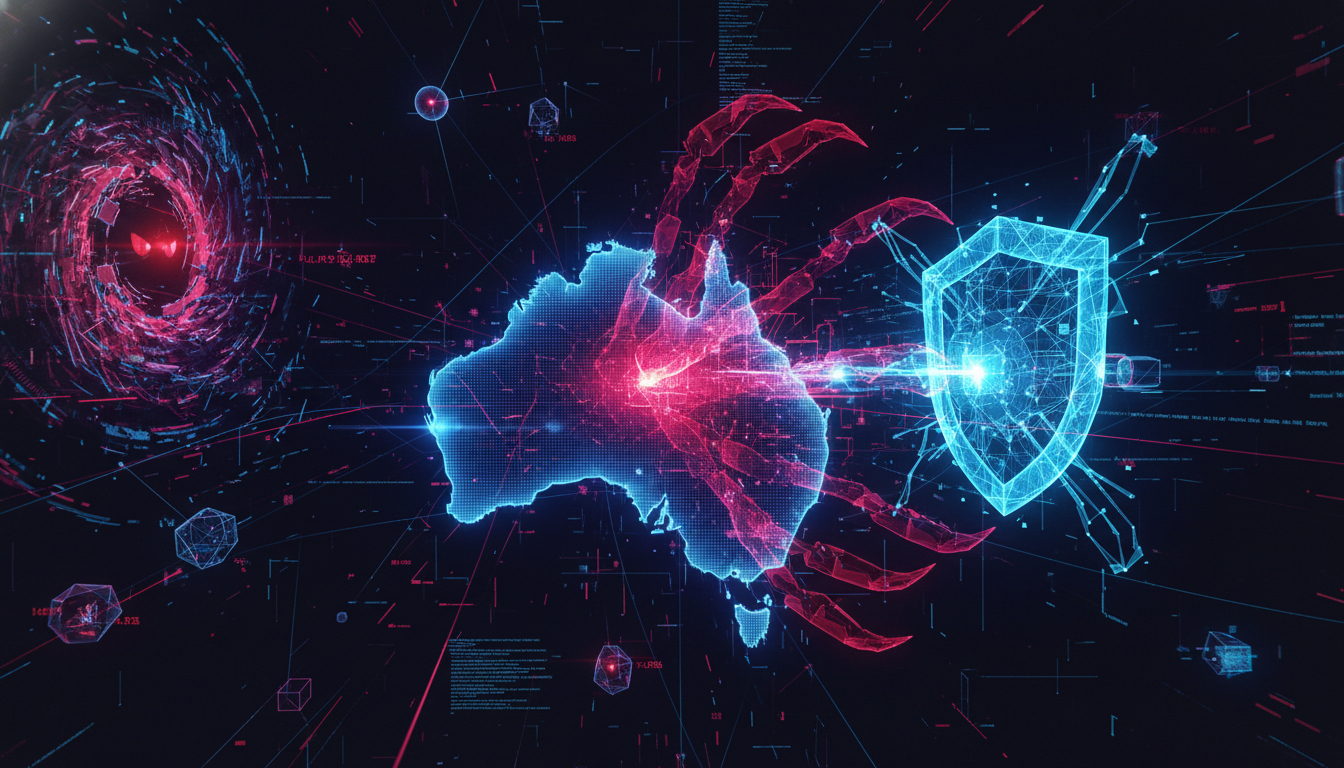
As a senior penetration tester actively analysing adversary behaviour and responding to frontline incidents, I am tracking a highly volatile threat landscape across Australia. Over the past seven days leading up to 22 March 2026, the window between vulnerability disclosure and active exploitation has collapsed to mere days. A recent industry survey reveals that "cyber breach fatigue" is setting in among the Australian public, while 70% of local organisations report being impacted by AI-led attacks over the last year. Adversaries are aggressively weaponising artificial intelligence, exploiting cloud misconfigurations, and capitalising on critical zero-day vulnerabilities in web applications and APIs.
As a senior penetration tester actively analysing adversary behaviour and responding to frontline incidents, I am tracking a highly volatile threat landscape across Australia. Over the past seven days leading up to 22 March 2026, the window between vulnerability disclosure and active exploitation has collapsed to mere days. A recent industry survey reveals that "cyber breach fatigue" is setting in among the Australian public, while 70% of local organisations report being impacted by AI-led attacks over the last year. Adversaries are aggressively weaponising artificial intelligence, exploiting cloud misconfigurations, and capitalising on critical zero-day vulnerabilities in web applications and APIs.
Here is your weekly threat briefing detailing the active exploits, prominent threat actors, and critical vulnerabilities impacting Australian organisations across key sectors.
Sector Threat Analysis
Healthcare The healthcare sector remains under intense siege from double-extortion ransomware. A joint advisory from the Australian Cyber Security Centre (ACSC) warned of the INC Ransom group breaching over 11 Australian organisations. Affiliates operating this Ransomware-as-a-Service (RaaS) are using legitimate administrative tools like 7-Zip and rclone to blend into normal network traffic and bypass basic defences. Concurrently, the SafePay ransomware gang recently targeted an Australian orthodontics provider, publishing staff details and patient payment plans to the dark web to force extortion payments.
SaaS Providers & Government Supply chain and cloud vulnerabilities took centre stage following a major data breach involving a global legal intelligence SaaS provider. A threat actor tracked as 'FulcrumSec' breached the provider's AWS cloud environment by exploiting "React2Shell"—a critical vulnerability in an unpatched web application. This supply chain attack exposed highly sensitive data belonging to Australian law firms and federal government agencies. Furthermore, recent audits have revealed severe Microsoft 365 cloud misconfigurations within state government departments, including a critical lack of Data Loss Prevention (DLP) controls.
eCommerce Digital retail and physical supply chains are facing cascading disruptions. Attackers recently leaked data stolen from major Australian poultry processor Hazeldenes, while the Kairos ransomware group disrupted consumer-facing commerce by breaching the Seagrass Boutique Hospitality Group. Exploited web application vulnerabilities and poorly secured APIs remain the primary initial access vectors for these financially motivated threat actors.
FinTech Proactive cyber resilience is now a strictly enforced regulatory expectation in Australia. This week, ASIC imposed a landmark AUD 2.5 million penalty on FIIG Securities for historical cybersecurity governance failures. With established threat groups like Akira and Qilin accounting for 45% of recent ransomware incidents, FinTech organisations must urgently secure their cloud infrastructure and financial APIs to defend against sophisticated extortion and comply with the mandatory reporting requirements of the Cyber Security Act.
Education / EdTech Higher education institutions and EdTech platforms are actively being targeted via CVE-2026-1731, a critical pre-authentication Remote Code Execution (RCE) vulnerability in BeyondTrust remote support software. Threat actors are exploiting this flaw to bypass perimeter defences and establish persistent footholds within self-hosted educational environments.
IoT The ACSC and the Five Eyes intelligence alliance issued an emergency directive regarding CVE-2026-20127, a maximum-severity (CVSS 10.0) authentication bypass vulnerability in Cisco Catalyst SD-WAN products. Actively exploited by a sophisticated threat actor dubbed UAT-8616, this flaw allows attackers to gain administrative privileges, create rogue local accounts, and establish persistent access across distributed IoT networks and critical edge-facing infrastructure.
AI Systems We are seeing the real-world impact of AI vulnerabilities expanding the attack surface. Researchers recently uncovered CVE-2026-0628, a high-severity security flaw in Google Chrome’s implementation of its Gemini AI feature. This vulnerability allowed malicious extensions to hijack the AI panel, tap into the browser environment, and access local operating system files. This highlights the urgent need to apply strict identity, privilege, and monitoring disciplines to AI-integrated systems.
Conclusion
The current threat landscape demands a paradigm shift. Traditional, reactive security approaches are obsolete against adversaries operating at machine speed. Australian organisations must urgently prioritise proactive exposure management, rigorous API testing, and continuous cloud security posture monitoring to build true resilience.
Contact us for a quote for penetration testing service or adversary simulation.