
Penetration Testing vs. Source Code Review: What’s Best for Web Application Testing in 2026?
Penetration Testing vs. Source Code Review: What’s Best for Web Application Testing?
If your business operates online, your web applications are the digital front door to your most critical assets. Back in 2017, it was a wake-up call to learn that 30% of breaches targeted web apps. Fast forward to 2026, and the landscape is vastly more complex. Recent threat reports highlight that web application and API attacks across the Asia-Pacific region have surged to over 65 billion annually, driven heavily by AI-powered exploitation and sophisticated credential theft.
For businesses in Sydney and across Australia, simply deploying a firewall is no longer enough. To truly secure your digital perimeter and manage your security risk, you need to proactively look for flaws before threat actors do. The two heavyweights in the world of application penetration testing and vulnerability management are Source Code Review and Penetration Testing.
But how do they differ? And more importantly, which one is best for your specific needs? Let's dive in and break down both techniques so you can make an informed, confident decision for your cyber security strategy.
Understanding the 2026 Web Application Threat Landscape
Before comparing the methodologies, we have to look at what we are defending against today. Attackers aren't just looking for simple SQL injections anymore. They are targeting business logic, exploiting over-permissioned cloud identities, and abusing APIs. In fact, api penetration testing services have become one of our most requested testing services because traditional security tools often fail to inspect the complex logic layer where modern APIs operate.
Whether you are seeking a penetration testing service in australia for a new fintech platform or need a dedicated mobile application penetration testing service for your customer-facing app, understanding how your code behaves both on the server and in the wild is paramount.
What is Source Code Review?
Also known as secure code review or static application security testing (SAST), a source code review is an inside-out approach. It examines the raw, underlying code of a web application to identify mistakes, logic errors, and security weaknesses that were overlooked during the development phase.
Think of it as proofreading a manuscript before it gets published. Security experts and automated code analysers scan the application’s source code line by line. When the analyser flags potential issues, a human expert steps in to filter out false positives and pinpoint the exact line of code causing the problem.
The Strengths of Source Code Review
A source code review is incredibly effective at identifying vulnerabilities early in the software development life cycle (SDLC). Key strengths include:
Early Detection: By catching flaws before the app goes live, developers save time and money. Fixing a bug in the coding phase is significantly cheaper than fixing an actively exploited vulnerability in production.
100% Coverage: Automated code scanners can review every single line of code, ensuring no hidden pathways or unused functions are ignored.
Identifying Deep Logic Flaws: It is highly effective at finding encryption errors (like hardcoded keys or weak algorithms), buffer overflows, race conditions (performing simultaneous operations unsafely), and missing input sanitisation that leads to cross-site scripting (XSS).
Developer Education: It provides direct feedback to developers, improving their secure coding practices over time.
However, source code reviews aren't perfect. They cannot test how the application behaves once deployed in a live environment, and they often struggle with environment-specific misconfigurations.
What is Penetration Testing?
If source code review is proofreading the manuscript, a pen test is trying to break into the bookstore and steal it.
Penetration testing involves ethical hackers actively attacking a deployed application or network to expose its vulnerabilities. A penetration tester mimics the tactics, techniques, and procedures (TTPs) of a real-world adversary. This is an outside-in approach.
The process is structured into stages: reconnaissance, scanning, gaining access, maintaining access, and analysis. Simulating real world attacks allows testers to see exactly how an attacker could bypass your security controls and extract sensitive data. Depending on the scope, this might include social engineering tactics or deploying a comprehensive active directory penetration testing service to see if a compromised web app could lead to total network takeover.
The Strengths of Penetration Testing
The most significant benefit of pen testing is its real-world, risk-based context. You don't just get a list of theoretical bugs; you get proof of what is actually exploitable.
Proving Exploitability: It filters out the noise. If a vulnerability is found, the tester proves whether it can actually be exploited to cause harm.
Finding Runtime and Configuration Errors: Some exploitable vulnerabilities only exist when the app interacts with its live environment (e.g., web servers, databases, third-party APIs). Pen testing excels at finding search engine indexing leaks, weak authentication mechanisms, and server misconfigurations.
Meeting Security Standards: Regular assessments are mandated by many compliance frameworks. For example, if you process credit cards, an annual pen test is a strict requirement for pci dss compliance.
Tailored Threat Scenarios: Testers adapt their attacks to your specific business logic. If you are an eCommerce platform, they will try to manipulate pricing carts.
When looking for a penetration testing provider, you'll notice variations in scope. Some organisations opt for continuous penetration testing as a service (PTaaS) to keep up with agile development, while others bring in a penetration test service for a massive annual audit.
Comparing the Two: A Side-by-Side Breakdown
To help you choose the best route for your security assessments, we've broken down the key differences between these two vital practices.
| Feature | Source Code Review | Penetration Testing |
|---|---|---|
| Approach | Inside-out (White-box testing). Evaluates the raw codebase. | Outside-in (Black-box or Grey-box testing). Evaluates the running application. |
| Primary Goal | Find coding errors, poor logic, and insecure design practices early. | Exploit vulnerabilities in a live environment to prove business risk. |
| Timing in SDLC | Early phases (Development, Commit, Build). | Late phases (Staging, Pre-Production, Production). |
| Types of Flaws Found | Hardcoded secrets, race conditions, buffer overflows, syntax errors. | Business logic flaws, weak passwords, server misconfigurations, chained exploits. |
| Speed & Automation | Highly automated scanning, but manual review takes significant time. | Requires highly skilled manual effort; length varies by scope and complexity. |
| False Positives | High. Automated tools flag many things that aren't exploitable in reality. | Low. Testers verify and exploit the vulnerabilities they report. |
Cost Considerations
When evaluating penetration testing cost versus source code review, it’s important to understand how they scale.
A source code review is generally priced based on the size of the application (lines of code) and the programming languages used. It requires specialised analysts who understand specific frameworks.
Penetration test services are usually priced based on the time and complexity of the engagement. A simple web app might take a few days, while a complex enterprise ecosystem requiring mobile application penetration testing services and internal network pivoting could take weeks.
In the long run, adopting a "Shift Left" approach—where you use source code review early—reduces your overall remediation costs. However, investing in a reputable penetration testing provider ensures you aren't hit with the devastating financial blow of a cyber attack in production.
Which is Best for Your Web Application?
If you are asking "which one is better," the honest truth from a professional penetration testing service provider is that you need both. They are highly complementary.
Relying solely on source code review leaves you blind to server-side misconfigurations and real-world attack chaining. Relying solely on a pen test means you might catch issues too late, resulting in expensive, rushed fixes that disrupt your operations.
Here is our collaborative recommendation for a robust strategy in 2026:
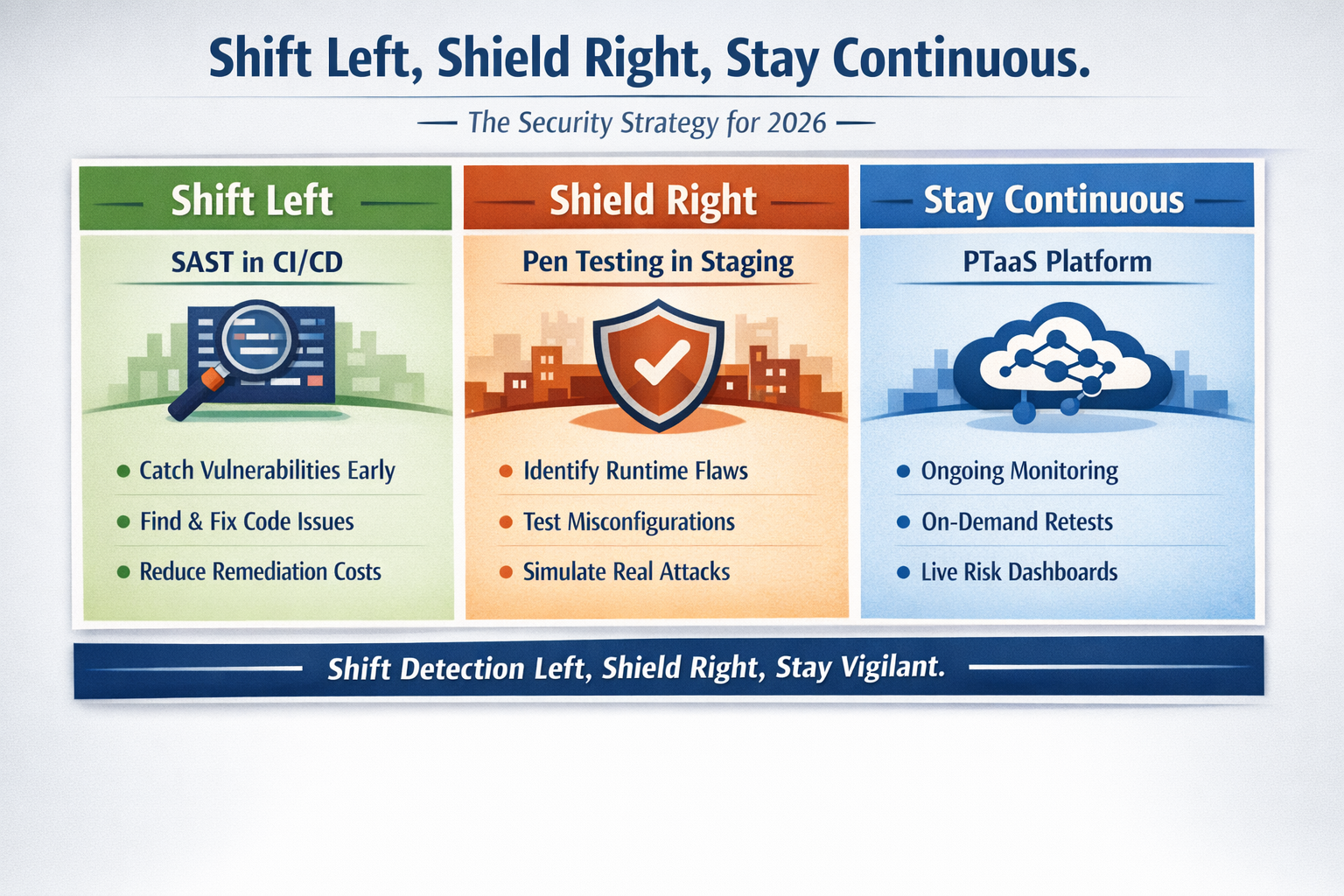
Shift Left: Integrate automated source code scanning into your CI/CD pipeline. Catch the low-hanging fruit (like hardcoded API keys) before the code is even merged.
Shield Right: Once the application reaches a staging environment, engage penetration testing services. A human tester will uncover the complex business logic flaws that no automated scanner can understand.
Stay Continuous: The days of testing once a year are over. Threat actors move fast. Look into penetration test as a service (PTaaS) models to ensure your applications are continuously monitored and tested as new features are pushed live.
If you are a business operating in Australia, partnering with a local penetration testing sydney expert ensures your security teams understand regional compliance mandates (like the ACSC Essential Eight) and can provide context-rich reporting.
Wrapping Up: Secure Your Digital Assets Today
Your web applications hold the keys to your company’s reputation, revenue, and customer trust. Understanding the types of penetration tests and knowing when to deploy a source code review will dramatically strengthen your security posture.
Don't wait for a breach to discover your vulnerabilities. Whether you need a comprehensive penetration testing service, a deep dive into your source code, or specialised api penetration testing services, our team is here to help you navigate the complexities of the 2026 cyber landscape.
Ready to bulletproof your web applications? Contact us today for a free, no-obligation quote, or leave a comment below with your specific security questions. Our experts are ready to collaborate with you to build a more secure future!